Introduction
The Country They Walked Into
There is a stretch of country in southeastern Missouri where the hills rise low and tight, the springs run cold out of limestone, and the soil is thin enough that a farmer needs to know not just where to plant but how deep he can plant before he hits stone. The Rayfields settled there in the 1830s and were still there a hundred years later when the Army Corps of Engineers bought them out. The Manns were there before the Rayfields. The Robinsons and the Lewises came later, from different directions, into the same hills. By the time Vernon Rayfield married Opal Robinson on a January day in 1928, the Ozark country they were marrying into was a place where the four families had been arriving and rearranging themselves for nearly a century. This book is the story of those families — among the pioneer families who settled this pocket of the Ozarks and married into one another until the surnames braided into a single web of kin. It follows a few of those threads down one direct line; the wider story of the community and its intertwined families is told on the companion site, rayfieldfamilyhistory.com. Before the story begins, it is worth knowing the country they were arriving in.
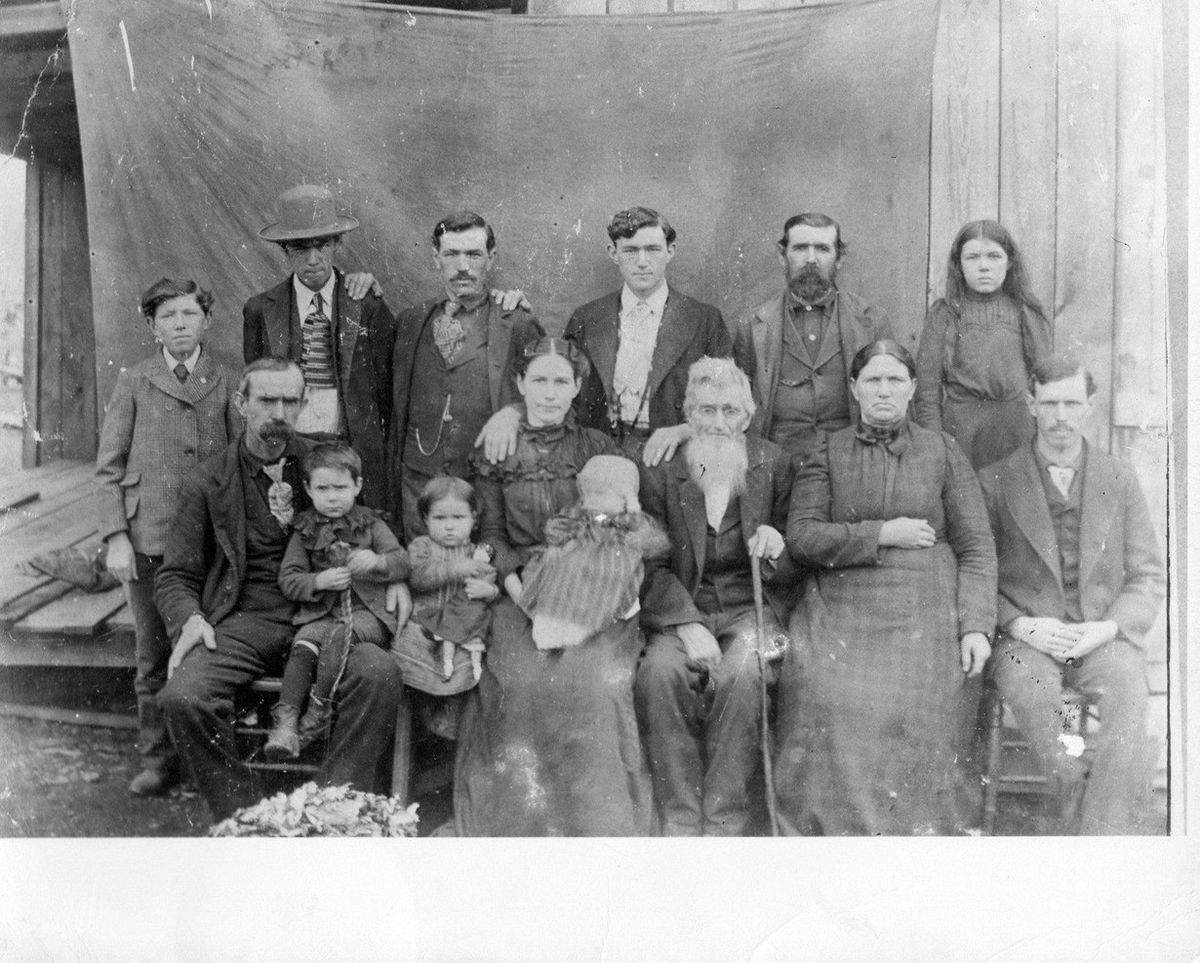
WHAT THE GROUND REMEMBERED
The Ozarks are old. The land here is not the worn-down stump of some lost mountain range, the way the Appalachians are. It is the eroded top of a dome — the Ozark Plateau — that buckled upward under pressure from below in a slow geological event that began before the dinosaurs and is still, in some imperceptible measure, going on today. The hills are not mountains lowered by time. They are the upper edges of a once-flat sea bed lifted into the air and then cut, century by century, by the springs and creeks that drained it. The rock the families were farming on top of was older than they could imagine.
The dolomite and limestone of these valleys were laid down at the bottom of a shallow tropical sea five hundred million years ago, long before there were hills here at all. The stone still holds the proof of it — the fossil shells of small sea creatures, settled to that ancient floor in a country no human eye had yet seen, and waiting in the ground for the families who would one day farm above them.
The springs that ran cold and clean through the hollows came up out of fissures in that same ancient stone. Limestone and dolomite dissolve slowly in rainwater made faintly acid by the soil, and over the ages the water had eaten the hills hollow — so they were riddled with caves. The land held water and gave it back in unexpected places. There were sinks where a creek would simply disappear underground for a quarter mile and surface again, blinking, as if it had never been gone. The family called one of those creeks Sinking. The name was older than they were, and it described what the creek did.
THE YEAR THE EARTH MOVED
In December 1811, in the bottomland near a small town called New Madrid on the Mississippi River — a few days' ride east of where the Rayfields and Manns and Robinsons would, in time, all eventually settle — the ground began to shake. The first quake came on December 16. It was followed by another on January 23, 1812, and a third on February 7. The third was the largest. Modern estimates place all three among the most powerful earthquakes in the recorded history of eastern North America — seismic events comparable to the great quakes of California, occurring under a continent that nobody, in 1811, knew could shake like that. The Mississippi River, people said, ran backwards. Witnesses described watching the current reverse, the great brown sheet of water flowing north against itself while waves rose and broke along the banks. Whole stretches of riverbank collapsed into the channel; islands disappeared overnight.
The land along the New Madrid bend sank by as much as twenty feet in places, creating a depression that filled in with floodwater and became Reelfoot Lake — a lake, in northwest Tennessee, that did not exist on February 6 and did exist on February 8. Across that terrible winter, the shockwaves traveled so far that church bells rang in Boston and people in Charleston, South Carolina, ran into the streets. In the Ozark country a hundred miles to the west, the ground shook hard enough that springs ran muddy for weeks afterward. Caves collapsed.
Where the small fault lines beneath the Ozark dome had been quiet for centuries, the New Madrid event set them shifting in ways geologists would not begin to understand for another hundred and fifty years. The country the Rayfields would walk into was, in 1812, still settling. John Carter Rayfield was born in Cumberland County, Kentucky, in 1816 — four years after the last of the great quakes. He was a small child when the stories were still in the air. By the time he was old enough to ride west with his uncles in 1829, the earthquakes had
become legend, retold and embroidered around fires from Tennessee to Ohio. But the land bore the marks. Anyone who farmed the southeast Missouri lowlands in the 1830s and 1840s would still find cracks in the ground that ran for miles. Anyone who fished Reelfoot Lake was fishing in a place that the earthquake had made. The country, in other words, was not stable when the families arrived. The hills had been moved within human memory. The ground had cracked open. It was older country than the people who walked into it, and stranger.
WHAT THE HILLS HELD
The other thing the country had, and the other reason it drew settlers, was metal. The St. Francois Mountains — the ancient volcanic remnants that rise in the country around Pilot Knob and Ironton — contained some of the richest deposits of lead, iron, and silver in North America. The French, working west from the Mississippi in the early 1700s, had been the first Europeans to mine in this country. Mine La Motte, opened in 1715, became one of the oldest and longest-operated mining regions in what would later be the United States. By the time the Louisiana Purchase brought this country under United States authority in 1804, lead had been coming out of the St. Francois region for ninety years. Lead was an industrial necessity. It made bullets, paint, pipes, and roof flashing. It made the ammunition that armed the American expansion across the West. It made the type that printed the newspapers.
The mines at Mine La Motte, Old Mines, and Bonne Terre were small and rough — shallow pits worked by ten or twenty men, ore hauled out by mule, smelted in primitive furnaces and shipped down the Mississippi in flatboats — but they were producing real wealth before any of the families in this book set foot in Missouri. Iron came next. In 1837, a businessman named James Harrison purchased the mountain called Pilot Knob, which rose six hundred feet out of the Arcadia Valley and was almost entirely composed of magnetite — iron ore so rich it could be loaded directly into a furnace with little processing.
By 1846, the Pilot Knob Iron Company was in operation. The Iron Mountain, a few miles north, was even larger. The St. Louis, Iron Mountain and Southern Railroad — eventually called simply the Iron Mountain — was built in the 1850s to haul the ore north to St. Louis, and the railroad's path threaded directly through Iron and Wayne counties, passing just east of the valleys where the Rayfields, Manns, Robinsons, Lewises, and Seals were beginning to settle.
The mines made the towns. Annapolis, Ironton, Pilot Knob, Des Arc, Arcadia — these were not natural places for towns. They were places where ore came out of the ground and men with shovels came to take it. The blacksmiths who would shoe the mules that hauled the ore, the merchants who would sell the men their dry goods, the farmers who would feed them — they all came because the mines came first. A century later, when John Wesley Robinson opened his blacksmith shop in Des Arc, he was working in a town that existed because of metal in the ground. When Franklin Rayfield's wife Myrtle Seal was born in the Arcadia Valley country in 1888, she was born into a community that the iron furnaces had built.
The mining wealth was not stable. It boomed and crashed on the rhythm of national markets. The Panic of 1873 wrecked the iron operations; the Panic of 1893 closed them again. By the early twentieth century, the easy ore had been worked out and the timber that had fed the furnaces had been cut to the stumps. The towns shrank. The men who could not move found other work. But for nearly two centuries — from Mine La Motte's first French shaft in 1715 to the final closure of the Iron Mountain works in the early 1900s — the metal in the ground had been the engine of the country.
THE LONG MARCH
In June of 1838, soldiers of the United States Army began rounding up the families of the Cherokee Nation in their home villages in Georgia, North Carolina, Alabama, and Tennessee. They were herded into stockades, held there through the worst of a hot summer, and then driven west, on foot and by wagon and by river, toward the new Indian Territory in what would eventually become Oklahoma. By the time the last of them arrived, in March 1839, more than four thousand had died of cold, hunger, disease, and exhaustion on the road.
The Cherokee called it Nu na da ul tsun yi — the place where they cried. White Americans came to call it the Trail of Tears. There were several major routes. The Northern Route, the one taken by most of the larger detachments, ran from Tennessee across Kentucky and Illinois, crossed the Mississippi at Cape Girardeau, and then continued west across southern Missouri. The route passed within a day's walk of where John Carter Rayfield was living, newly married to Polly Mann, in the Sinking Creek valley. The road threaded through Farmington and Caledonia and
Steelville, running north of the deepest Ozark country but not far north — within walking distance, in some places, of the Mann farms on the Black River. The detachments moved in groups of a thousand or more. They camped at night by the road, watched by armed soldiers. They froze in the unusually cold winter of 1838–1839. Children died on the road and were buried in shallow graves in country their families had never seen and would never see again.
Local newspapers in Missouri reported the passage of the detachments with the dispassion of weather coverage: such-and-such a group passed through on Tuesday, headed west. John Carter Rayfield was twenty-two years old. He was farming. He was raising the first of what would become eight children with Polly. He had received his land — forty acres at first, then two hundred more — from a government that had, through the same federal authority, evicted the people who had lived in this country before him. The land the Manns had been farming since 1820 had been Osage and Shawnee country in living memory.
The Cherokee passing through to the west had been driven from their homes by the same federal hand that signed John Carter's land patents. It is uncomfortable to say so and impossible to look away: the farms the families built in the Ozarks were built on ground that had been forcibly emptied. The record does not preserve what John Carter or Polly thought as they watched the columns move past, if they watched. The diaries that survive from southern Missouri in 1838 and 1839 sometimes mention the passing detachments and sometimes do not. The families in this book left little record.
They were not, by every available indication, slaveholders or men of significant standing in the federal authority that had just opened the country to them. They were small farmers, working their own land. They saw what their neighbors saw, and they kept what their neighbors kept. But this country was not empty when they arrived. It had been made empty, just before they arrived, by acts of state violence that were national in scale and that passed through these valleys in living color. The history of the Rayfields and the Manns and the Robinsons and the Lewises in this country cannot honestly be told without saying that.
SANG
In the autumn, when the air went cool and the hardwoods began to turn, hill people walked the woods for a small five-fingered plant with red berries that grew in the deep shade of north-facing hollows. They called it sang. The book name was ginseng — a wild perennial that had grown in the Ozark hills since long before Europeans named it, and that the Chinese had prized as a medicinal root for two thousand years. After French missionaries found a related species in the American forests in the early 1700s, the trade began almost at once; by the Revolution, ginseng was a regular export from North America to Canton. Daniel Boone dug it; and it is said that a young Abraham Lincoln dug it too, in Indiana.
The work fit hill people. It needed no land, no capital, no tool but a digging fork and the eye to know the plant — only what they already had: knowledge of the woods, time to walk them, and the patience to find something that grew in particular places and was easy to miss. A patch worked gently, the young roots and seed-berries left to come again, could yield for years; dug out greedily, it could be stripped bare in a season and not return for decades. And the cash was real. A pound of dried root might bring two or three dollars in the 1850s — a week’s wages for a farm laborer — and as much as ten by the early 1900s.
None of this shows up in a census; the records do not track that kind of thing, and no document says that any particular Rayfield or Robinson or Lewis ever dug sang. But Reynolds, Iron, Wayne, and Shannon counties were all sang country, and for the families in this book it was simply part of what the hills gave you, if you knew where to look.
THE COUNTRY, THE TIMES, THE PEOPLE
This is the country the families walked into. An old country, broken and lifted by forces beyond human time. A working country, with metal in the ground and roads built to carry it out. An emptied country, made habitable for one set of families by the violent removal of another. A foraged country, where the woods themselves were a kind of bank. The Rayfields are where this story starts, arriving in the 1830s and walking west from Kentucky — though the Manns were already there on Sinking Creek. The Seals had settled in the lead country around Arcadia. The Lewises walked in from Tennessee in 1857, a few years before the Civil War found its way down into these hollows. The Robinsons settled in Iron County in the 1870s, in time for the second wave of mining booms.
Each family was carried by its own particular pressures — restlessness, opportunity, kin already gone west, the need for land or work or a fresh start. None of them arrived in country that was new to anyone but them. They built lives there. They married into one another's families until the surnames braided. They raised children, and buried children, and grew old, and went into the ground in the same cemeteries their grandparents had been laid in. They lived through the Civil War and the Panic of 1893 and the 1918 influenza and the Great Depression and two world wars, and through it all the hills remained the same hills, the springs still rose cold out of the limestone, the sang still came up in the autumn shade where the diggers knew to look for it. What follows is their story.
PART I
The Rayfields
Chapter One
John Carter Rayfield Sr.
& Mary Ann “Polly” Mann1816–1903 / c. 1820–1860
THE DROWNED VALLEY
There is a valley in southeastern Missouri that does not exist anymore. Parts of it lie under the cool green water of Clearwater Lake, a few miles west of Piedmont, where Reynolds and Wayne counties meet. Parts of it sit just above the waterline, on slopes the Army Corps of Engineers could not flood without re-engineering half the Ozarks. The grist mill — turned by a water wheel mounted in a chute built in the creek itself — would have gone under. The local post office, which the government later established there under the name Martha, would have gone under. The lowest fields along the creek the old maps spelled Sinkin (and that the new maps spell Sinking) would have gone under. The cemetery, on higher ground, did not. The one-room schoolhouse, on a hillside two hundred yards north of the graves, did not. Most of the farm buildings — including a five-room frame house, a walnut-plank barn, and the two small log cabins built in the 1850s by a man who had walked into this country, as a boy of thirteen, from Kentucky — were not flooded at all.1
The farms were acquired by the federal government before the water ever arrived, as the valley emptied. The valley had a name: the Buffington Community. Beginning in the late 1930s the federal government acquired its land, evacuated its residents, and in 1948 closed the dam that would impound Clearwater Lake.2 The community went. This is the story of one of the men they bought out — long after he was dead, long after his bones had been buried up the hill at the Buffington Cemetery on ground the water couldn't reach. His name was John Carter Rayfield Sr. He was born in Cumberland County, Kentucky, in 1816 and he died in Reynolds County, Missouri, in 1903. He fathered fourteen children. He outlived two wives, both named Mann.3 This is also the story of how he got there. It is, in some ways, the story of how anyone gets anywhere.
THE CROSSING
In 1829, somewhere on a road leaving Cumberland County, Kentucky, the thirteen-year-old John Carter climbed onto a wagon and pointed it west. He was riding with two of his uncles. Uncle William was the elder of the two, then forty-three, a man with a family of his own. Uncle John was younger, just thirty, recently married to a Kentucky woman named Nancy King, and traveling with an infant son. The baby's name was William — everyone called him Billy — and he was about a year old.4 In time, Billy would grow up to be a successful farmer and one of the most extensive stock dealers in the county — and a merchant besides: a partner in Adams and Rayfield at Lesterville and, from 1883, co-owner with his son James F. of Rayfield and Son at Centreville. To stock those shelves, his freight wagons had to haul every crate of dry goods overland from the nearest railhead — Reynolds County had no mainline rail.5
His was the kind of life that got written up in books with leather covers. On the day they left Cumberland County, he could not yet walk. John Carter could. That mattered. None of his sisters had come. His father had not come. His mother was already dead. The journey ahead — across the mountains, the rivers, the long arc of country between Kentucky and Missouri — was one he was making with his uncles, not his parents. Decades later, telling the story to his grandchildren on a Reynolds County porch, he would always come back to the Cumberland. The ferry. The current. The far bank pulling closer. The near bank slipping away. As far as anyone knows, he never crossed it again.6
HIS MOTHER
Sometime around 1815, in Cumberland County, Kentucky, a Rayfield man married a young woman from the Mansfield family. No surviving primary document yet found — no marriage register, no birth certificate, no probate file — names John Carter’s father directly. But the evidence points consistently in one direction: Isaac’s son James Rayfield, born about 1793. His brother William — the uncle who later held John Carter’s inheritance and traveled west with him — was alive into the 1850s and patenting land at age seventy-one, making him the uncle, not the father. The family memory agrees: John Carter’s descendants always called William “Uncle William,” never grandfather. Eddy Pratt’s genealogical reconstruction reached the same conclusion by elimination. James is the only candidate the evidence doesn’t rule out.7
What follows simply calls him his father. What we do know is that the marriage was not a popular one on the Mansfield side. The Mansfields were slaveholders. The Rayfields were not. They were small farmers — descended, four generations back, from an Englishman named William Rayfield who had stepped off a ship from England in the early 1700s and bought bottomland along Alligator Creek in coastal North Carolina.
By 1815, the family had drifted inland through North Carolina and across the mountains into Kentucky, gaining Tidewater accents, then Surry County dust, then bluegrass mud. They were not rich. They worked their own land. According to the family memory passed down a hundred years later in the Reynolds County Courier, the Mansfields disinherited their daughter the moment she married into the Rayfields.8 A planter family in Kentucky did not give its daughter to a man who would put his own hand to a plow. She bore three children. John Carter, born December 16, 1816. Then two daughters — one around 1820, the other around 1823. Then she died. The record does not say when, exactly, or how.
The likeliest cause, in 1820s rural Kentucky, is childbirth — a delivery that went wrong. She was probably in her late twenties. She left behind a husband, a son, and two daughters under five. What happened to the husband is also uncertain. The version John Carter told his grandchildren — preserved in Kathryn Vickery's Pioneer Families newspaper sketch — was that both parents died, that the Mansfields took the daughters but not him, and that he went west with his uncle. That is consistent with a father who died in Kentucky sometime between 1816 and 1829. The paper trail is not quite so clean.
Uncle William turns up on the 1820 Cumberland County census and again, by 1830, in Washington County, Missouri — young John Carter likely in his household.9 Of the father himself there is no such trace. Whether he died, as the family always said, or simply left, the result for the boy was the same: to a child, a father who goes is as gone as one who dies. The household John Carter had been born into was gone by the time he was old enough to know it.
What every source agrees on is the outcome. By 1829, when John Carter was thirteen, his mother was dead, his sisters were with the Mansfields, and his father — whether by death or departure — was no longer in the picture. He was alone among his Rayfield kin. The uncles took him west.
THE LONG LINE
Before we follow John Carter west, it is worth pausing in the country he came from — because the family had been in motion for a long time before he was born. On July 27, 1703, in a courthouse held at Captain John Hecklefield's home in Little River, North Carolina, a man named William Rayfield Sr. appeared before the Colonial Court and claimed his right to 200 acres of land.10 The colony paid out at fifty acres per "imported" family member. He named four: himself, his wife Ann, his daughter Patience, and his young son William Jr. Two younger sons, James and John, had probably been born by then but were too small to qualify. William Sr. was about thirty-three. Eddy Pratt's research places his birth around 1670, in England, though the surviving record we have — his 1703 headright claim — doesn't itself state a birthplace. He died in March 1731 on his land along Alligator Creek in the Pasquotank Precinct, and his will, dated 1722 and probated 1731, named three sons — including William Jr., who carried the family inland to Tyrrel County.11 William Jr. married twice.
His second wife, Ann Meekins, gave him at least two sons — including Isaac Rayfield, born around 1748 in Tyrrel County, North Carolina.12 He was likely named for his maternal grandfather, Isaac Meekins, whose own 1760 will named a grandson “Isaac Rapheld” among his heirs.13 This chain — William Rayfield Sr. to William Rayfield Jr. to Isaac Rayfield — was first traced by the genealogist Eddy Pratt’s independent reconstruction of the family’s North Carolina origins, and the records behind it have since been checked here against the originals.14 Isaac is the grandfather John Carter actually knew. Isaac is worth pausing on. He spent his early years on the North Carolina coast, moved inland to Surry County, and sometime before 1810 pushed across the mountains into Cumberland County, Kentucky. He was poor. He was — according to the Kentucky Legislature's own act of relief, dated January 28, 1812 — "indigent and a cripple," and the state forgave the unpaid balance on his fifty acres rather than make him pay it.15
He died in Kentucky sometime after 1822. Isaac and his wife had ten children.16 A Cumberland County deed of 1826 preserves her name — Jerusha — though whether she was the mother of all his children or a later wife, the record doesn’t say. Two of them were the William and James we met earlier — Uncle William, and the father the evidence points to.17 So when John Carter Rayfield, at thirteen, climbed onto a wagon and rode west in 1829, he was not setting out on some new and unprecedented thing. He was the fifth generation of
his line to be doing it. England to the Tidewater coast of Carolina. Coastal Carolina inland through the Carolina foothills. Across the Appalachians into the Bluegrass of Kentucky. The Bluegrass west to the Ozarks of Missouri. The Rayfields had been moving for a hundred and twenty-six years. They were not finished.
FAMILY TRADITION, AND THE PAPER TRAIL
Toward the end of his life, John Carter told his children and grandchildren a story about his family that you should know, even though no document anyone has found supports it. In John Carter's telling, his grandfather — singular, recent, vivid — came from England in the 1700s and settled in Virginia. His wife had died on the voyage or before it, so he sailed with two sons and two young bondsmen who were working off the cost of their passage. He bought a plantation. He didn't believe in slavery. As soon as the bondsmen had paid off their ship's fare, he set them free, and they worked the land alongside the family. There were, the story went, two more enslaved people already on the property — an elderly man and woman, abandoned by the previous owner because they were too old to sell. They had hidden in the back of the farm, terrified, until hunger and cold forced them to make themselves known. John Carter's grandfather took them in. Then he did something that took real nerve.
He rode out with a neighbor, on horseback, to find the former owner. He told the man that abandoning slaves was unlawful, and that he would expose him publicly if he refused to sign the manumission papers. The man signed. The grandfather rode home with freedom in his pocket. The elderly couple stayed on the place, paid for what work they could do, until they died. It is a beautiful story, and John Carter made sure his grandchildren heard it.
The "grandfather" in the story is almost certainly not John Carter's actual grandfather Isaac, who was a Kentucky farmer with no plantation. More likely, the story reaches back further — to his great-great-great-grandfather, William Rayfield Sr., the immigrant of 1703. Family memory often compresses generations this way, folding several ancestors into one vivid figure. What we know is that John Carter Rayfield carried this story with him to Missouri and told it to his children and grandchildren, and that it survived — passed down until a descendant finally set it on paper, in Kathryn Vickery’s 1978 sketch.15 The values in
the story — the refusal to hold slaves, the insistence on doing right by people others had abandoned — were clearly values the family held and passed forward. That matters, whether the details sharpened or softened over the generations. Some history lives in courthouses. Some lives in the stories families tell on porches. Both are real. And “Virginia” may not be the error it first appears. Pasquotank, where William Sr. settled in 1703, sits on the North Carolina–Virginia border — and in the early 1700s, that border was still actively disputed. The colony line was not formally surveyed until the 1728 Dividing Line expedition.16 A family arriving before that date could reasonably have described themselves as Virginians; the distinction barely existed on the ground. John Carter’s “Virginia” may be the oldest layer of the story — a pre-boundary truth, frozen in the telling.
AMONG THE MANNS
By 1830, John Carter was fourteen, listed in his Uncle William's household on the federal census of Washington County, Missouri.17 Washington County in 1830 was enormous — it stretched deep into the southern Ozarks. The township where the Rayfields lived, Black River Township, sat along the same river valleys where John Carter would eventually homestead. When the state carved Reynolds County out of Washington County’s southern half in 1845, the Rayfield land went with it. The family didn’t move. The county line did. The household next door belonged to his Uncle John, with Nancy King and their now-toddler Billy. The two Rayfield households sat side by side at the edge of a sparsely settled stretch of forest near the headwaters of the Black River. The land had been federal until ten years earlier. It was, by any honest standard, frontier. It was also already settled — quietly, almost invisibly — by another family. The man who first turned a wagon down the lower Sinking Creek valley was named Jacob Mann. The line, as later genealogists traced it, has him arriving from Germany in the late 1700s and settled in Kentucky by the close of the century; there, in 1798, his son Arnold was born — named, the same trees hold, for his mother’s family, the Arnolds. Arnold grew up in Kentucky, married into the Biggers family, and moved west to Missouri before any of his children were old enough to remember Kentucky.18
By 1820, the Manns were planting corn on bottomland along Sinking Creek. Within a generation, Arnold and his sons had claimed the river bottoms from the mouth of the creek eight miles up the Black River. The Mann Cemetery, where most of the family eventually came to rest, still sits on a quiet ridge overlooking the Black River valley, just across the county line west of Annapolis — well above the lake line. Arnold and Lucinda had at least eleven children. The second was named Mary Ann. The family called her Polly. Around 1837, in what was then Ripley County, Missouri (the county lines have shifted; this same patch of ground would be part of Reynolds within a decade), Polly Mann — seventeen years old, born in the valley, raised among her grandfather's claimed bottomland — married John Carter Rayfield.19 He was twenty. According to family memory, his Uncle William — who had been holding John Carter's inheritance until he came of age — handed
it over a few months early so the young couple could buy land. They used it to do exactly that. Polly's father Arnold would live another thirty-five years. He died in 1872, in Missouri, having outlived his daughter by twelve years.20
THE LAND
By the 1850 census, the household had moved south into Reynolds County, the same valley the Manns had been farming for a generation. John Carter was thirty-four. Polly was thirty. They had four daughters and a small son.21 Three years later, on August 1, 1853, the federal government granted him 40 acres, with paperwork signed by President Franklin Pierce.22 Two and a half years after that, on January 3, 1856, came the big one — a second federal grant, also signed by Pierce, for 200 acres of bottomland in Reynolds County, "lying on both sides of Sinking Creek about two miles west of where it runs into Black River."23 That was the place. That was the home. The family kept the original presidential signatures in a drawer for the next century and a half. The land had a spring running freely at the foot of a hill. John Carter built two log houses on the slope above the water.
He did not build them as one big cabin. He built them separately. The "cooking" house sat on the south side of the yard. The "living" house stood on the north. Each had its own large fireplace. The pattern was a Southern and Ozark tradition — a separate summer kitchen, built away from the main cabin to keep the cooking heat, the grease smoke, and the kitchen fires out of where the children slept. You could lose the kitchen and still have a bedroom. It was the design of a man who had thought about disaster, and meant to live around it. Years later, when a sawmill came to the community, he built a proper five-room frame house out of milled lumber. One of the log cabins was torn down. The other was reassigned — it served as the family's chicken house until 1910. There was also a barn, with a section used for grain that was floored in thick hand-hewn walnut planks.24
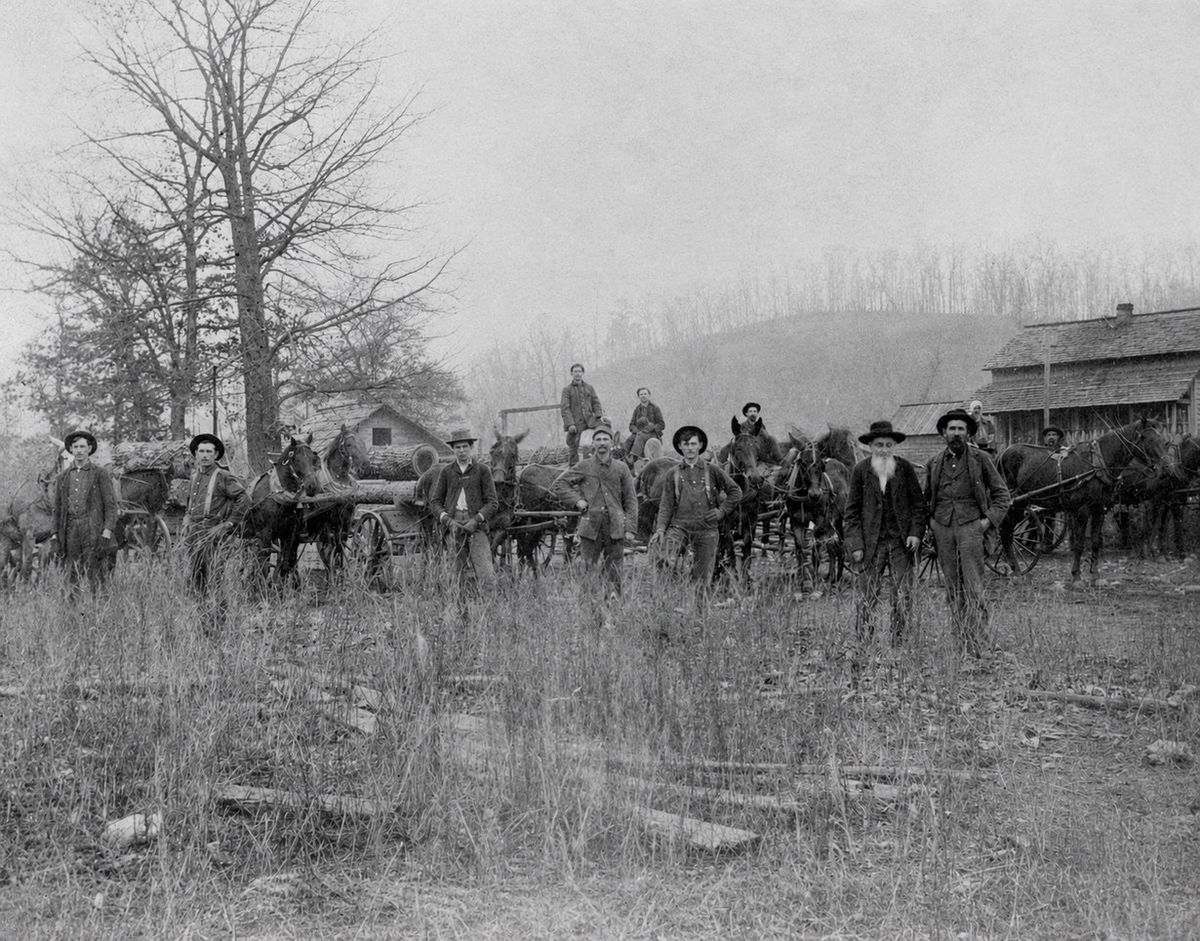
To the west of the farmstead rose a feature the family called Bald Hill — an informal, common name for treeless, glade-topped rises across the Ozarks rather than a fixed place on any map, so a present-day search turns up an unrelated Bald Hill farther south in the state, not this one. Different from the surrounding Ozark ridges, its soil was a strange white sand "full of little shells, as though it had once been a lake bed that bulged up to form this hill." The family was very nearly right about what they were standing on. What they were calling a hill is, in geological terms, a dolomite glade — an outcrop of the Cotter Formation, a layer of marine bedrock laid down hundreds of millions of years ago when southeastern Missouri lay at the bottom of a shallow tropical sea. The "little shells" the family found in the soil were fossils of brachiopods, gastropods, and other sea creatures, preserved when the sea drained and the stone lifted. For decades, the glade sat nearly treeless — open dolomite glades stay open because periodic fires keep the woody growth in check.25
By the time the story was written down in the twentieth century, fire suppression had let Eastern red cedars begin to move in, the classic late-stage glade pattern. Locals still hiked it for the view, and for the strangeness of standing on what looked like, and was, the bottom of an ancient sea. To place it for a modern reader: John Carter Rayfield's land sat in Reynolds County, Missouri, on Sinking Creek about two miles west of where the creek empties into the Black River. The Black River there is now Clearwater Lake.
His lower bottomland lies under water; the higher slope where his cabins stood is dry ground today, part of the Clearwater Conservation Area along the lake's western shore. The closest town is Piedmont, in adjacent Wayne County, about six miles east — the same town where Michael Rayfield's parents, Vernon and Opal, would later return to from St. Louis. Ellington, the largest town in Reynolds County, sits about twenty miles north. The homestead was between the two: legally in Reynolds County, geographically closer to Piedmont.
EIGHT CHILDREN, THEN POLLY DIED
Polly bore John Carter eight children in fifteen years. — Deborah "Debey" — January 23, 1842 to 1905 — married John V. B. Thornton — Sarah Jane — November 6, 1843 to 1919 — married William D. Dickson — Lucinda — March 19, 1846 to October 9, 1887, Paris, Texas — married Joel Chitwood Dickson — John Carter Jr. — May 18, 1848 to March 1915 — married Nancy Ann Farris — Benjamin Franklin "Frank" — March 13, 1852 to 1932 — married Nancy Louisa Pratt — Andrew Jackson — August 30, 1853 to November 29, 1924 — married Mary E. Parkhill, then Isabelle Goggin — George Washington — August 9, 1855 to June 28, 1915 — married Sarah Jane Thornton — Permelie C. — March 16, 1857 to 1915 — married a Seal.26
They are a kind of poem if you read them straight through. Two presidents (Andrew Jackson, George Washington), a founding father (Benjamin Franklin), a doubled Sarah Jane, a Lucinda who would one day cross the country to die in Texas. Eight children in fifteen years. Three married into neighboring Sinking Creek families. Two of John Carter's daughters — Sarah Jane and Lucinda — married Dicksons who were almost certainly brothers.
His daughter Deborah and his son George Washington married Thorntons whose names suggest they were brother and sister. John Carter Jr. married Nancy Ann Farris, whose father Lucien Farris farmed the land just west of the Rayfield place. Permelie married into the Seals, the next plot over. Frank married Nancy Louisa Pratt. The valley was small. The families wove into one another like willow. Then, on August 1, 1860, Polly died. She was forty. Her youngest, Permelie, was three. Her oldest, Deborah, was eighteen. She was buried at the Buffington Cemetery, on the hill above the farm.27
THE SECOND FAMILY
Polly's first cousin, Nancy Ann Mann, was twenty-five when Polly died. She was unmarried. She knew the Rayfield household — knew the children, knew the spring, knew the cooking house and the living house and the barn with the walnut planks. John Carter Sr. married her formally in 1865, but their first child, Albert, arrived in 1864 — suggesting the household had joined well before the ceremony was filed at the courthouse. Together, they had six children: — Albert S. (about 1864) — Margaret Susan (May 12, 1866) — the "Susan" the Vickery article remembered — Elizabeth "Lizzie" Nancy (about 1869) — James Richard "Jim" (about 1872) — Edward R. (February 5, 1875) — Walter Lee (October 1879 to May 16, 1948) Fourteen children. Two wives. Both Manns. Sixty-six years of family life in one valley.28
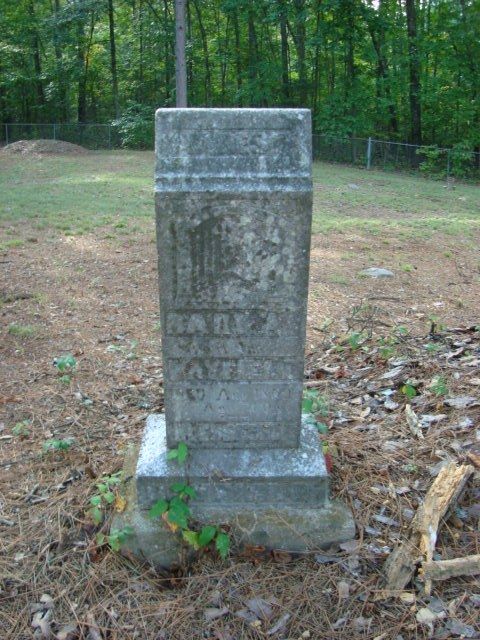
The Rayfield-Mann pattern didn't stop with John Carter Sr. His son Jim, late in his own life, would marry Julie — the widow of Allen Mann — another generation, another Mann match. By the time John Carter's grandchildren came of age, the Rayfield, Mann, Farris, Seal, Thornton, Dickson, and Pratt families had grown together into something closer to a single sprawling kin network than a community of separate households. There was also a Texas chapter. Sometime in the 1870s, Lucinda — the third of Polly's daughters — moved with her husband Joel Chitwood Dickson to Paris, Lamar County, Texas, and her brother John Carter Rayfield Jr. followed briefly with his own young family before bringing them home to Missouri — a sojourn told in Chapter Two. By 1887, Lucinda was dead — buried in Texas at forty-one. The Texas branch of the family kept going.29
THE WAR ON THE BORDER
Reynolds County in 1861 was about the worst place in the country to be raising a houseful of children. Missouri never seceded. It didn't really stay Union, either. The state was a battleground of regular armies, irregular militias, and — worst of all, for the people who actually lived there — bushwhackers: Confederate-aligned guerrilla bands who came at night, burned barns, stole livestock, and shot men suspected of Union sympathies. The Union had its own version: jayhawkers, who burned and stole and shot in the other direction. Reynolds County sat exactly on the cultural border between North and South, in country dense enough to hide in and poor enough that no one paid much attention to who was doing what.
It was a hunting ground. Among the worst of the bushwhackers was a man named William "Bloody Bill" Anderson, who had broken off from Quantrill's Raiders and gathered his own band. His band included a teenaged Jesse James, then learning the scouting, the ambush craft, and the casual violence that would, after the war, make him America's most famous outlaw. Anderson and Quantrill operated mostly farther west. But the model spread. The Ozarks had their own bands. Everyone knew someone who had been visited. Here is what John Carter Rayfield Sr. did. He took his team of horses and he left.
We know the choice because his descendants remembered it. He hauled his team down into Arkansas at times, working far enough south that the raiders wouldn't bother chasing him. He came home when he could. The farm survived. The family survived. Eight children, two adults, a presidential land grant in a drawer, and a hill above the spring — they all came through. The war ended, but its violence cast a long shadow.30
Nine years after Appomattox, on January 31, 1874, Jesse and Frank James — joined by the Younger brothers — flagged down a southbound Iron Mountain Railroad train at Gad's Hill, Missouri, a few miles east of John Carter Sr.'s farm. They robbed the express car of an estimated twelve thousand dollars and rode off. A Buffington-area man named Sanders happened to be aboard. According to the family who passed the story down, the James boys recognized him, knew his family, and let him keep his money on account of how many children he had. Bushwhackers had become outlaws. The valley had not changed.31
THE LONG TWILIGHT
The census records sketch the rest of his life in ten-year intervals. In 1850: Reynolds County, District 76. In 1860, the year Polly died: Barnsville — the settlement now known as Ellington. In 1870: still Barnsville. By 1880: Webb Township, the rural district covering the southeastern corner of Reynolds County, including the Clearwater Lake area where his land patent lay. He kept farming. The children grew up. The children had children. The children's children had children. Nancy Ann died in 1902, age 67. John Carter Rayfield Sr. died the following year, on July 27, 1903, at the age of 86. The 1900 census had caught him just before the end, still in Webb, marital status married, relation to the head of household: Father. He had moved in with one of his children to be cared for. He was buried at Buffington Cemetery, on the hill above the valley he had walked into as a thirteen-year-old boy seventy-four years earlier — beside Polly, within earshot of the spring, on ground the water would never reach.32
WHAT THE LAKE TOOK
Authorized by the Flood Control Act of 1938, the Army Corps of Engineers began acquiring the Black River bottomland to impound Clearwater Lake. Construction started in 1940, paused during the war, and the dam closed in 1948. The water came up.
The lower farms went under; the higher ground did not. Whether each Rayfield, Mann, Farris, Seal, and Dickson place was bought out, sold privately, or simply abandoned once the neighbors were gone, the result was the same: by the early 1950s the Buffington Community as a living network of kin had ceased to exist. The five-room frame house. The barn with the walnut-floored grain bin. The chicken-house that had once been a cabin. The spring at the foot of the hill. Gone — bought, dismantled, or drowned, depending on the elevation.
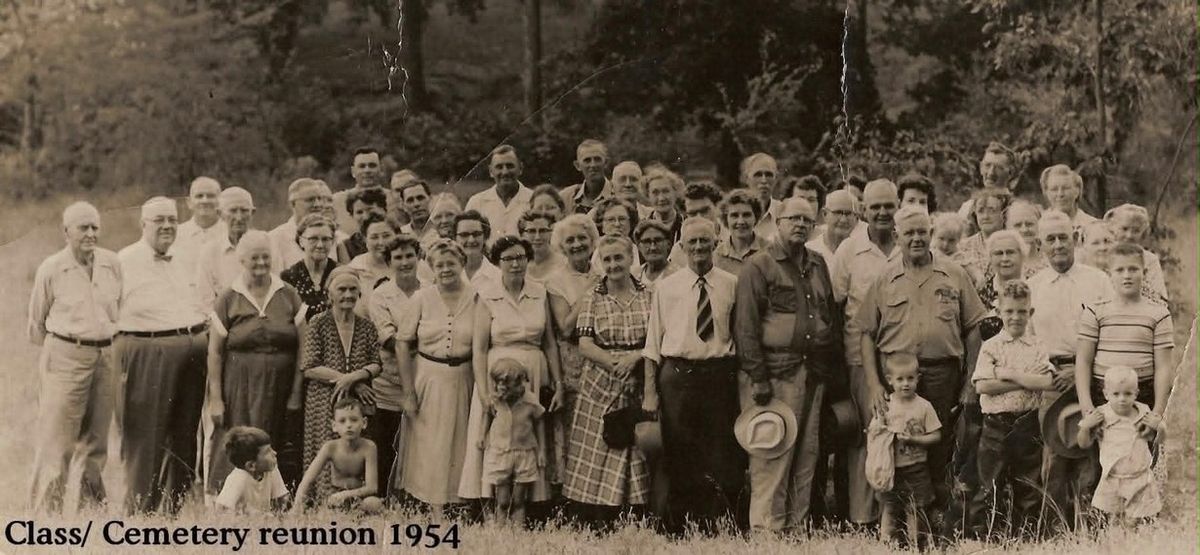
What survived sat above the water line: the cemetery, the schoolhouse on its hillside two hundred yards north of the graves, and the memory. On a Saturday morning in October 1954, eleven men and women in their fifties and sixties — born in the valley before the water came, scattered afterward to other counties and states — drove back to the cemetery and worked the weeds out with scythes.33
By noon the two-acre plot was clear. They moved up to the deserted schoolhouse, which still stood about two hundred yards north of the graves, for a basket dinner. Among them was a Rayfield. His name was Drew. He was seventy-six. He had been born in the Buffington valley in 1877, the son of John Carter Rayfield Jr. He had come home. He died fourteen years later in Poplar Bluff. The graveyard workings continued for at least another twenty years. They may, in some form, continue still.
WHAT ENDURED
Nearly two hundred years after the wagon left Cumberland County, the names are still around. In the towns of southeastern Missouri — and in the spillover towns up the river, the suburbs of St. Louis, the small cities on the Illinois side — you'll meet someone whose great-grandmother was a Mann from Piedmont, or a Farris from Lesterville, or a Dickson from up near Sinking Creek. The community is gone. Its grammar is not. The threads that knit the Rayfields to the Robinsons to the Lewises to the Seals to the Manns — and outward to the Buffingtons, Skaggs, Thorntons, Farrises, and Dicksons — run through families across three states and five generations. Pull on one of those threads anywhere in southeast Missouri, and something on the other side of the room will move. Somewhere on one of those threads, you find John Carter Rayfield Sr. A thirteen-year-old who crossed the Cumberland River and, as far as anyone knows, did not come back.
A man who bought land before he was old enough to vote. A husband whose wife died at forty. A widower who started a second family at forty-eight. A father of fourteen. A man who left town when the war came and worked in Arkansas until it was safe to come home. A grandfather who carried his own grandfather's English plantation story across a thousand miles and three generations, and made sure his grandchildren knew it. Buried on the only piece of his valley that the lake couldn’t take.
Notes
1. “History of the Buffington Family,” compiled community history (typescript, privately circulated), copy in the compiler’s files; and Kathryn Vickery, “Rayfield Families in County Trace Genealogy to England,” Pioneer Families series, undated newspaper clipping [ca. 1978], the complete article filed as ARN0000025, privately held by Andrea Harter. ↩
2. U.S. Army Corps of Engineers, St. Louis District, “Clearwater Lake” project history (project authorized by the Flood Control Act of 1938; dam closed 1948); and “History of the Buffington Family.” ↩
3. Find a Grave (https://www.findagrave.com), memorial page for John Carter Rayfield Sr. (1816–1903), Buffington Cemetery, Reynolds County, Missouri; corroborated by the 1900 U.S. census (note 32) and Vickery, “Rayfield Families.” The fourteen children by two Mann wives are traced through the 1850–1900 census sequence (notes 21, 32). ↩
4. Vickery, “Rayfield Families”; and 1830 U.S. census, Washington County, Missouri, p. 64, William Rayfield and John Rayfield households (adjacent); digital image, Ancestry.com. ↩
5. “Biography of William Rayfield,” in A Reminiscent History of the Ozark Region (Chicago: Goodspeed Brothers, 1894), biography of William Rayfield (also transcribed at accessgenealogy.com); identifying William (“Billy”) Rayfield, b. 1829 Cumberland Co., Ky., son of John and Nancy (King) Rayfield, and his firms Adams & Rayfield (Lesterville) and Rayfield & Son (Centreville, from 1883). Filed as ARN0000115. ↩
6. The Cumberland River crossing, as John Carter told it to his grandchildren, is preserved in Vickery, “Rayfield Families.” ↩
7. PATERNITY. No surviving primary record names John Carter Rayfield Sr.’s father; the identification of James Rayfield (b. ca. 1793), son of Isaac Rayfield, rests on indirect evidence and elimination. (1) Isaac’s son William Rayfield (b. ca. 1786) — the “Uncle William” with whom John Carter traveled west and who held his inheritance — was living into the 1850s and patented Missouri land at about age seventy-one, and is remembered in family accounts as John Carter’s uncle, never his father (notes 4, 9). (2) Family tradition holds that John Carter’s father died or departed in Kentucky before 1829 (Vickery, “Rayfield Families”). (3) Among Isaac’s documented sons, James is the only candidate not excluded by age, residence, or the surviving record. Eddy Pratt, “The Rayfield Record” (2008), reaches the same conclusion by elimination. The link is therefore offered as a reasoned probability, not a proven fact. ↩
8. The Mansfield marriage and disinheritance survive only as family tradition: Vickery, “Rayfield Families,” drawing on memory recorded in the Reynolds County Courier. ↩
9. 1820 U.S. census, Cumberland County, Kentucky, p. 158, William Rayfield household; and 1830 U.S. census, Washington Co., Mo., p. 64 (note 4). No surviving record documents John Carter’s father in either place — the basis for the inference that he had died or departed by 1829. ↩
10. William Price, ed., North Carolina Higher-Court Records, 1702–1708 (Raleigh: State Dept. of Archives and History, 1974), 124, 142–43 (William Rayfield’s 1703 headright claim, Little River, Pasquotank Precinct); and S. B. Weeks, ed., Colonial and State Records of North Carolina, vol. 1 (1993 ed.), 588–89. ↩
11. Will of William Rayfield Sr. of Alligator, Pasquotank Precinct, dated 4 August 1722, proved 23 March 1731; abstracted in J. Bryan Grimes, Abstract of North Carolina Wills, 1690–1760 (1967 reprint), 307. ↩
12. Will of William Rayfield Jr., planter, Tyrrell County, N.C., dated 24 January 1757, proved March 1757; in S. Bradley, Tyrrell County, North Carolina, Wills (1994), 57; original manuscript image and probate page, North Carolina Wills, 1663–1789, imgs. 1397–1398/1466; FamilySearch, ark:/61903/3:1:3QS7-89GC-F98J-Y. ↩
13. Will of Isaac Meekins, Tyrrell County, N.C., dated 5 January 1760, naming grandson “Isaac Rapheld” among his heirs — the record establishing that William Rayfield Jr.’s second wife, and Isaac Rayfield’s mother, was Ann Meekins; Tyrrell Wills, 1744–1836, img. 437/700; FamilySearch, ark:/61903/3:1:SQWX-8F73-9. ↩
14. This reconstruction of William Rayfield Sr. to William Rayfield Jr. to Isaac Rayfield was first traced by the genealogist Eddy Pratt in an independent study of the family’s North Carolina origins (Eddy Pratt, “The Rayfield Record” [2008]); the original wills cited above (notes 11–13) were located and verified against the manuscript images for this book. ↩
15. “An Act for the relief of Isaac Rayfield,” 28 January 1812, in William Littell, The Statute Law of Kentucky, vol. 4 (Frankfort, 1814), 336 (declaring Isaac “indigent and a cripple” and forgiving the balance owed on his fifty acres). ↩
16. Deed, Isaac Rayfield to William Rayfield, Cumberland County, Kentucky, 15 March 1826, proved 31 October 1826; Cumberland County, Kentucky Deeds, 1822–1832, img. 377/765; FamilySearch, ark:/61903/3:1:3Q9M-CS4F-4S8X-2. The dower release names and “privily examines” Jerusha Rayfield, wife of Isaac, who signed by mark; a companion 1827 deed renders the name “Jemitha,” a clerk’s variant spelling. Transcription confirmed against the manuscript image by Andrea Harter, July 4, 2026. ↩
17. Isaac Rayfield’s children, including William and James, are reconstructed in Eddy Pratt, “The Rayfield Record” (2008), citing (among others) Frank C. Eddlemon, Missouri Genealogical Records and Abstracts, vol. 4: 1741–1839 (1992), 141. ↩
18. The immigrant-ancestor tradition (the English plantation, the freed bondsmen, the rescued couple) is preserved in Vickery, “Rayfield Families,” and is treated here as compressed family memory rather than documented history. ↩
19. On the disputed North Carolina–Virginia line and the 1728 Dividing Line survey, see William Byrd II, Histories of the Dividing Line betwixt Virginia and North Carolina, and standard colonial-boundary histories. ↩
20. 1830 U.S. census, Washington Co., Mo., p. 64 (note 4). ↩
21. The Mann line (Jacob Mann, German immigrant; his son Arnold Mann, b. 1798 Kentucky, m. Lucinda Biggers, to Missouri by 1820) rests on derivative compilations: Geneanet Community Trees Index, entry for Arnold Mann, accessed via Ancestry.com; Missouri State Census Collection, 1844–1881; and General Land Office (BLM) patents. No original record of Jacob Mann’s immigration has been examined. ↩
22. Find a Grave, memorial no. 63732396, Mary Ann “Polly” Mann Rayfield (ca. 20 October 1820 – 1 August 1860), Buffington Cemetery, Reynolds County, Missouri; with family records for her marriage to John Carter Rayfield (ca. 1837). ↩
23. Arnold Mann’s death (1872, Missouri): Geneanet Community Trees Index (note 21); Missouri State Census Collection, 1844–1881. ↩
24. 1850 U.S. census, Reynolds County, Missouri, p. 402, John C. Rayfield household; digital image, Ancestry.com. ↩
25. John Carter Rayfield, U.S. land patent, 1 August 1853, for 40 acres, Reynolds County, Missouri, signed by President Franklin Pierce; original privately held by the Rayfield family; General Land Office Records, Bureau of Land Management (https://glorecords.blm.gov). ↩
26. John Carter Rayfield, U.S. land patent, 3 January 1856, for 200 acres on Sinking Creek (“on both sides of Sinking Creek about two miles west of where it runs into Black River”), Reynolds County, Missouri, signed by President Franklin Pierce; original privately held; GLO/BLM records. ↩
27. The separate “cooking” and “living” houses, the later frame house, the walnut-plank barn, and the chicken house are described in Vickery, “Rayfield Families,” and “History of the Buffington Family.” ↩
28. “Bald Hill” and its “little shells” are described in Vickery, “Rayfield Families”; the geological identification as a dolomite glade of the Cotter Formation follows the Missouri Geological Survey and standard Ozark glade ecology. ↩
29. The eight children of John Carter and Polly (Mann) Rayfield, with dates and marriages, are compiled from Vickery, “Rayfield Families”; Find a Grave memorials for the Buffington and area cemeteries; and the 1850–1860 census sequence (notes 24, 35). ↩
30. Polly Mann Rayfield died 1 August 1860 and was buried at Buffington Cemetery: Find a Grave, memorial 63732396 (note 22). ↩
31. John Carter Rayfield’s 1865 marriage to Nancy Ann Mann (Polly’s first cousin), with a first child in 1864, and the six children of that marriage, are drawn from Vickery, “Rayfield Families,” and the 1870–1880 census sequence. ↩
32. Lucinda (Rayfield) Dickson removed to Paris, Lamar County, Texas, where she died in 1887; her brother John Carter Rayfield Jr. followed briefly (see Chapter Two and its notes). Family records; Find a Grave. ↩
33. John Carter Rayfield’s wartime practice of hauling his team into Arkansas is preserved in family memory: Vickery, “Rayfield Families,” and descendants’ accounts. ↩
34. The Gad’s Hill train robbery, 31 January 1874, is documented in standard accounts of the James–Younger gang; the Sanders anecdote is preserved in “History of the Buffington Family.” ↩
35. 1850, 1860, 1870, 1880, and 1900 U.S. censuses, Reynolds County, Missouri (John Carter Rayfield Sr. household; 1900 showing him, age 84, as “Father” in a child’s household, Webb Township); with Nancy Ann (Mann) Rayfield d. 1902 and John Carter Rayfield Sr. d. 27 July 1903 (Find a Grave, note 3). ↩
36. J. Lloyd Huett, “Eleven students of fifty years ago meet again at Buffington Reunion,” St. Louis Post-Dispatch, 18 October 1954 (the graveyard working, the surviving schoolhouse, and the attendance of Drew Rayfield, b. 1877, son of John Carter Rayfield Jr.). ↩
Chapter Two
The Farmer’s SonJohn Carter Rayfield Jr. & Nancy Ann Farris
~1848–~1915 / 1847–1931
THE SON WHO CARRIED THE NAME
When John Carter Rayfield Sr. listed his household on the 1850 census, one of the entries was a boy of about two — his fourth child, and the one who would carry his name into the next century. John Carter Rayfield Jr. had been born around 1848 on the Reynolds County land his father had only lately settled, into a household still being built: the log cabins recently raised, the presidential land patents still a few years off, the nearest town a long day’s ride. He grew up on Sinking Creek learning what his father knew — how to clear and plant thin Ozark soil, how to read water and weather, how to make a farm pay in country that gave up its living grudgingly.1
He rarely appears in the records under his own full name. Enumerators and clerks, faced with a father and son who shared every syllable, wrote him down as they could: “John C.,” “J. C. R.,” “John,” and — the name that finally stuck, the one his wife’s obituary would use to tell him from his father — simply “Carter.” It is a small thing, but it is the shape of his life in the documents: a man defined, again and again, in relation to the people around him. He is the bridge generation. His father crossed the Cumberland as a boy and built the homestead; his son Franklin would carry the Rayfield name into the twentieth century; his father-in-law was among the most written-about men in the county. Carter Rayfield stands quietly among them, the hinge on which the whole line turns, and the records let him speak only in glimpses.2
He was twelve when his mother, Polly Mann, died in August 1860, leaving his father a widower with eight children. The oldest understood what had happened; the youngest, Permelie, was three. John Carter Sr. married again within a few years — Nancy Ann Mann, Polly’s first cousin, was in the household by 1865 — and the younger children grew up knowing her as mother. Carter, a teenager by then, was old enough to remember both women.3
NANCY ANN FARRIS
The woman he married had lost as much, and younger. Nancy Ann Farris was born June 12, 1847, the daughter of Lucian Nester Farris — a Reynolds County farmer who would become a two-term state legislator and a Confederate officer, one of the most prominent men the county produced in the nineteenth century. His story is Chapter Three. But prominence did not spare his family grief. Nancy Ann’s mother, Nancy Hyatt, died when the girl was about seven; her father remarried — to Anna Carter — when she was nine. By the time Nancy Ann was old enough to marry, she had already outlived one parent and watched a stepmother take her mother’s place.4
That second marriage gave her a shelf of half-siblings who would still be living, and still close, when she died sixty years later: four half-sisters — Ella Taylor, Molly O’Dell, Bell Smith, and Ida Boston, all settled around Piedmont — and two half-brothers.5 The Farris and Rayfield families had farmed the same Reynolds County valleys since the 1840s; when Carter Rayfield married Nancy Ann Farris sometime in the late 1860s, he was knotting together two of the county’s founding households. No marriage record has yet surfaced — the courthouse fires that erased so much of early Reynolds County may have taken it — but the 1870 census finds the couple keeping their own household in Logan Township, Carter farming at twenty-two, a young wife of matching age beside him and a first child already arrived.6
THE TEXAS YEARS
What the record shows next is a chapter the family nearly forgot it had. Sometime around 1879, Carter and Nancy Ann pulled up and went to Texas.
They were not striking out blind. Carter’s sister Lucinda had already moved with her husband, Joel Chitwood Dickson, to Paris, in Lamar County, Texas; and Nancy Ann’s own family had a foothold there too — her brother Seth Farris died in Lamar County in December 1876. The northeast-Texas prairie around Paris was drawing Missouri Ozark families west by the wagonload in those years, and the Rayfields followed their kin.7
The proof that they made the trip sat hidden for years under a mangled name. In June 1880 a census taker in Precinct 5 of Lamar County, Texas, wrote down the household of “J. C. Ray Fields” — the surname split into two words, which is why the record never turned up under “Rayfield.” He was thirty-three, a farmer. His wife was thirty-four; the census garbled her given name, but recorded her father’s birthplace as Illinois — exactly where Nancy Ann’s father, Lucian Farris, had come from — a quiet confirmation, buried in a column, that this is the right family. With them were four children: Lily, seven; William, five; Andrew, three; and Samuel, only four months old.8
The record does more than place the family in Texas — it settles which of the children was the Texas baby. Family tradition named more than one, but the older three, Lily, William, and Andrew, were all Missouri-born; the real Texan was the youngest, Samuel, born at Paris about January 1880. The 1880 census itself oddly dissents, marking the four-month-old Missouri-born like his older brothers and sister — but Samuel corrected it himself all his life, giving Texas as his birthplace on every later census, down to the 1940 count he personally answered. The family was right. And Samuel’s Texas birth fixes the whole sojourn in time: Carter and Nancy Ann went out to Paris around 1879, following the Dicksons and the Farrises already there, and were home in Missouri by 1882, when their next son, John Richard, was born near Piedmont.9
THE CHILDREN
Carter and Nancy Ann raised eight children — five sons and three daughters, the arithmetic her obituary would give in 1931. The 1880 census and that obituary, read together, finally sort them out of the tangle of half-remembered and duplicated names the trees had made of them. The five sons were William Thomas (born about 1875); Andrew Carter — the “A. C.” of the records — born about 1877; Samuel Lee (born in Texas, about January 1880); John Richard (1882); and Franklin Peter (1884). The three daughters were Lily Olivia (1873), Sarah Fern (1887), and one more whose name the record has not yet given up.10
By the time Nancy Ann died, the sons had scattered across the Ozark counties in the ordinary way: A. C. farmed at Sinking Creek, on the old home ground; Franklin — F. P. — was at Ironton; John and William had settled at Des Arc; Sam had gone to Eminence. The daughters did not live to be counted among the survivors. Lily and Sarah Fern both died in 1918 — the year the influenza pandemic swept the Ozarks, though the record does not name the cause — and the third daughter was already gone. Nancy Ann outlived all three of her girls.11
It was the fourth son who mattered most for the thread of this book. Franklin, born in 1884 after the family came home from Texas, would leave Reynolds County, marry Myrtle Lee Seal in 1905, and carry the Rayfield name into a century his parents would not see. His story picks up in Chapter Four.
THE LAND, THE DECADES
Home from Texas, Carter and Nancy Ann did what Rayfields did: they farmed, and they stayed. The 1900 census found them in Webb Township — the same stretch of Reynolds County where Carter’s father had patented two hundred acres on Sinking Creek half a century earlier — with three children still under the roof: John, eighteen; Franklin, sixteen; and Sarah, twelve. Carter was fifty-two, the same age his own father had been farming this ground a generation before. The 1910 census caught him there again, still working the land he had worked his whole adult life. Their names are in no county history. They cleared and planted and raised their children and stayed where they had always been — which in that country and that century was its own kind of achievement.12
Carter Rayfield died about 1915. No death certificate has surfaced — Missouri had only begun registering deaths statewide in 1910, and the Reynolds County record, if it was ever made, has not been found. What fixes the date is his widow’s obituary, sixteen years later, which noted that “Carter Rayfield” had preceded her in death by about sixteen years. He was roughly sixty-seven. He had been born before the county had railroads and died before it had good roads, on the same Sinking Creek ground where he came into the world.13
AUNT NAN
Nancy Ann lived another decade and a half. She had been widowed at sixty-seven; she would be a widow until she was eighty-three. The 1920 and 1930 censuses find her in Reynolds County still, folded into the households of her children — mother-in-law, then mother, in the enumerator’s column.14
The community had a name for her by then. She was “Aunt Nan” — the same affectionate title the Iron County hills gave to Uncle Billy Lewis a few chapters on, an honorific that had nothing to do with blood and everything to do with belonging. She had “become a christian very early in life,” her obituary said, and joined the Sinking Creek Baptist Church, “of which she was a faithful member” for the rest of her many years. It was her own institution — the one part of the record that belongs to Nancy Ann and not to her father, her husband, or her sons.15
She died on February 8, 1931, at the home of her son A. C., on Sinking Creek — eighty-three years, eight months, and twenty-seven days old, the obituary counted, with the precision families reserve for the people they cannot quite let go of. She left thirty-nine grandchildren and fifteen great-grandchildren. The funeral was held not in a church or a parlor but at the Buffington schoolhouse, the one-room building on the hillside above the graves, and was preached by the Rev. Joseph O’Dell of Piedmont — very likely kin, since one of her half-sisters had married an O’Dell. They buried her in the cemetery close by: Buffington Cemetery, on the ridge where her father Lucian Farris had been laid in 1876 and her father-in-law John Carter Rayfield Sr. in 1903 — where the family had been planting its dead for nearly a century, and where Nancy Ann Farris Rayfield came at last to rest among them.16
Notes
1. 1850 U.S. census, Reynolds County, Missouri, John Carter Rayfield household (John Carter Jr. enumerated as a child of about two); ARN0000179; digital image, Ancestry.com. ↩
2. John Carter Jr.’s name as it varies in the records (“John C.,” “J. C. R.,” “John,” “Carter”) is drawn from the 1850–1910 U.S. census sequence (ARN0000179–ARN0000182) and from the 1931 obituary of Nancy Ann (Farris) Rayfield, which distinguishes him from his father as “Carter Rayfield” (Reynolds County Courier, 19 February 1931; ARN0000100). ↩
3. Polly (Mann) Rayfield’s death (1 August 1860) and John Carter Sr.’s remarriage to Nancy Ann Mann are documented in Chapter One and its notes. ↩
4. Nancy Ann Farris’s birth (12 June 1847): obituary of Nancy Ann (Farris) Rayfield (Reynolds County Courier, 19 February 1931; ARN0000100), with the 1850 and 1860 U.S. censuses, Reynolds County (ARN0000205, ARN0000206). Her mother, Nancy Hyatt, and stepmother, Anna Carter, are identified in the biographical account of Lucian Nester Farris (ARN0000233; see Chapter Three). ↩
5. Nancy Ann’s half-siblings — Ella Taylor, Molly O’Dell, Bell Smith, Ida Boston, and two half-brothers — are named in her 1931 obituary (ARN0000100). ↩
6. No marriage record for John Carter Jr. and Nancy Ann Farris has surfaced; the Reynolds County courthouse burned in 1863, 1871, and 1872, destroying much of the early record (“Burned to the Ground: Courthouse Disasters in the Region,” KRCU, Southeast Missouri State University, 10 July 2024). The couple first appears together in the 1870 U.S. census, Logan Township, Reynolds County (ARN0000180). ↩
7. Lucinda (Rayfield) Dickson’s removal with her husband Joel Chitwood Dickson to Paris, Lamar County, Texas, is noted in Chapter One; Nancy Ann’s brother Seth C. Farris died in Lamar County, Texas, in December 1876 (Ancestry.com family data; derivative — original record not yet examined). ↩
8. 1880 U.S. census, Precinct 5, Lamar County, Texas, household of “J. C. Ray Fields” (surname recorded as two words), age 33, farmer; wife age 34 (her father’s birthplace given as Illinois); children Lily (7), William (5), Andrew (3), and Samuel (4/12); digital image, Ancestry.com. ↩
9. BIRTHPLACE OF THE CHILDREN. The 1880 census (note 8) records all four children as Missouri-born, but for Samuel this is contradicted by every record he later reported: the 1900, 1920, 1930, and 1940 U.S. censuses (Reynolds and Shannon counties, Missouri) all give his birthplace as Texas — the 1940 enumeration taken with Samuel himself as the respondent — and family tradition agrees. Samuel Lee Rayfield is therefore the one child born during the Texas sojourn (Paris, ca. January 1880). Andrew’s Missouri birth is separately corroborated by his 1968 Missouri death certificate. The next son, John Richard, was born near Piedmont, Missouri, in 1882, fixing the family’s return. ↩
10. The roster of eight children — five sons (A. C. of Sinking Creek, F. P. of Ironton, John and William of Des Arc, Sam of Eminence) and three daughters — is given in Nancy Ann’s 1931 obituary (ARN0000100), reconciled against the 1880 census (note 8), which resolves the duplicated names carried in online trees. ↩
11. Sons’ 1931 residences: obituary (note 10). Lily Olivia Rayfield died 15 March 1918 and Sarah Fern Rayfield died 18 November 1918 (Ancestry.com family data); on the 1918 influenza pandemic, Alfred W. Crosby, America’s Forgotten Pandemic: The Influenza of 1918 (Cambridge University Press, 2003). ↩
12. 1900 U.S. census, Webb Township, Reynolds County, Missouri (J. C. R. Rayfield, 52; wife “Nannie,” 52; with John, Franklin, and Sarah); ARN0000181. 1910 U.S. census, Webb Township, Reynolds County; ARN0000182. ↩
13. John Carter Jr.’s death, about 1915, is inferred from Nancy Ann’s 1931 obituary, which states that “Carter Rayfield” preceded her in death by about sixteen years (ARN0000100). No death certificate has been located; Missouri began statewide death registration in 1910. ↩
14. 1920 and 1930 U.S. censuses, Reynolds County, Missouri (Nancy Ann Rayfield, widow; ARN0000208, ARN0000209). ↩
15. Nancy Ann’s community name “Aunt Nan” and her membership in the Sinking Creek Baptist Church are from her 1931 obituary (ARN0000100). ↩
16. Nancy Ann (Farris) Rayfield’s death (8 February 1931) at the home of her son A. C. Rayfield, the funeral conducted by the Rev. Joseph O’Dell at the Buffington schoolhouse, her burial at Buffington Cemetery, and the count of thirty-nine grandchildren and fifteen great-grandchildren are all recorded in her obituary (Reynolds County Courier, 19 February 1931; ARN0000100). Her father, Lucian Nester Farris (d. 1876), and her father-in-law, John Carter Rayfield Sr. (d. 1903), lie in the same cemetery (see Chapters One and Three). ↩
Chapter Three
Before the County
Had a NameLucian Nester Farris · 1820–1876
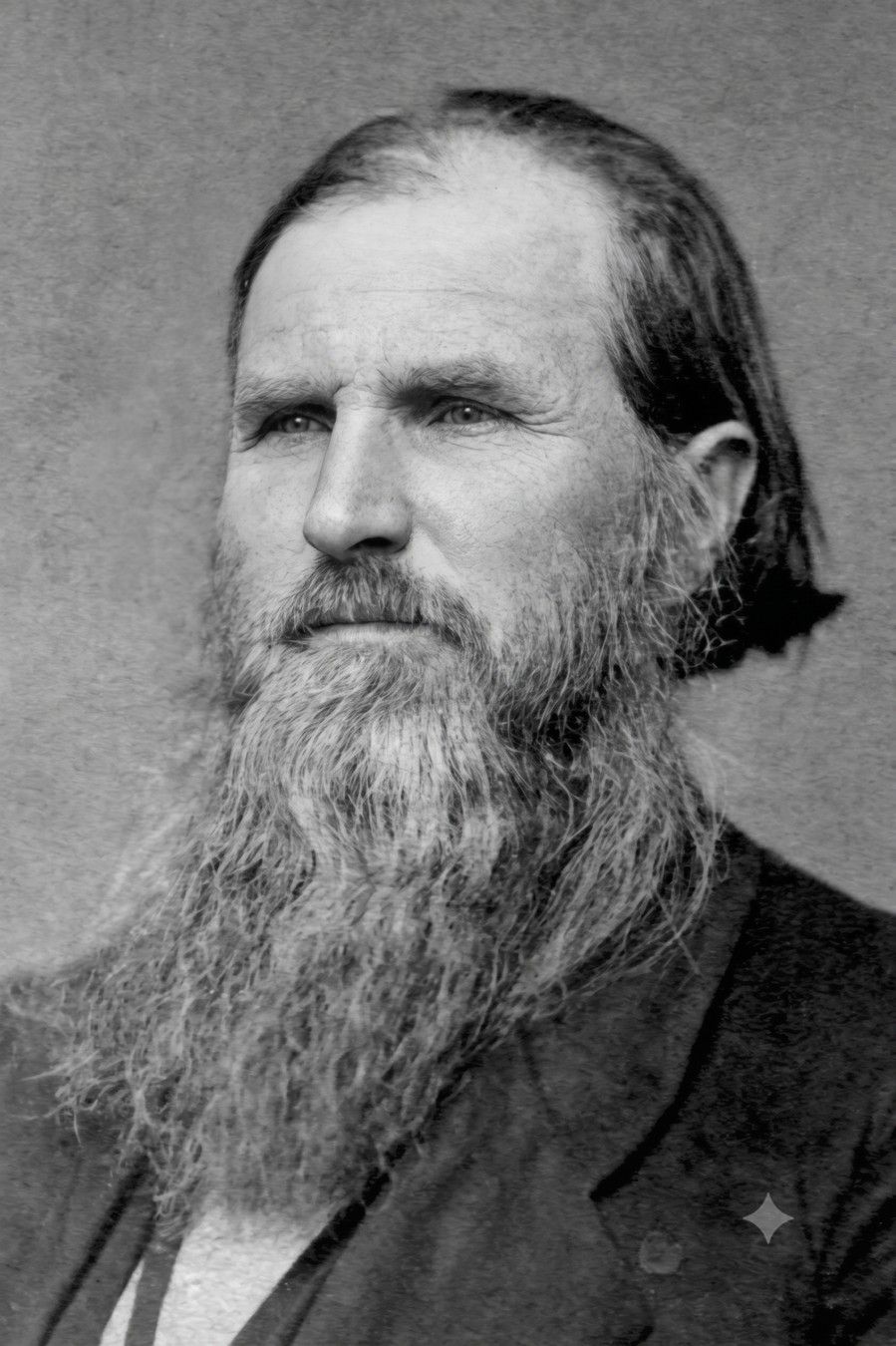
THE NEIGHBOR ON THE RIDGE
The woman John Carter Rayfield Jr. married had a father worth knowing about. Lucian Nester Farris arrived in the Ozark hills from Franklin County, Illinois, in 1840, before Reynolds County existed — before the state had carved it from Ripley and Shannon, before its farmers had a county seat or a name for where they lived. He married Nancy Hyatt that February and settled in. By the time the 1850 census was taken, he was farming in District 76, Reynolds County — the same district where John Carter Rayfield Sr. was farming at the same time. The man who would become his daughter’s father-in-law was his neighbor.1
He was more than a farmer. By 1858, he had earned a seat in the Missouri General Assembly — Reynolds County’s representative in a chamber of 133 men in Jefferson City. He wrote to his second wife Anna from the capital on January 12, 1859, in the only personal letter from this family’s entire documentary record to survive in his handwriting. The spelling is entirely phonetic — he writes “rite” for write, “rote” for wrote, “no” for know — the limits of frontier schooling even for a man capable of winning an election. But the voice is unmistakable: practical, observant, plainly in love with his family.2
“it is astonishing to see 133 men all seeted in one house to make laws & see how little is done it has been a perfect confusion so far”
“Jefferson City is situated on the west side of the missouri river on the ugliest ground you ever seen it is a rooting hollow points of ridges & the mudiest place in creation”
“I will assure all of you that I have the deepest regard for the wellfare prosperity of my Dear family.”
He also wrote about Kansas. Antislavery jayhawkers had been crossing the Missouri border the previous summer — raiding farms, freeing enslaved people, burning houses. The man Lucian named, “Montgomery,” was almost certainly James Montgomery — the Kansas abolitionist whose raids on Missouri border counties the state’s Democrats regarded as terrorism. (Lucian gives no first name; James Montgomery is the strongest candidate given the border violence of 1858–59, but the identification is not confirmed.) Lucian, a Missouri Democrat in a slaveholding county, called them thieves and murderers. At the letter’s close he asked his wife to kiss “sweet little Johnny” for him — their son John Carter Farris, just a few months old, named in the nineteenth-century custom after Anna’s maiden name.3
He served his first term and came home. Three years later, the war arrived.
A CONFEDERATE OFFICER IN HIS OWN COUNTY
Missouri never left the Union, but Reynolds County was Confederate territory in everything but law. When the war began, Lucian went with the Confederacy. He was commissioned as a Lieutenant Colonel in the 3rd Regiment of Infantry, 1st Division of the Missouri State Guard, beginning service in August 1861. He served until around March 1862, then returned home.4
He did not stay out of it. On February 1, 1863, Union forces captured him in Reynolds County itself — on his own land, in his own hills. He was taken to Pilot Knob, the Union stronghold in Iron County, and sent to Myrtle Street Prison in St. Louis. He was released on an oath of loyalty and a bond of one thousand dollars, restricted to Iron and Reynolds Counties.5
Union records indicate he violated those terms. Sworn statements later taken at Pilot Knob show what that meant on the ground: in the fall of 1864, Farris was openly conscripting men for the Confederacy along the Black River and Logans Creek in his own county — one witness swore that Farris had gathered some thirty recruits before he slipped away to the Union lines. That December, the Provost Marshal General in St. Louis declared Farris’s thousand-dollar bond forfeited by special order, for breaking its conditions. When Sterling Price launched his last major Confederate campaign through Missouri in the fall of 1864, Lucian reportedly rode with him — serving as Captain of Farris’s Company, Clardy’s Battalion, Missouri Cavalry. When General M. Jeff Thompson surrendered the unit, Lucian was paroled at Wittsburg, Arkansas, on May 25, 1865. He came home to a county that had been through four years of raids, reprisals, and ruined farms.6
THE SECOND TERM
The Missouri Constitution of 1865 barred former Confederate supporters from holding office, voting, and practicing certain professions. For Lucian — who had served as a Confederate officer, taken a loyalty oath, and then rejoined Confederate service — this meant years out of political life.7
He waited. When Missouri voters repealed the restriction in 1870, he ran again. He won. His second term as Reynolds County’s state representative ran from 1872 to 1874. He was fifty-one years old, and the people who knew him still thought him worth sending.8
He died on August 8, 1876, in Reynolds County, at fifty-five. The death notice ran in the St. Louis Republic eight days later. He is buried at Buffington Cemetery, on the ridge above the Buffington valley — the same cemetery where John Carter Rayfield Sr. would be buried twenty-seven years later.9
The year was hard on the Farris family. His son Seth, from his first marriage, died the same year. His youngest child, Ella, had been born three months earlier, on May 2, 1876. He met her, but only barely.10
His daughter Nancy Ann — born June 12, 1847, to his first wife Nancy Hyatt — was thirty years old when he died. She had already married John Carter Rayfield Jr. and was raising their children in the same Reynolds County hills where Lucian had arrived as a young man thirty-six years before. Chapter Two tells their story.11
Notes
1. Lucian Nester Farris’s arrival from Franklin County, Illinois, in 1840, his marriage to Nancy Hyatt that February, and his farming in District 76, Reynolds County, alongside John Carter Rayfield Sr.: biographical account of Lucian Nester Farris (ARN0000233) and the 1850 U.S. census, District 76, Reynolds County, Missouri (ARN0000236). ↩
2. Lucian’s service in the Missouri General Assembly, and his letter to his second wife, Anna, written from Jefferson City on 12 January 1859 — the source of the quoted passages here — are preserved in the biographical account and the letter itself (ARN0000233). ↩
3. The reference to the Kansas raider “Montgomery,” identified as probably James Montgomery (the letter gives no first name, and the identification is not confirmed), and the mention of the couple’s infant son John Carter Farris, are from Lucian’s 1859 letter (ARN0000233); on Montgomery’s Missouri border raids, Nicole Etcheson, Bleeding Kansas: Contested Liberty in the Civil War Era (University Press of Kansas, 2004). ↩
4. Lucian’s commission as Lieutenant Colonel, 3rd Regiment of Infantry, 1st Division, Missouri State Guard (August 1861–March 1862): Confederate service records (ARN0000234, ARN0000235). ↩
5. His capture in Reynolds County on 1 February 1863, imprisonment at Myrtle Street Prison, St. Louis, and release on an oath of allegiance and a one-thousand-dollar bond restricting him to Iron and Reynolds counties are drawn from his Confederate service records (ARN0000234, ARN0000235) and the biographical account (ARN0000233); the surviving federal provost file documents the bond directly (note 6). ↩
6. U.S., Union Provost Marshals’ File of Papers Relating to Individual Citizens (National Archives microfilm M345, roll 0089), file for Lucian N. Farris, Missouri, six images (Fold3.com): Special Order No. 313 (St. Louis, 8 December 1864) declared his one-thousand-dollar bond forfeited for violating its conditions, and sworn statements describe him conscripting men in Reynolds County for Confederate service in the fall of 1864. His service as Captain of Farris’s Company, Clardy’s Battalion, Missouri Cavalry, and his parole at Wittsburg, Arkansas, 25 May 1865: Compiled Confederate Service Record (ARN0000235). On Sterling Price’s 1864 Missouri Expedition, Kyle S. Sinisi, The Last Hurrah: Sterling Price’s Missouri Expedition of 1864 (Rowman & Littlefield, 2015). ↩
7. On the Missouri Constitution of 1865 (the “Drake Constitution”) and its ironclad test oath barring former Confederates from office, the vote, and certain professions: William E. Parrish, Missouri Under Radical Rule, 1865–1870 (University of Missouri Press, 1965); and “Constitution of 1865 (Drake Constitution),” The Civil War in Missouri (civilwarmo.org). ↩
8. Missouri voters repealed the test oath in 1870 (Parrish, note 7); Lucian’s second term as Reynolds County’s representative, 1872–1874, is recorded in the biographical account (ARN0000233). ↩
9. Death, 8 August 1876, Reynolds County; death notice, St. Louis Republic, 16 August 1876 (ARN0000232); burial at Buffington Cemetery, Reynolds County, Missouri (Find a Grave). ↩
10. The death of his son Seth (1876) and the birth of his youngest child, Ella, on 2 May 1876: biographical account (ARN0000233) and family records. ↩
11. Nancy Ann Farris (b. 12 June 1847), daughter of Lucian and his first wife Nancy Hyatt, married John Carter Rayfield Jr.; see Chapter Two and its notes. ↩
Chapter Four
Franklin Peter Rayfield
& Myrtle Lee SealA Partnership
A FARMER'S SON MEETS THE SEAL GIRL
Franklin Peter Rayfield was born on April 13, 1884, in Gads Hill, Missouri — a settlement so small it consisted of little more than a general store, a sawmill, and a wooden platform that served as a train depot. The place sat on the western edge of the Ozark plateau, in Wayne County, where the hills rose thick with shortleaf pine and white oak, and the hollows ran with cold, clear water. A decade before Franklin's birth, Gads Hill had made national headlines as the site of the 1874 Jesse James train robbery — the same holdup that took place only a few miles from the farm of Franklin’s grandfather, John Carter Rayfield Sr.1
By the time Franklin arrived, the robbery was already local legend — the kind of story old men told on store porches while the cicadas droned in the summer heat. His parents were John Carter Rayfield Jr., then thirty-five, and Nancy Ann Farris Rayfield, thirty-seven. The family had not been in Missouri long enough to feel settled in the way some of their neighbors did, but they had been there long enough to know what the country could and could not do.
All around them in those years, the Ozarks were being stripped of their pine forests. Narrow-gauge railroads pushed into every creek valley, and logging outfits — the Missouri Lumber and Mining Company, the Cordz-Fisher Company — felled trees at an industrial pace. By 1910 the pine would be largely gone. The men who stayed behind turned to what the cutover land could still offer: subsistence farming, hacking oak railroad ties by hand, cutting stave bolts and firewood to sell for whatever the market would bear.2
By the time Franklin was sixteen, in 1900, he was already listed in the federal census as a farm laborer, working alongside his father in the fields near Webb, in Reynolds County. The census records him as “Frank Rayfield,” age sixteen, born April 1884, occupation farm laborer, living in the household of J. C. R. Rayfield (age fifty-two) and Nannie Rayfield (age fifty-two), along with siblings John (eighteen) and Sarah (twelve). Franklin was learning the trade his family had practiced for generations.3
Around the same time, a girl named Myrtle Lee Seal was growing up four years behind him. She was born on July 29, 1888. Her father was Benjamin F. Seal, born in Arcadia, Iron County, in 1859. Her mother was Mary Jane Lewis — a surname shared with Uncle Billy Lewis and his descendants in Iron County, though a direct connection between the two Lewis lines has not been established. When Myrtle turned seventeen and Franklin twenty-one, they married — June 17, 1905, in Butler County, Missouri.4
Before Myrtle was born, her father’s family already had a documented legal tie to the Mann family — the same Manns who had helped make the Rayfields at home in Reynolds County. In the summer of 1873, an order of publication ran in the Iron County Register naming John P. Seal Jr. and his wife Mary E. Seal — née Mann, almost certainly a daughter of the Reynolds County landowner Isaac Mann — as defendants in an estate dispute over roughly 140 acres of land in Township 30. The suit arose because Isaac Mann’s deed to that property, the only written evidence of his title, had been destroyed by fire. His widow Millie and a man named Zemri Mann petitioned the Reynolds County Circuit Court to reconstruct the lost record, and the heirs, including Mary E. (now Mary E. Seal), were named as defendants to answer the claim. It was the kind of legal business that ran through rural communities like a seam — land and inheritance and a burned piece of paper — and it placed the Seal name beside the Mann name in Reynolds County’s records fifteen years before Myrtle Lee Seal was born. What the court ultimately decided has not yet surfaced — and in Reynolds County, where fire took so much of the early courthouse record, that silence may have a permanent explanation.5
THE YOUNG FARMING FAMILY
By 1910, Franklin was twenty-six and head of his own household. The 1910 census listed him as a farmer on his own account — no longer laboring for his father, but working land he owned or controlled. He had been married five years. Myrtle, at twenty-two, was his wife. They had two children: Jesse, three years old, and Bessie, two. Franklin could read and write; he was literate, educated to the eighth grade, which in an era when many Ozark men had little formal schooling marked him as someone who had seized what opportunity the local school offered. Myrtle's literacy was never recorded in the census forms of that era, which rarely asked such questions of women. What the records do show is what her days were made of: children, and the relentless work of keeping them alive. She bore five children — Jesse Clyde (born 1906, Ironton, Iron County), Bessie L. (born 1907, Piedmont Way, Missouri; known to family as Betty, and referenced as Betty in her brother Elmo’s obituary), Vernon Jack (born September 1909, Reynolds County),
Elmo (born 1912, Missouri), and Imogene Inez (born about 1919, Missouri). She managed a household through both prosperity and catastrophe. Every pregnancy was a gamble, and Myrtle took it five times — childbed fever and the fevers that ran through a houseful of children were the constant hazards of those years. The 1920 census captured the family at a particular moment: Franklin was thirty-six, Myrtle thirty-two.6
They were still farming in Webb, Reynolds County, on mortgaged land — the census records the home as owned but mortgaged. The household had grown to include Jesse (twelve), Bessie (eleven), Vernon (nine), Elmo (seven), and baby Imogene Inez (one). These were the years when the wider world pressed in on even the most remote Ozark hollows. In 1917, when the United States entered the Great War, Franklin registered for the draft. His registration card records his birth date as April 13, 1884, his residence as R.F.D. No. 2, Reynolds County, Missouri, and his physical description: medium height, medium build, dark brown hair, blue eyes.7
His nearest relative was listed as Myrtle Lee Rayfield. He was thirty-three, a farmer with a wife and young children — likely exempt from service, but required to register all the same. Nearly seven hundred fifty thousand Missouri men signed those cards. Many young men from the surrounding farms were not so fortunate; draft boards disproportionately selected rural men, and the war pulled laborers out of the fields at the worst possible time. Then, in the fall of 1918, the Spanish influenza tore through Missouri. Rural communities were especially vulnerable — travel was difficult, communication was unreliable, and the war had siphoned off many of the region's doctors and nurses for military service.
In nearby Carter County, the industrial town of Midco was hit so severely that dozens died, thousands fell ill, and the town never fully recovered. Whether the flu touched the Rayfield household is unrecorded, but it would have been impossible to live in the Ozarks in the autumn of 1918 without knowing someone who was sick, or someone who had died. Through it all, the farm endured. The mortgaged land, the growing children, the ordinary rhythm of Ozark agricultural life — ordinary only if you did not count what it cost Myrtle, year after year, to keep that rhythm going.8
THE PIVOT TO TOWN
Something changed in the late 1920s. The farm was no longer providing as it once had. Crop prices, which had been strong during the war years when the government needed food for soldiers, had been falling since 1920. The timber that had once supplemented farm income was largely played out. And then, in October 1929, the stock market crashed, dragging the national economy into a depression that would last a decade. Franklin made a decision: they would leave the land.
By 1930, at age forty-six, the census recorded him as head of household, his occupation listed not as farmer but as "Furniture" — industry "Store Retail," class of worker "Working on own account." He was no longer tied to the soil. The house was rented, not owned. No radio set. This was a different kind of life entirely. The move placed the family in the orbit of the Arcadia Valley — a cluster of small towns including Arcadia, Ironton, and Pilot Knob, nestled in the St. Francois Mountains about eighty miles south of St. Louis. The valley had a different character than the deep hollows of Reynolds County.9
It had been a mining community since the nineteenth century, built on iron and lead ore, and by the 1930s it still carried traces of its earlier prosperity: graceful antebellum homes, red brick storefronts, the Iron County courthouse. The Missouri Pacific Railroad ran through, connecting the valley to St. Louis and the wider world. A furniture store in such a town — even a small one — was a bet on the community's survival through hard times. While millions of Americans lost everything in the Depression — banks shuttering, farms going to auction, families piling their belongings into cars and heading west — Franklin Rayfield had pivoted.
He had closed the farm and opened a store. Whether it was calculated or desperate is impossible to know from the records. But the land was not feeding the family, and he adapted. The pivot fell to Myrtle as well. At forty-two, she left behind the rhythms she had known for decades — the garden, the livestock, the farm chores tied to seasons and weather — for the unfamiliar routines of town life. A rented house in Union. New neighbors. Imogene Inez, her youngest, was about eleven. She was rebuilding a household in a new place, alongside a husband trying his hand at a business neither of them had been trained for.
THE ILLNESS AND ITS AFTERMATH
In January 1938, Franklin Rayfield was admitted to a hospital in St. Louis. He was fifty-three years old. The diagnosis was tuberculosis. The Wayne County Journal-Banner of Piedmont, Missouri, on January 13, 1938, reported that F. P. Rayfield of Ironton, "but formerly of this community," was "at this time a patient in St. Louis" and was "still in a most critical condition and quite weak." In the 1930s, tuberculosis was still one of the leading causes of death in America. It moved through families and communities silently — a cough that wouldn't clear, a fever that came and went, a slow wasting that could take months or years to kill.10
There were no antibiotics. The only treatment was rest, careful nutrition, fresh air, and the hope that the body's own defenses might prevail. Across Missouri, sanatoriums housed patients for months or years at a stretch, and many never came home. The Woodmen of the World, a fraternal benefit organization, operated a hospital that treated members for tuberculosis — and the newspaper's reference to "Woodman Hospital" suggests Franklin may have been a member, receiving care through the fraternal network that served as a kind of social safety net in an era before widespread health insurance.
For several months, Franklin lay in that St. Louis hospital, a hundred miles from home. Myrtle, at forty-nine, was likely managing the household alone. Franklin was determined. The Wayne County Journal-Banner, May 4, 1939, reported: "We were very glad to meet our old friend, F. P. Rayfield, again. He has been under a doctor's care at a Woodman Hospital for several months. The doctors reported that all traces of T.B. had disappeared and told him if he would take care of himself he would get along allright, which his many friends will be very glad to hear. He and one of his sons, who works in St. Louis, were here Monday." The newspaper noted the visit — a small-town kindness, the kind of notice that reminded a man he was known, that people had been watching and hoping. Myrtle was not mentioned in the account. She rarely was. But she had weathered the months of crisis, and she had held things together.11
THE FINAL CHAPTER
Franklin had survived tuberculosis. But the disease had marked him. Two years later, on January 16, 1941, he died in Ironton, Iron County, Missouri. The death certificate recorded
the cause as prostate trouble and left bronchial pneumonia — the lungs weakened, the body unable to fight off what a healthier man might have survived. Myrtle herself served as the informant — the person who reported his death to the authorities. His burial was in Des Arc, in the Ozark soil that had shaped every generation of Rayfields before him. He was fifty-six years old. Myrtle was fifty-two.12
THE LIFE MYRTLE BUILT ALONE
The 1940 census, taken just months before Franklin's death, shows the couple living in Arcadia, Iron County, Missouri, in a rented house on North Side Wayne Street. Franklin's age is listed as fifty-five and Myrtle's as fifty-three. His highest grade of education completed was recorded as elementary school, eighth grade. Myrtle is listed as married, her relationship to head of household recorded as "Wife." Within a year, that word would no longer apply. The losses came close together.13
Franklin died in January 1941. Myrtle was fifty-two years old, a widow in a small Missouri town, with most of her children grown and scattered. Three years later, on November 21, 1944, she lost the other fixed point around which her life had been organized: her father, Benjamin F. Seal, died at Des Arc at the age of eighty-five, cared for in his last years by his second wife, Minnie. What became of Myrtle Rayfield in the years that followed is less well documented than the years of her marriage to Franklin.14
She had done what countless women of her generation did: married young, borne children in an era when women had little say in the timing or number, managed a household on limited resources, adapted when circumstances demanded it, and endured loss when it came. Five of her children survived to have children of their own, carrying forward the blood of the Rayfields and the Seals and the Lewises into the second half of the twentieth century and beyond. Her son Elmo's obituary in 1964 identified her as she had always been known: Myrtle Seal Rayfield — still carrying Franklin's name, still anchored to the family they had built together.15 In the years after Franklin's death, Myrtle would have watched the world transform around her — another war that took young men overseas, the postwar boom that paved roads and brought electricity to places that had done without, the slow emptying of the Ozark towns as young people moved to cities for work. If she lived long enough to see her
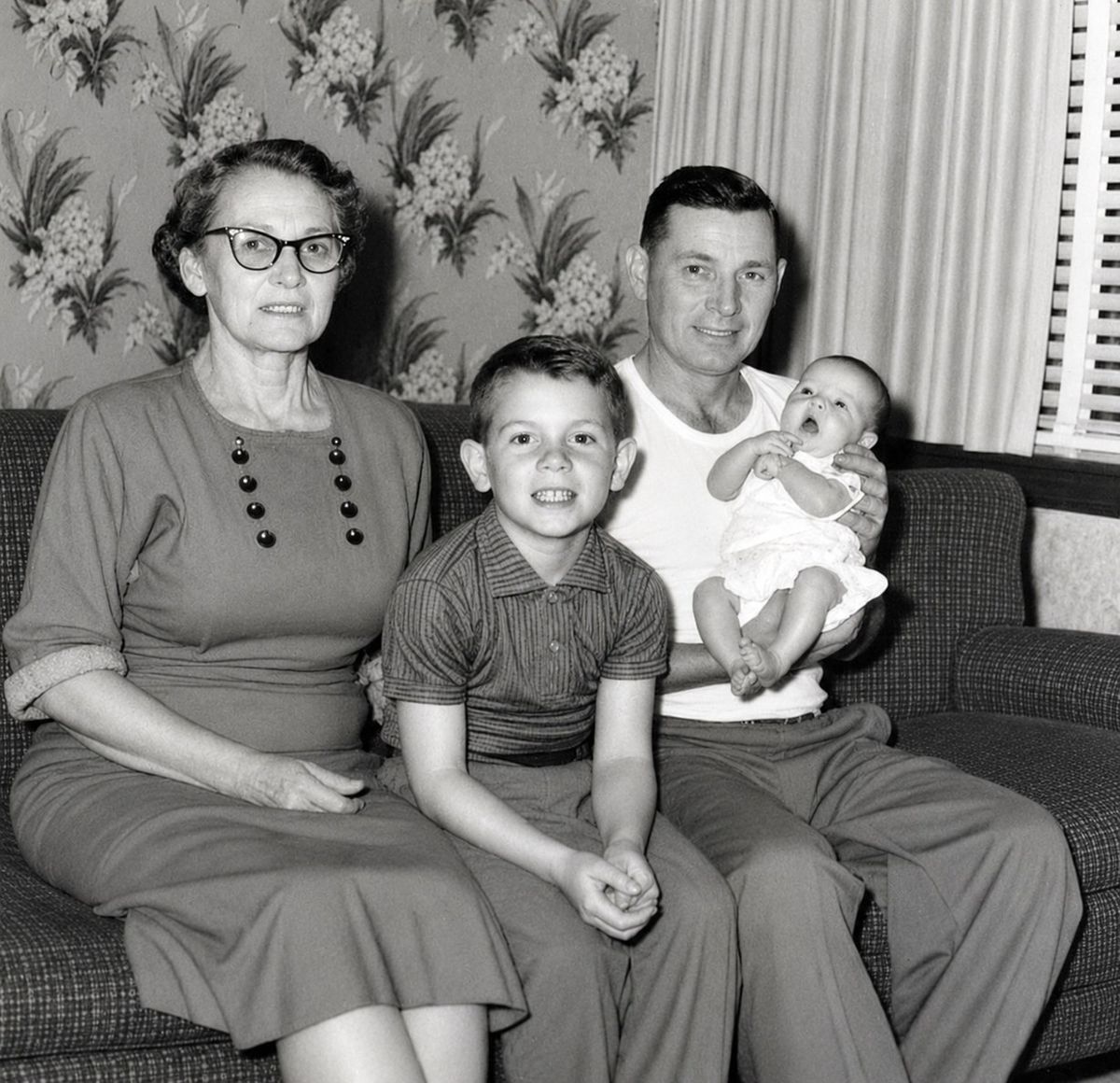
great-grandchildren — and at seventy-nine, she likely did — she carried the family's stories forward into a generation that could scarcely imagine the world she had been born into. Myrtle Lee Seal Rayfield died on July 1, 1968. She was seventy-nine years old. She was buried in Mountain View Cemetery in Des Arc, in the same ground where her husband had been laid twenty-seven years earlier.16
Notes
1. Franklin Peter Rayfield’s birth, 13 April 1884, at Gads Hill, Wayne County, Missouri: 1900 U.S. census (note 3) and his 1917 WWI draft registration card (ARN0000191). On the 1874 Gads Hill train robbery, see Chapter One. ↩
2. On the industrial logging of the southeast Missouri Ozarks — the Missouri Lumber and Mining Company (headquartered at Grandin) and the Cordz-Fisher Lumber Company — and the cutover economy of railroad-tie hacking and stave-cutting, see Milton D. Rafferty, The Ozarks: Land and Life, 2nd ed. (Fayetteville: University of Arkansas Press, 2001), and the Missouri Lumber and Mining Company records, State Historical Society of Missouri (C3875). ↩
3. 1900 U.S. census, Webb Township, Reynolds County, Missouri (“Frank Rayfield,” 16, farm laborer, b. April 1884, in the household of J. C. R. Rayfield, 52, and “Nannie,” 52); ARN0000023. ↩
4. Myrtle Lee Seal’s birth (29 July 1888) and her parents, Benjamin F. Seal (b. Arcadia, Iron County, 1859) and Mary Jane Lewis: 1900 U.S. census, Iron County (Myrtle in the B. F. Seal household; ARN0000160). Marriage of Franklin Rayfield and Myrtle Seal, 17 June 1905, Butler County, Missouri (ARN0000164). ↩
5. The 1873 estate suit placing the Seal name beside the Mann name — John P. Seal Jr. and his wife Mary E. (Mann) Seal named as defendants over roughly 140 acres in Township 30, Isaac Mann’s burned deed at issue: order of publication, Iron County Register, 2 August 1873 (ARN0000284). On the Reynolds County courthouse fires, see Chapter Two, note 6. ↩
6. The 1910 U.S. census (Franklin, 26, farmer on his own account; Myrtle, 22; children Jesse, 3, and Bessie, 2; ARN0000161), and the five children — Jesse Clyde (1906), Bessie “Betty” L. (1907), Vernon Jack (September 1909), Elmo (1912), and Imogene Inez (ca. 1919) — from the 1910–1920 censuses and Elmo Rayfield’s 1964 obituary. ↩
7. 1920 U.S. census, Webb Township, Reynolds County (Franklin, 36; Myrtle, 32; five children; home owned but mortgaged; ARN0000162). Franklin’s physical description and residence (R.F.D. No. 2, Reynolds County) are from his 1917 WWI draft registration card (note 1). ↩
8. On the 1918 influenza pandemic, Alfred W. Crosby, America’s Forgotten Pandemic: The Influenza of 1918 (Cambridge University Press, 2003); on the Ozark and southeast-Missouri experience, including the Carter County mill town of Midco, see Rafferty (note 2). ↩
9. 1930 U.S. census (Franklin, 46, head of household; occupation “Furniture,” industry “Store Retail,” working on own account; home rented; ARN0000189). ↩
10. Franklin’s tuberculosis and St. Louis hospitalization: Wayne County Journal-Banner (Piedmont, Mo.), 13 January 1938. The “Woodman Hospital” reference points to care through the Woodmen of the World fraternal benefit society. ↩
11. Franklin’s recovery: Wayne County Journal-Banner (Piedmont, Mo.), 4 May 1939. ↩
12. Franklin’s death, 16 January 1941, at Ironton, Iron County: Missouri death certificate (cause: prostate trouble and left bronchial pneumonia; informant, Myrtle Rayfield; ARN0000192); burial at Mountain View Cemetery, Des Arc (Find a Grave). ↩
13. 1940 U.S. census, Arcadia, Iron County (Franklin, 55; Myrtle, 53; North Side Wayne Street; rented; ARN0000163). ↩
14. Benjamin Franklin Seal, Myrtle’s father, died on November 21, 1944, at Des Arc, Iron County, at the age of eighty-five; obituary, Iron County Register (Ironton, Mo.), 30 November 1944 — naming his parents as John and Anna (Vance) Seal, his 1880 marriage to Mary Jane Lewis, and his second marriage to Minnie Farr in February 1931; buried Mann Cemetery, Reynolds County (Find a Grave). ↩
15. Myrtle is identified as “Myrtle Seal Rayfield” in her son Elmo Rayfield’s 1964 obituary. ↩
16. Myrtle Lee Seal Rayfield’s death, 1 July 1968; buried Mountain View Cemetery, Des Arc (Missouri death record, ARN0000172; Find a Grave). ↩
PART II
The Robinsons and the Lewises
Chapter Five
Uncle BillyWilliam John Lewis & Abigail Johnson
c. 1834–1900 / 1840–1919
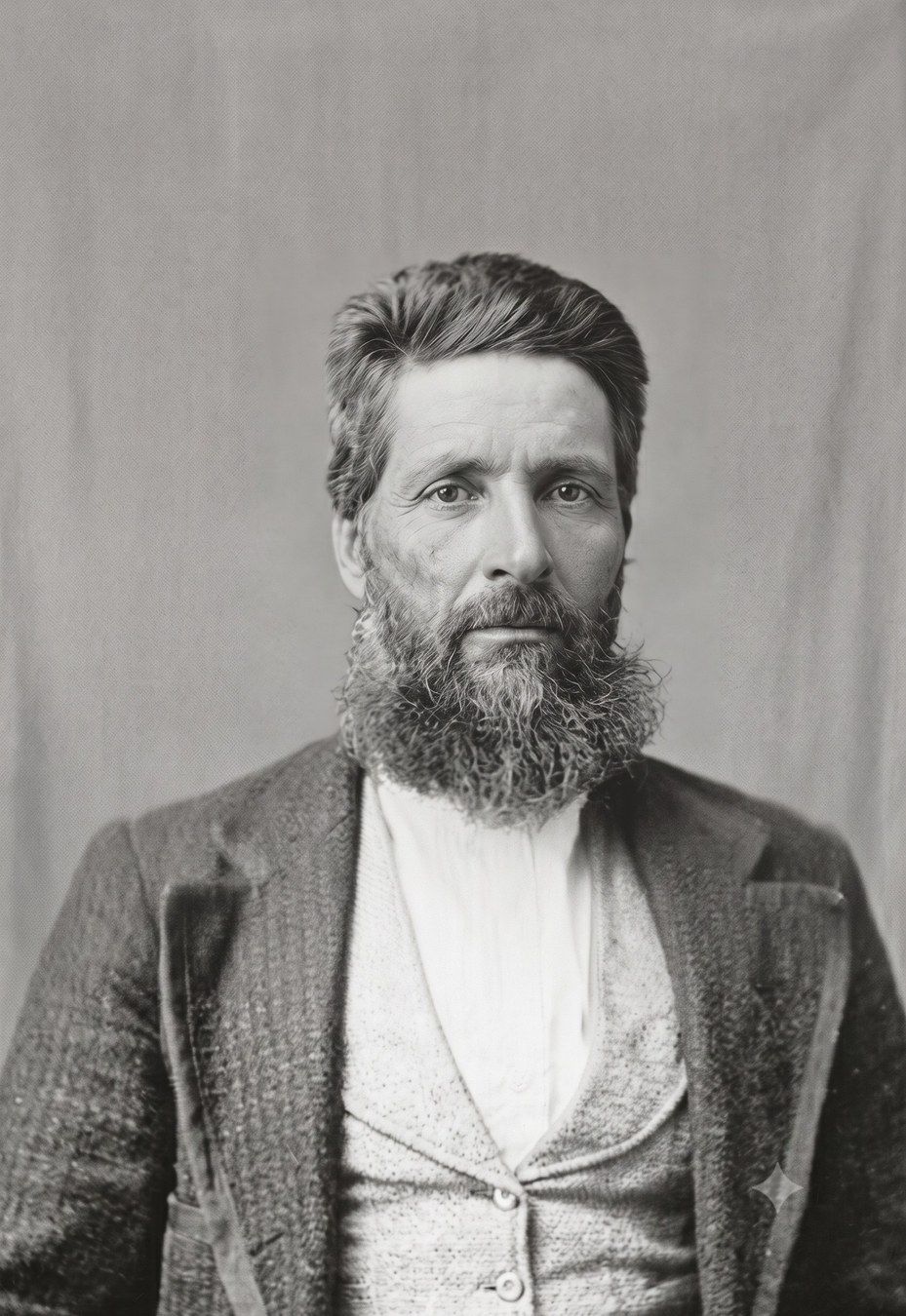
THE TENNESSEE YEARS
William Lewis was born in Marion County, Tennessee, around 1834, the son of George Lewis and Elizabeth Gilliland. His father had migrated from North Carolina in the early 1800s and settled in the foothills of the Cumberland Plateau, where the ridges ran northeast to southwest in long parallel folds and the creek bottoms held whatever soil a man could farm. Marion County was not prosperous country. George's real estate in the 1850 census was valued at six hundred dollars — enough to say he owned his ground, not enough to say it owed him anything in return. The family worked the land. They knew the place. Then, sometime in the mid-1850s, the Lewis family began to scatter. George died in late 1857, leaving behind his widow Elizabeth and their children. William, already in his twenties, had already begun looking west. Something — restlessness, opportunity, the pull of kin who had gone before — drew him out of the Tennessee hills and into Missouri.1
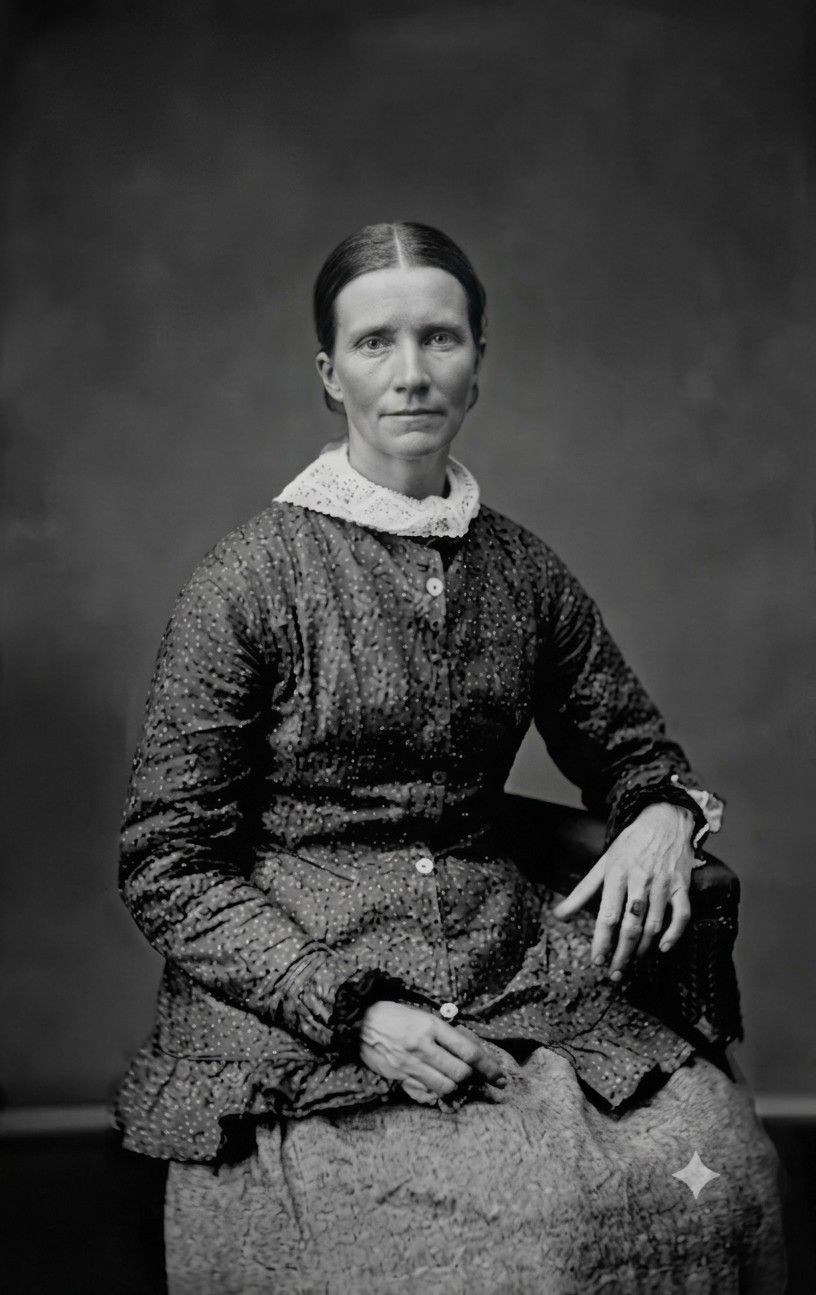
IRON COUNTY
By 1857, William had come to Iron County, Missouri. On October 30 of that year, he married Abigail Johnson, a young woman from Floyd County, Kentucky. She was seventeen. He was twenty-three.2 Abigail could not read or write — a fact the census enumerator would note decade after decade, marking the same two letters beside her name: "Cannot Read Y, Cannot Write Y." This never diminished her. She would become the keeper of a farm and a household, the mother of nine children who survived to adulthood, and eventually the head of her own estate. But in the autumn of 1857, she was simply a bride in a new country, married to a man who could not write his own name either. They settled in the high Ozarks of Iron County, in a landscape of steep-sided hollows and limestone springs, shortleaf pine on the ridges and hardwood in the bottomland. The nearest town of any consequence was Annapolis — a scattering of houses and a post office
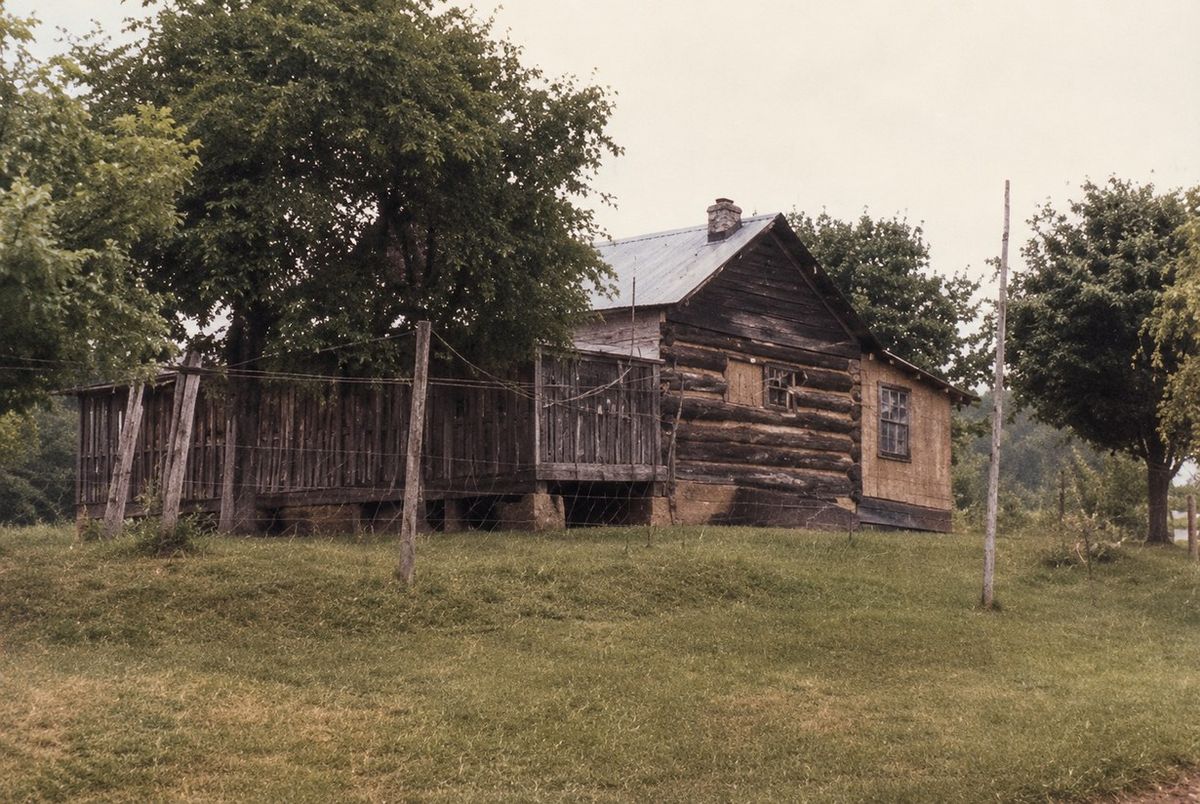
at the junction of two creeks. The St. Louis Iron Mountain Railroad had reached Pilot Knob by 1858, but its influence thinned quickly as you moved south and west into the hills. Out where William and Abigail lived, the roads were still creek-bed tracks that washed to nothing in the spring rains. Within two years, William had acquired land. On September 10, 1859, he received two federal land patents from the General Land Office at Jackson, Missouri — Certificate No. 26,147 and Certificate No. 27,410, 160 acres in all, purchased at the standard government price of one dollar and twenty-five cents per acre under the Land Act of 1820. Both patents were signed by President James Buchanan. The land lay in Township 31 North, Range 3 East, in Sections 10 and 15, on the high ground near Annapolis. He was twenty-five years old. He had a wife, land of his own, and the beginning of a life that looked, for a moment, as if it might hold steady. It did not.3
THE WAR
The Civil War came to the Missouri Ozarks not as a war between armies but as a war between neighbors. Iron County would see one of the war’s fiercest engagements — the Battle of Pilot Knob, fought on September 27, 1864, where fewer than fifteen hundred Union troops held Fort Davidson against roughly twelve thousand Confederates under Major General Sterling Price. The assault cost Price nearly a thousand casualties in under an hour; the delay and losses doomed his entire Missouri campaign. But for families scattered along the hollows of Iron and Reynolds counties, the war more often arrived not as a pitched battle but as something quieter and more corrosive.4
Raids. Ambushes on creek roads. Homes burned in the night. Guerrilla bands — some flying Confederate colors, some Union, some nothing at all — moved through the hollows taking horses, grain, livestock, and sometimes lives. Men who had farmed side by side for a decade found themselves on opposite sides of a conflict that neither had chosen and neither could escape. Bushwhackers wore stolen Union uniforms to get close to their targets; Union scouts dressed in butternut to infiltrate Confederate sympathizers. A farmer answering a knock on his door had no reliable way to know whether the man standing there had come to recruit him, rob him, or kill him.
On October 4, 1862, William Lewis enlisted in the Confederate Army at Pocahontas, Arkansas, joining Colonel Timothy Reeves’ 15th Missouri Cavalry Regiment, Company A. He was twenty-eight years old. Whatever convictions or pressures led him to the Confederate side, the records do not say. In the border counties of Missouri, a man’s allegiance was often determined less by ideology than by geography, kinship, and which armed band reached his door first. Ten weeks later, on December 22, three of William’s brothers followed him into the same regiment and company: John, Andrew, and Benjamin Lewis all enrolled at Pocahontas on the same day.5
Four sons of George and Elizabeth Lewis now rode in Reeves’ Confederate cavalry. By the summer of 1863, the war was wearing William down. A company muster roll for the period ending August 31, 1863, lists him as absent — left sick at Little Rock, Arkansas, since August 9. He was thirty years old, far from his wife and children, and ill in a city that was itself about to fall to Union forces. Within weeks of that muster, the war had turned on him. On October 31, 1863, William appeared before a Union Provost Marshal at Pilot Knob, Missouri. He had been arrested.6 The charge
field on his bond was left blank — whether by accident, by mercy, or by the simple administrative chaos of a war that had overwhelmed the legal system is impossible to know. What survives is the document itself: the Bond and Oath of Allegiance, preserved in the Missouri State Archives. It records his physical description with the dispassionate precision of a military bureaucracy cataloging a human being. Age: twenty-nine. Height: five feet, six inches. Eyes: black. Hair: black. He stood before a Union officer in the shadow of Pilot Knob with his freedom hanging on the words he was about to swear. The oath was unambiguous. He swore to bear true allegiance to the United States.7
He pledged to maintain national sovereignty paramount to that of all state, county, or Confederate powers. He promised to oppose secession, rebellion, and the disintegration of the Federal Union. He promised never to aid or comfort the Confederate armies. And then he signed with his mark — an X — because he could not write his name. The terms of his release were specific. He was restricted to Iron and Reynolds counties. He was required to report to the Provost Marshal's office monthly. He could not leave, could not travel, could not disappear into the hills. He was, in effect, paroled into his own life — free to farm, free to feed his children, but watched. William had sworn his oath and gone home. But the war was not done with the Lewis family.
On Christmas Day 1863 — less than two months after William signed his oath at Pilot Knob — a detachment of Union cavalry attacked a Confederate encampment at Pulliam’s Farm near the springs in southwestern Ripley County, about seventeen miles southwest of Doniphan. The engagement would become known as the Wilson’s Massacre. Among those captured was William’s brother Benjamin. He was sent to Gratiot Street Prison in St. Louis on December 31 and died there on January 30, 1864, one month after his capture.8
A military report listed the cause as inflammation of the lungs. He was buried at Jefferson Barracks National Cemetery, where his government-issued headstone still stands: BENJAMIN LEWIS / CO A / 7 REGT / MO CAV / CSA / JAN 30 1864. The regiment number on the stone reads 7th rather than 15th — Confederate Missouri unit numbering was notoriously inconsistent, and the headstone was placed in 1908 by the Commission for Marking Graves of Confederate Dead, working from whatever records had survived forty-four years. The date, the company, and the name match exactly.9
Benjamin left behind a wife, Naoma, and at least six children. Family tradition holds that Naoma herself died in St. Louis while bringing food to prisoners at Gratiot — presumably visiting her husband, and possibly also a young relative named Robert Lewis who was held there from May 1863 to September 1864. A 2008 letter from Naoma’s great-granddaughter to the Iron County Historical Society preserved this account, noting that Naoma’s exact date of death is uncertain: she may have died while Benjamin was imprisoned, or just days before he arrived. What is certain is that both parents were gone by early 1864. Their daughter Naoma — the child everyone called “Omy” — was approximately two years old.10
The Lewis family did what Ozark families did when parents were lost: the surviving brothers and sister divided the children among themselves and raised them as their own. The 1870 and 1880 censuses document the arrangement. William and Abigail took in Nancy and young William, called “Punkin.” Andrew and his wife Angeline raised Daniel and Martha Mary, known as “Polly.” Benjamin’s sister Elizabeth, who had married Thomas Jackson, took little Naoma — called “Omy” — into her household. Another daughter, Kizzy, does not appear in the 1870 census; she married Andrew Ruble in 1877. The children were scattered across Iron County, but they were not abandoned. They were absorbed into the fabric of the family that remained.11
After Benjamin’s death, the documentary record on William himself falls quiet. A muster roll for January and February 1864 still lists him as absent from the regiment, with a note that he was temporarily attached to a unit called Kitchen’s Regiment and involved in recruiting activity. Whether he served further, whether he honored his oath and stayed home, or whether he found his way through the last year of violence by some other means — the records do not say. What is certain is that he was alive in 1870. The census-taker found him back at home in Iron County, listed as a farmer, with two of Benjamin’s orphaned children in his household alongside his own growing family. Abigail was keeping house. The children kept arriving.12
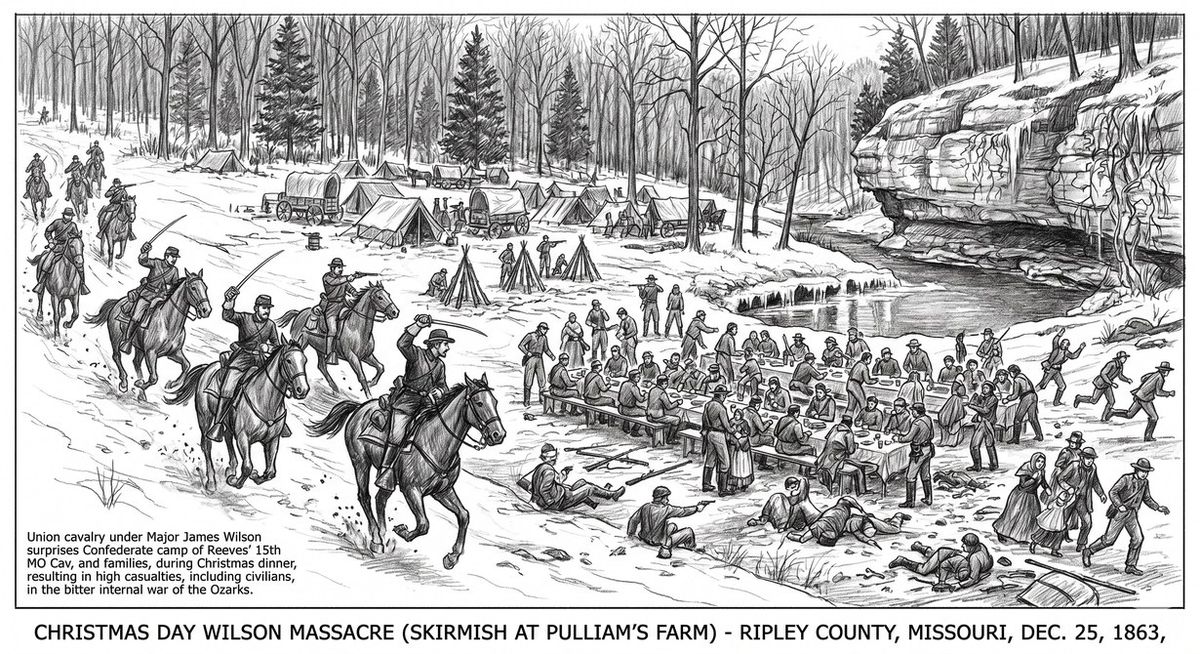
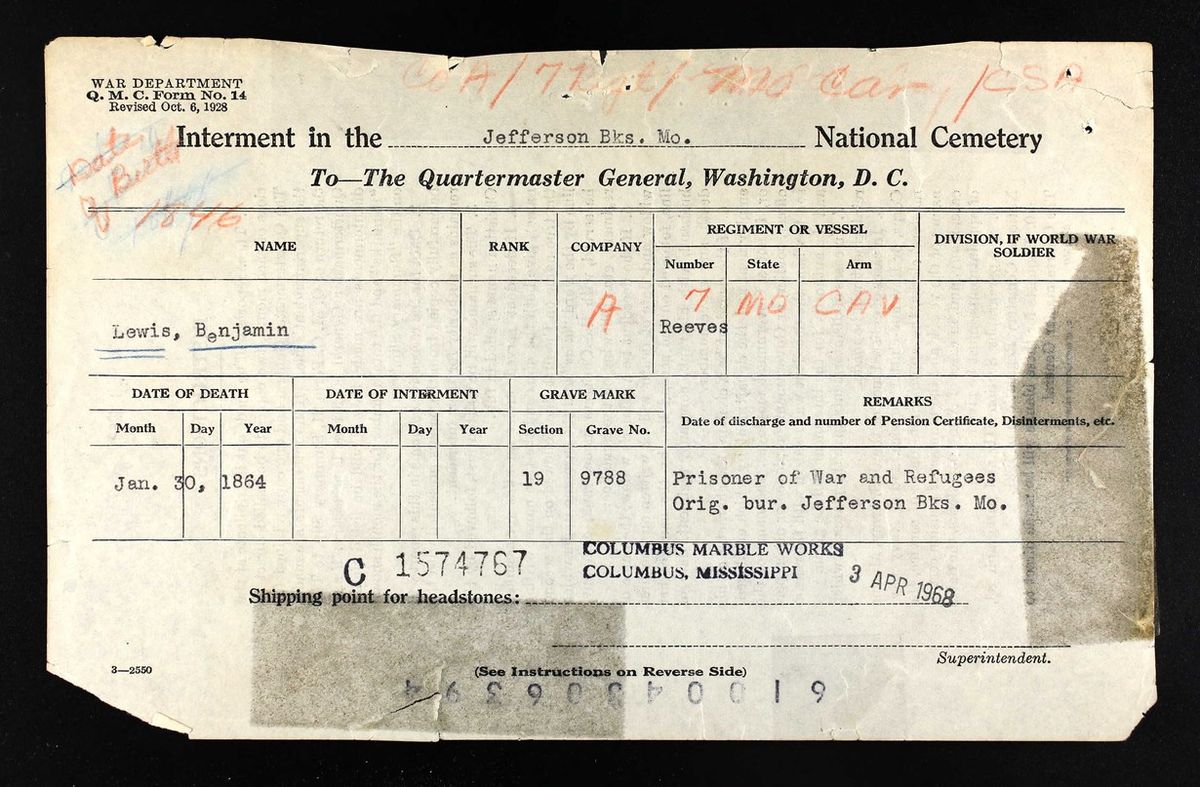
THE FARMER
The years after the war were years of rebuilding — not just fences and barns, but trust. In communities where neighbors had fought on opposite sides, where men had been arrested and paroled, where the dead were buried in family cemeteries that lay within sight of the
farms of the people who had killed them, the work of living together again was slow and difficult. William and Abigail did what most Ozark families did: they put their heads down and farmed. The children were arriving in the steady cadence of nineteenth-century rural life — one every year or two, each birth attended not by a physician (the nearest doctor might be a full day's ride) but by a local granny woman.
By 1880, William was forty-six and Abigail was forty. The census enumerated nine children in the household: Marion (twenty-one), John (seventeen), Andy (fourteen), Lee (twelve), Mary (ten), Jerome (eight), Martha (six), William Jr. (four), and Katherine — just a year old. Nine children who had survived infancy, in a time and place where not all of them did. William's occupation was listed as farmer. He could not read; he could not write. But he owned 160 acres, and he had kept his family alive and together through a war and its aftermath. In the arithmetic of Ozark life, that was no small thing.13
UNCLE BILLY
Sometime in the 1880s, a shift occurred — not in William's circumstances, but in how the community regarded him. The Iron County Register, the local newspaper, began referring to him as "Uncle Billy." In the rural Ozarks, "Uncle" was not a term of blood relation. It was a title conferred by a community on a man who had earned its affection and respect — an elder, a fixture, someone whose presence in the neighborhood was as familiar and as permanent as the landscape itself. In June 1888, the Register reported a discovery on Uncle Billy's farm: lead ore, found a mile and a half north of Annapolis, described as being of very fine quality and great abundance.14
A company would be formed to develop the mine, the newspaper said. Whether anything came of it is lost to the record. But the notice tells us something about William at fifty-four: he was still paying attention, still engaged with the possibilities of his land, still alert to whatever the ground beneath his feet might offer. The optimism of the lead discovery did not last. In 1893, a national financial panic collapsed the mining operations that had sustained Iron County's economy for more than a
decade. Banks failed. Mines closed. The iron furnaces that had given the county its name went cold. Families that had come to depend on mining wages — or on selling goods and services to miners — found themselves thrown back on whatever the land could provide. William was nearly sixty. His 160 acres, which had seemed modest beside the promise of lead wealth, became what they had always been: the floor beneath his family's survival. The Panic of 1893 did not break William Lewis. But it reminded him, and everyone around him, how thin the margin was between getting by and going under.15
Then, in July 1897, the newspaper published a detailed account of a Fourth of July celebration held at Uncle Billy's home. His children had come — Marion, John, Andy, and others — bringing their families back to the old place. A correspondent described the scene in the Iron County Register: men on horseback arriving through the morning heat, refreshments spread across a long table set in the grove near the spring on the property, the Declaration of Independence read aloud under the trees, voices raised together in song.
Uncle Billy, the correspondent noted, was a free silver man who had voted for Bryan in the previous fall's election — a man of political opinions who did not hesitate to voice them. But what struck the writer most was the spirit of the gathering. The best of order prevailed throughout the day. No profane word was uttered. The children had agreed, the account noted, to spend the day with the old folks at home, and make them feel happy once more in life. William Lewis was sixty-three years old. He had survived a war that had divided his community, had rebuilt a life on land he had purchased before the fighting began, had raised nine children with a wife who could not read or write, and could still, on a summer afternoon, gather his family around a table in the shade of his own trees and host a celebration that a newspaper thought worth recording. That is not nothing. That is, in fact, a great deal.16
THE INVALID
Sometime in the mid-1880s — the chronology is imprecise — William suffered a disabling injury. His obituary would later describe him as having been an invalid for fourteen or fifteen years. A newspaper account attributed the disability to a fall from a horse. For a working farmer, the loss of physical capacity was a kind of slow catastrophe — not sudden ruin, but the steady narrowing of what a man could do for himself and his family. Yet the same
obituary noted that despite his condition, William remained cheerful and entertaining in his conversation, energetic in his business dealings, and a good manager. The body had failed him. The mind had not. In September 1898, the Iron County Register noted a small event: "Uncle Billy Lewis and wife attended meeting at Lewis graveyard near Sabula." The family cemetery — a patch of ground on a hillside near the old settlement, maintained by the descendants of those who lay there — was more than a burial place. It was a gathering point, a site of annual meetings where extended families came together to clear brush, repair fences, and sit among their dead. That William attended, even as an invalid, tells us what mattered to him at the end: the connection to the ground where his people lay, and the obligation to tend it.17
THE END
In the spring of 1900, William's health failed for the last time. The Iron County Register reported his death with the kind of notice that small-town newspapers reserved for men who had earned the community's regard: an old and highly respected citizen of the county, who had lived in Iron County nearly all his life, well known throughout the county, leaving a widow and eight children to mourn his loss. The newspaper called him an upright man and good citizen and wrote that the people of the community would long cherish his memory and recall his many virtues. He died on April 9, 1900. He was sixty-five years old. His headstone in Mountain View Cemetery at Des Arc is plain: WM. LEWIS / DIED / APR. 9, 1900 / AGE / 65 YRS.18
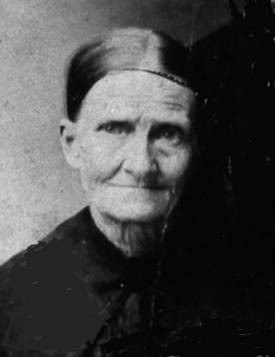
ABIGAIL
William's widow did what women of her generation did when the work of a marriage ended and the work of survival did not. She continued. She was sixty years old. She had never learned to read or write. She had no inheritance beyond the farm, the house, and whatever her husband's reputation was worth in a community that measured a man's legacy by what he left behind. She lived for another nineteen years — nearly two decades as a widow, managing alone, farming into her sixties and beyond.19 The full span of her widowhood is longer than many
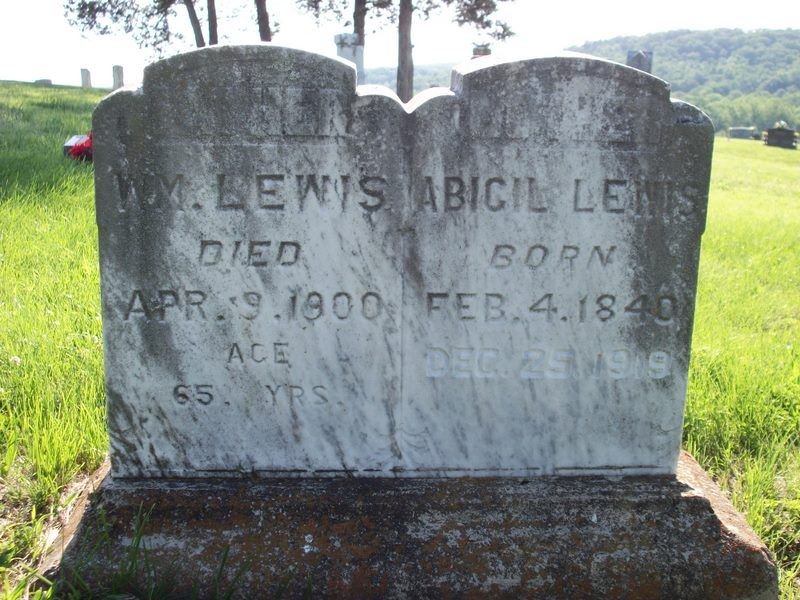
marriages of that era lasted. She buried children before she was done: the records do not tell us which ones, or when, only that the work of loss continued after William was gone. She died on December 25, 1919 — Christmas Day — at Des Arc, Iron County, Missouri. She was seventy-nine years old. Her side of the shared headstone reads: ABIGIL LEWIS / BORN / FEB. 4, 1840 / DEC. 25, 1919. They are buried together in Mountain View Cemetery, on a hillside above Des Arc, in the Ozark ground that William had come to as a young man from Tennessee and that Abigail had come to as a bride from Kentucky. The stone is weathered now. The names are legible. The hills have not changed. Their daughter Katherine — Katie, the year-old child counted in the 1880 census — would grow up on this farm. She would marry a blacksmith. She would carry her parents' steadiness, and her father's hard-earned standing in the community, into a household of her own. That household is the next story.20
Notes
1. William Lewis’s birth (ca. 1834, Marion County, Tennessee), his parents George Lewis and Elizabeth Gilliland, and the family’s Tennessee years: 1850 U.S. census, Marion County, Tennessee (George Lewis household, real estate valued at $600). ↩
2. William’s marriage to Abigail Johnson, of Floyd County, Kentucky, 30 October 1857, Iron County, Missouri (marriage record). ↩
3. William Lewis’s two federal land patents (Certificates 26,147 and 27,410), 160 acres in Township 31 North, Range 3 East, Sections 10 and 15, issued 10 September 1859 from the Jackson, Missouri, land office and signed by President James Buchanan (General Land Office / BLM records). ↩
4. On the Battle of Pilot Knob (Fort Davidson), 27 September 1864, Bryce A. Suderow and R. Scott House, The Battle of Pilot Knob: Thunder in Arcadia Valley (Cape Girardeau: Southeast Missouri State University Press, 2014), and Fort Davidson State Historic Site, Missouri State Parks. ↩
5. William Lewis’s enlistment, 4 October 1862, at Pocahontas, Arkansas, in Colonel Timothy Reeves’s 15th Missouri Cavalry (Confederate), Company A, and the enrollment of his brothers John, Andrew, and Benjamin on 22 December 1862: Confederate company muster rolls (brothers’ enrollment courtesy Rob’s Genealogy, robsgenealogy.com). ↩
6. The August 1863 muster roll listing William absent, sick at Little Rock since 9 August, and his 31 October 1863 arrest at Pilot Knob: Confederate muster rolls and the Union provost record (note 7). ↩
7. Bond and Oath of Allegiance of William Lewis, 31 October 1863, Pilot Knob, Missouri, recording his description (age 29; height about five feet six; black eyes and hair) and his mark: Missouri State Archives, Jefferson City, Provost Marshal Records (Reel F/362). ↩
8. Benjamin Lewis’s capture at the Christmas Day 1863 attack on Reeves’s camp at Pulliam’s Farm (the “Wilson Massacre”), Ripley County; committed to Gratiot Street Prison, St. Louis, 31 December 1863; died 30 January 1864, inflammation of the lungs (Report of Sick and Wounded). ↩
9. Benjamin Lewis’s burial at Jefferson Barracks National Cemetery; the government headstone (placed 1908 by the Commission for Marking Graves of Confederate Dead) reads “7 REGT MO CAV,” a probable transcription error — the 7th Missouri Cavalry was recruited from Dunklin County, not Iron — while the name, company, and date match William’s brother. ↩
10. Benjamin Lewis’s wife Naoma and children: 1860 U.S. census, Liberty Township, Iron County (Benjamin, 30; Naoma, 25). The tradition of Naoma’s death at Gratiot Street Prison is preserved in a 2008 letter from Norma Kniss Schaub (her great-granddaughter) to the Iron County Historical Society. ↩
11. The placement of Benjamin and Naoma’s orphaned children among the surviving siblings (William, Andrew, and Elizabeth Lewis Jackson) is documented in the 1870 and 1880 U.S. censuses and in the Benjamin Lewis estate administration, Iron County probate court, 1867–1868. ↩
12. The January–February 1864 muster roll (William absent, temporarily attached to Kitchen’s Regiment, recruiting) and the 1870 U.S. census, Iron County (William at home with two of Benjamin’s orphaned children). A Confederate parole dated 25 May 1865 at Wittsburg, Arkansas, has been widely but wrongly attributed to this William Lewis; the parolee’s description (about 23 years old, auburn hair) does not match William (29 in 1863, black hair). ↩
13. 1880 U.S. census, Iron County, Missouri (William Lewis, 46, farmer; Abigail, 40; nine children in the household). ↩
14. The June 1888 report of lead ore found on William Lewis’s farm, a mile and a half north of Annapolis: Iron County Register (Ironton, Mo.), June 1888. ↩
15. On the Panic of 1893 and its collapse of Iron County mining, Milton D. Rafferty, The Ozarks: Land and Life, 2nd ed. (University of Arkansas Press, 2001), and contemporary reports in the Iron County Register (Ironton, Mo.). ↩
16. The July 1897 account of the Fourth of July gathering at Uncle Billy’s home, and his “free silver” politics and vote for Bryan: Iron County Register (Ironton, Mo.), July 1897. ↩
17. William’s disabling injury (mid-1880s; described in his obituary as fourteen or fifteen years an invalid, attributed to a fall from a horse) and his September 1898 attendance at the Lewis graveyard meeting near Sabula: Iron County Register (Ironton, Mo.), September 1898, and his April 1900 obituary. ↩
18. William Lewis’s death, 9 April 1900: obituary, Iron County Register (Ironton, Mo.), April 1900; headstone and burial, Mountain View Cemetery, Des Arc (Find a Grave). ↩
19. Abigail (Johnson) Lewis’s long widowhood: 1900 and 1910 U.S. censuses, Iron County; Find a Grave. ↩
20. Abigail (Johnson) Lewis’s death, 25 December 1919, at Des Arc, Iron County; buried beside William at Mountain View Cemetery (Find a Grave). Their daughter Katherine (“Katie”) is the subject of Chapter Seven. ↩
Chapter Six
The Salesman
from Des ArcAbsalom Robinson & Josephine Parks
~1856–1936 / c. 1861–1900
THE MAN WITHOUT A CHILDHOOD
For now, the first twenty years of Absalom Parker Robinson’s life are missing from the record. He was born in Missouri — that much he stated on every census from 1880 through 1930, on his marriage record, and on the death certificate filed after his death in 1936. His parents came from Tennessee — or so he recorded on every census he answered. Beyond that, the earliest decades of his life are, so far, a gap — and in genealogy a gap is rarely the end of the story. No birth register has surfaced. No childhood household has been identified with certainty. No family Bible entry has turned up. Whether those records were never created, were lost, or are simply still waiting to be found, the search hasn’t closed them. What’s certain is where he first appears: in the documentary record fully formed, at about twenty years old, standing in a neighbor’s house in Perry Township, St. Francois County, Missouri, marrying a young woman named Josephinia Parks.1
Everything before that moment is a question. Everything after it is on paper. What had come down through the family — carried in the line of Alexander Robinson’s descendants — was a story of loss: parents gone young, children scattered, a brother somewhere. For generations that was nearly all anyone knew. Recent work has filled in more than the family ever had. Census records and DNA together now point to a father — Isaac Robinson, a North Carolina–born farmer who brought his people from Sevier County, Tennessee, into the Arcadia valley of Iron County, Missouri, in the 1850s. Isaac’s own census entries — 1850 in Sevier County, 1860 in Iron County — consistently record his birthplace as North Carolina, not Tennessee. That Ab reported his parents as coming from Tennessee almost certainly reflects where the family had been, not where his father was born; it is the kind of detail a child loses when a parent dies young. In the federal census of 1860, Absalom is there: a boy of about five, in Isaac’s Missouri household. The man family memory credited with having raised him appears, on the evidence, to have been his own father. His mother is still unknown — she seems to have died young — and the Alexander long remembered as his brother was, indeed, his brother — a 1923 newspaper notice names Alex Robinson as having a brother, “Abb,” confirming the two shared their father, Isaac. Whether they shared a mother as well is, on the present evidence, unresolved. The old account had the shape of the truth even where it lacked the names.2
There is a story told in the Robinson family for generations: Absalom, as a grown man, encountered another Robinson and asked him to remove his shoes. He was looking for a scar — an old injury to the foot, from childhood. The man had it. Absalom declared they were brothers.3
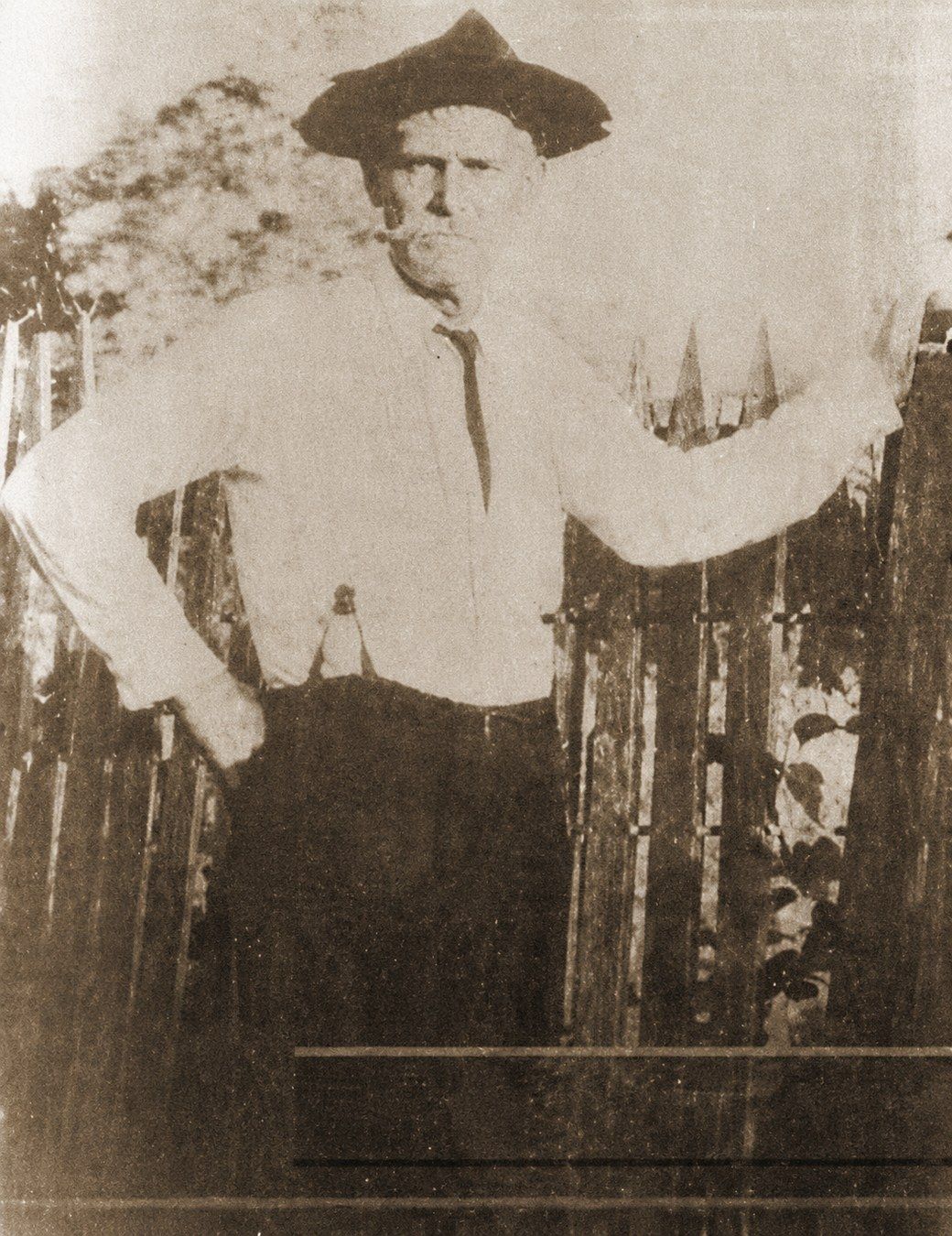
What we know of Ab Robinson begins not with a birthplace or a father’s name, but with a marriage.
THE MISSOURI MARRIAGE
On March 22, 1878, Absalom Parker Robinson married a young woman named Josephinia Parks at the home of a neighbor named Donaldson, in Perry Township, St. Francois County, Missouri. George Crump, Justice of the Peace of Perry Township, performed the ceremony. Ab was about twenty. She went by Josie. The record gives no detail beyond the facts: names, date, place, the witnesses present. It is a plain document for a plain beginning.4
FARM LABORER
The 1880 census found them still in Perry Township — Ab at twenty-three, occupation farm laborer; Josie keeping house; their two-month-old son John Wesley just arrived.5 They had married in the same township where they would spend the next two years, working other people's land while they worked toward something of their own. By the mid-1880s they had moved into Iron County, settling in the Des Arc community along the St. Francis River bottoms. The country was Ozark hill country — familiar, for anyone raised in east Tennessee, in its bones. Hard-timbered ridges, creek-bottom farms,
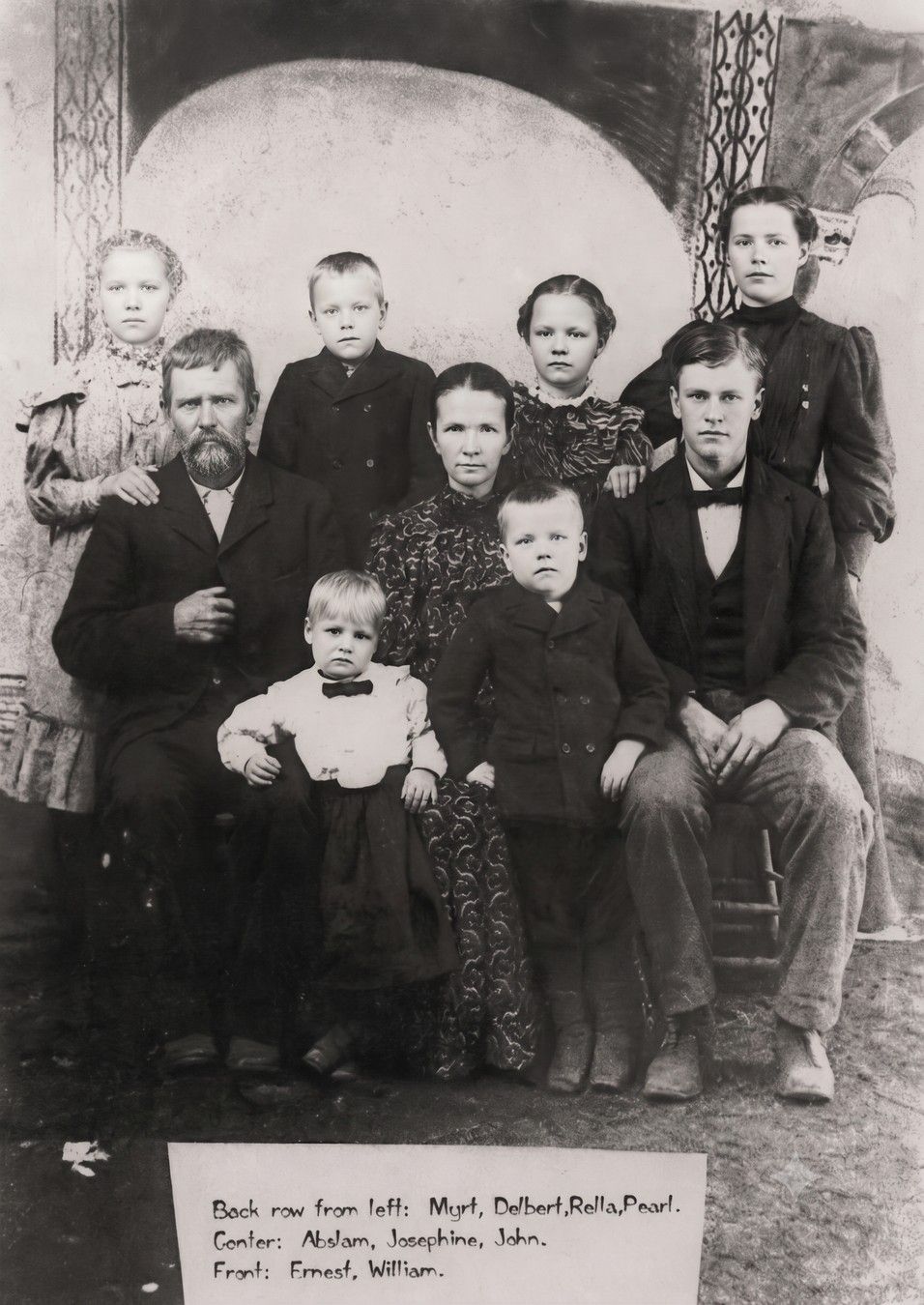
communities scattered along hollows and ridge roads. The families who had walked into Iron County a generation earlier from Tennessee and Kentucky had names Ab Robinson would have recognized. For Josie, the census line that read "keeping house" described a life of unbroken labor. It was the dawn-to-dark round of woodstove, garden, washtub, and canning shed that fell to every Ozark farm wife — the same labor her son’s wife Katie would later live in turn — and the eggs, butter, and garden surplus it produced were often the household’s only source of cash.
She did all of this while pregnant for most of her twenties and thirties, and while minding small children who could not yet be trusted near the creek or the fire. When her time came to deliver, there was no doctor within practical reach.
In communities like Des Arc, childbirth was attended by a granny woman — a local midwife, usually an older woman whose own children were grown, who had learned the work by apprenticing with the granny woman before her. She came on horseback or on foot, sometimes in the middle of the night, carrying whatever herbs and experience she had accumulated over decades of deliveries. Blackberry tea to prevent hemorrhaging. Raspberry tea to strengthen the contractions. Slippery elm bark to speed things along. The granny woman stayed through the birth and often for days afterward, helping with the older children and the household while the mother recovered — if she recovered.6
For a woman who bore thirteen children, as Josie did, the lifetime risk of dying in childbirth ran as high as one in eight. Josie bore children in steady succession through these years. Each birth was recorded. Some of the records also show a death. Armintie Ann, born in February 1879, died one month later. A boy in June 1887, unnamed in the surviving records, died the same week he was born. A girl in March 1890, also unnamed, also gone. Another child in January 1893, buried before it was a month old.7 By the time the twins arrived in May 1894 — William Abslum and Ernest Elmer, born together on the twenty-fourth — Josie and Ab had buried
four children in fifteen years. The twins must have felt like something shifting, after all of that. Two boys at once, arriving after years of small graves. The 1900 census, taken that June, found Ab still in Iron County, occupation day laborer. He was forty-two. Josie was listed beside him, married twenty-two years, nine children surviving of the thirteen she had borne. The youngest were the twins at six. John Wesley, the oldest, was twenty. Within months of the census taker's visit, Josie was dead.8
The record gives no cause. She was somewhere around thirty-nine years old. Thirteen pregnancies in twenty-two years, four infants buried, a body that had spent two decades hauling water and splitting kindling and kneeling over washtubs and bearing children in a house where the nearest doctor was a day's ride away. The documents don't say how it ended, only that it did. Whatever took her — exhaustion, hemorrhage, infection, some complication that a granny woman's herbs could not reach — it ended a life that had been spent almost entirely in service to the family she and Ab had built. He was forty-two, working someone else's land for wages, with children ranging from a twenty-year-old son to six-year-old twins, and no record that has surfaced of what he did next. The census had found him in June. The year had taken everything that anchored it.
THE REINVENTION
What the next four years looked like for Ab Robinson, no record that has surfaced can say. A man of forty-two with nine children and no wife does not simply vanish into grief — someone cooked, someone managed, the work continued — but the paper trail offers nothing until 1904. Her name, as it appears on the Iron County marriage license, was Mary Davis — she came from Madison County, Missouri. The ceremony was held at her home in Iron County on May 15, 1904, performed by Elder H. G. Wray. They were both noted as over twenty-one. He was forty-six. Two step-daughters, both named Davis, came with her into the household.9
Then, sometime in the next several years, something shifted that a single census line documents but does not explain. In 1900, Absalom Robinson had been a day laborer. In 1910, he was a sewing machine salesman. The 1910 census is explicit: Union Township, Iron County, Missouri. Head of household. Occupation: Salesman, sewing machine. He was fifty. He had traded the farmyard for the road. The Singer Sewing Machine Company had been placing agents through the Missouri Ozarks for decades by then. Their system was the territory — a man was given a stretch of country, a wagon, a stock of machines and parts, and the understanding that he would cover it all, month after month, collecting installment payments from the women who had bought on credit and demonstrating to those who hadn't.
The roads in Iron and Reynolds counties in 1910 were not roads in any modern sense — they were creek-bed tracks through timber, ridge paths that washed out with every hard rain, stretches of mud in spring that swallowed axles. A salesman on this territory needed to know which crossings ran high in April, which farms could be reached only from the north after a storm, which wives were home on which days. He needed to be trusted at the door. He needed to come back. Ab Robinson had been living in these hills for thirty years. He knew the territory — the creek crossings, the farm names, the families — in ways no outside salesman could replicate. Whatever made him leave day labor behind, the work fit him. He would carry the territory for the rest of his working life.10
STILL ON THE ROAD
The 1920 census found him still in Union Township, Iron County, still married to Mary. Their son Lloyd was fourteen. The 1930 census found him in Des Arc, age seventy-three, occupation the same line he had been carrying since at least 1910: sewing machine agent. On a Friday in early April 1929, Ab Robinson drove his circuit into Reynolds County — the county just west of Iron — and called on customers in the Peola community along its creek roads. The following Thursday, a local columnist noted the visit in a sentence that appeared in the third paragraph of the Peola News column of the Reynolds County Courier: "A. B. Robinson, the Singer Sewing Machine Salesman, was on our creek last Friday."
He was seventy-one years old. He had been selling on this territory for at least twenty years. He was, apparently, a familiar enough figure on the creek roads that the neighborhood correspondent thought his passage worth recording — not as news exactly, but as the kind of noticed thing that happened on a regular circuit. The familiar wagon. The familiar name. A man so woven into the rhythm of the community that his Friday appearance was as ordinary and as notable as the weather.11
THE END OF THE ROAD
Absalom Parker Robinson died on June 17, 1936, at Doniphan, Ripley County, Missouri. His physician, Dr. Clifton Go Fort of Doniphan, certified the cause as lobar pneumonia, with onset dating to March 1, 1936. He had been sick for three and a half months. The death certificate put his age at seventy-eight years and seven months, reckoned from a birthdate of November 16, 1857 — a date the family supplied, and one that fell a year or so later than his own lifetime of records, which pointed to about 1856. His occupation on the death certificate reads: salesman, solicitor. His birthplace is listed as Missouri, consistent with what he reported on every record throughout his adult life. The informant was D. L. Robinson.12
He was buried at Mountain View Cemetery in Des Arc, Iron County, on June 19, 1936 — carried back to the community where Josie had raised their children, where four infants lay in ground he had once worked for someone else's wages. His second wife Mary outlived him. He had come out of an unknown beginning in Missouri and married at a neighbor’s house in Perry Township before he left a single document of his childhood behind. He had buried children and a wife and reinvented himself when farming no longer held him. He had been still riding his circuit at seventy-one, recognized by name on a Reynolds County creek road, a Singer salesman with his wagon and half a county left to cover before the week was out. Somewhere on those roads, on some Friday not recorded, he made his last call and turned for home.
Notes
1. Absalom’s consistent statement of a Missouri birth and Tennessee-born parents appears on every U.S. census 1880–1930, his marriage record, and his 1936 death certificate; his first documented appearance is his 1878 marriage in Perry Township, St. Francois County (note 4). ↩
2. ABSALOM’S PARENTAGE. Recent work (2026) identifies Absalom’s father as Isaac Robinson, a North Carolina–born farmer who moved from Sevier County, Tennessee, to Iron County, Missouri, in the 1850s, on converging evidence: Absalom appears as a boy (“Apsa,” age 5) in Isaac’s household in the 1860 U.S. census, Arcadia, Iron County; a 1923 newspaper notice names Alexander Robinson (long held in family tradition to be Absalom’s brother) as having a brother “Abb,” confirming a shared father; and autosomal DNA supports the link. Absalom’s mother, who died young, is not yet identified. Earlier research wrongly assigned Absalom to John A. Robinson and Mary “Polly” Manis of Hawkins County, Tennessee — that family’s Absolom (“Dock”) was a different man who never left Tennessee (WikiTree profile Robinson-10159; Robinson family oral history via Roxanna Robison, 2026). ↩
3. The “injured foot” reunion story is preserved in Robinson family oral history (via Roxanna Robison, a descendant of Alexander Robinson, 2026). ↩
4. Marriage of Absalom Parker Robinson and Josephinia Parks, 22 March 1878, at the Donaldson home, Perry Township, St. Francois County, Missouri; George Crump, Justice of the Peace (marriage record). ↩
5. 1880 U.S. census, Perry Township, St. Francois County (Absalom Robinson, ca. 23, farm laborer; Josephinia, keeping house; son John Wesley, two months). ↩
6. On rural Ozark midwifery and the “granny woman,” Vance Randolph, Ozark Magic and Folklore (New York: Dover, 1964; orig. 1947), and Milton D. Rafferty, The Ozarks: Land and Life (University of Arkansas Press, 2001). ↩
7. The deaths of four of Josephine’s infants (Armintie Ann, 1879; an unnamed boy, 1887; a girl, 1890; a child, 1893) are drawn from family records and the 1900 census, which records nine of thirteen children surviving. ↩
8. The twins William Abslum and Ernest Elmer (b. 24 May 1894) and the family’s standing at the turn of the century: 1900 U.S. census, Iron County (Absalom, 42, day laborer; Josephinia, married 22 years, 9 of 13 children living; John Wesley, 20). Josephine died within months of the June 1900 enumeration. ↩
9. Marriage of Absalom Robinson and Mary Davis, 15 May 1904, Iron County, Missouri; Elder H. G. Wray officiating; two Davis step-daughters entered the household (marriage record). ↩
10. Absalom’s shift to sewing-machine sales: 1910 U.S. census, Union Township, Iron County (occupation: salesman, sewing machine); 1920 U.S. census, Union Township; 1930 U.S. census, Des Arc (sewing machine agent). On the Singer Sewing Machine Company’s territorial canvasser-and-agent system, Robert Bruce Davies, Peacefully Working to Conquer the World: Singer Sewing Machines in Foreign Markets, 1854–1920 (New York: Arno Press, 1976), and Andrew B. Jack, “The Channels of Distribution for an Innovation: The Sewing-Machine Industry in America, 1860–1865,” Explorations in Entrepreneurial History 9 (1957). ↩
11. Reynolds County Courier (Centerville, Mo.), “Peola News” column, April 1929, noting “A. B. Robinson, the Singer Sewing Machine Salesman, was on our creek last Friday.” ↩
12. Death certificate of Absalom Parker Robinson, 17 June 1936, Doniphan, Ripley County, Missouri; cause, lobar pneumonia; physician, Dr. Clifton Go Fort; informant, D. L. Robinson; buried Mountain View Cemetery, Des Arc, 19 June 1936. ↩
Chapter Seven
The Wagon Maker
of Des ArcJohn Wesley & Katie Robinson
TWO IRON COUNTY TOWNS
The town of Annapolis, Missouri, sits in the hill country of Iron County, about eight miles east of Des Arc as the crow flies. In the late nineteenth century both were small communities in the St. Francis River valley — Annapolis the county seat, Des Arc a few miles downstream along the bottomland. People knew each other across that distance the way people knew each other in hill country: by name, by family, by which church they attended on Sundays. Katie Lewis was born in Annapolis on November 28, 1878, the daughter of William John Lewis and Abigail Johnson Lewis. She grew up knowing the river bottoms and the ridge roads and the community rhythms of Iron County. She had five brothers and at least one sister. Her parents were both gone by the time she reached middle age — the obituary that would eventually be written for her described them as "the late Wm. and Abbiegill Lewis," rendering Abigail's name in the phonetic spelling of a small-town typesetter.1
John Wesley Robinson was born on March 18, 1880, the oldest surviving son of Absalom Parker Robinson and his first wife Josephinia Parks — the same Des Arc, Iron County household where Ab would spend the next two decades as a farm laborer and later a sewing machine salesman. John Wesley grew up watching his father work: watching him load the wagon, cover the territory, knock on doors with a machine to sell. His formal schooling ended after the fifth grade. By twenty, the 1900 census listed him as a teamster — a driver of horse or mule teams, hauling freight by wagon, the same kind of work his father knew. His WWI draft registration card, filled out in September 1918, is the only document that describes what he looked like: tall, medium build, light hair, light blue eyes. By then he had been a self-employed blacksmith in Des Arc for years, and would remain one through the 1920 census. When John Wesley came of age, he did not sell things. He made them.2
THE MARRIAGE
On November 30, 1902, John Wesley Robinson and Katie Lewis were married in Des Arc, Missouri. He was twenty-two. She was twenty-three. The records do not describe the ceremony, but it would have been what weddings were in Iron County at the turn of the century: a house, a minister, neighbors, and the beginning of a life that both families expected to be rooted in the same valley they had always known. And so it was. Des Arc was where they stayed, where they built, where they raised seven children — a son and six daughters — in a household that their daughter Opal, writing seventy-four years later, would remember as the fixed center of her world.3
THE BLACKSMITH'S SHOP
John Wesley Robinson was, his daughter wrote, "a general blacksmith because everything he made was, as the saying is today, from scratch." He made horseshoes from straight pieces of steel, bending each one to a perfect fit and seating it steaming hot from the slack barrel. He put wagon wheels on from the ring of fire — the iron band heated red hot, fitted, and cooled in place while the wood held its shape. He made wagons. He made whatever the people of Des Arc needed made, repaired, or rebuilt, and he did it under the name J. W. Robinson and Son — a name his business carried, Opal noted, for many years before his son Walter was old enough to be any kind of partner in it. The name was aspirational first and then literal.
The shop was not a place for children, but children came anyway. "As we kids came from school in the evening," Opal wrote, "we most always had to stop by the shop to watch Dad and take turns turning the forge handle. If he was real busy, we would be sent on our way fast. Although it was an interesting place, it was not a safe place for kids. As the sparks would be flying from the hot steel, and many times the horses or mules would be acting up because of the commotion." The detail that stays with you is the forge handle — the children taking turns at the crank that fed air to the fire, coaxing the coals up to working heat while their father shaped steel. It was a small chore, a way to be near him while he worked. If he was busy, they were sent home. The sparks and the shying horses were understood hazards of proximity to something that mattered.4
THE WAGON FACTORY
By the summer of 1909, John Wesley Robinson had taken on a partner. His name was P. B. Powers, and together they ran the blacksmith shop at Des Arc. Within weeks of forming the partnership, they were already thinking past horseshoes. That August, the Arcadia Valley Enterprise reported that Robinson and Powers were installing a six-horsepower International Harvester gasoline engine and extensive machinery for iron and woodwork, and described them as “both energetic and practical men” who were “bound to succeed.”
A gas engine in a blacksmith shop in 1909 was not a small investment. It meant mechanized drills, lathes, and boring equipment — the difference between a craft shop and something closer to a small factory. By April 1911, the Iron County Register reported that Robinson and Powers were manufacturing wagons at a rate of one every two weeks — roughly twenty-five wagons a year. The shop had specialized equipment; the paper called them “enterprising.”
In December of that year, Robinson bought out Powers and became the sole owner. The paper described him as “a deserving young man.” He also purchased a home on College Hill. He was thirty-one years old, and he had built the business into something that could sustain him and the family that was already forming.
He nearly lost it two years later. In February 1913, he placed an advertisement in the Iron County Register offering the shop for sale — tools, equipment, and a three-room house — citing bad health as the reason. He was thirty-two. Whatever ailed him, it passed quickly. By April, only six weeks after the advertisement ran, he had completed and shipped a new log wagon to the Lewis Brothers. He didn’t sell. He recovered. The shop stayed open.
By 1917, Des Arc had three blacksmith shops. A February item in the Iron County Register noted that John Robinson was turning out “some nice wagons,” and added that it was “a credit to him for he started out with nothing.” The phrase captured what the community had watched: that he had entered a partnership with borrowed ambition and built something substantial from it, piece by piece, over nearly a decade.
By the late 1910s, the community had settled on a fixed phrase for introducing him in the paper: “the blacksmith and wagon maker from Des Arc.” It appeared that way in December 1918, when he traveled to the Ironton area and purchased a cow and a ten-day-old calf from James G. Chilton for a hundred and twenty-five dollars, and again in May 1919, when he came to Ironton on business. He didn’t need an introduction. The title was his, and everyone knew what it meant.
That summer, a Mr. Fisher relocated his entire family to Des Arc to take a position helping Robinson in the shop. A man didn’t move his household for an operation that was struggling. By October, Robinson was briefly on the “local sick list” — but the Iron County Register still reported that his “wagon factory” was employing a number of men and had several orders for log wagons from Arkansas customers waiting to be filled. Factory was the word the paper used. Not shop. Factory. The language tracked what Robinson had built: a multi-employee manufacturing operation producing specialized heavy-duty log wagons for the regional timber trade, running at volume while its owner recovered at home.
By November 1920, the Iron County Register referred to him as “the well-known blacksmith and wagon maker from Des Arc” — he was in the area to have repairs made on his Ford automobile. He owned a Ford. The man who had spent more than a decade building horse-drawn wagons had his own motor car. He was forty years old. The business had become large enough that it ran itself when he was sick, well-known enough that his name introduced itself, and established enough that his son Walter — born in 1904, now fifteen — was already working alongside him under the name J. W. Robinson and Son.5
THE CASKET MAKER
John Wesley Robinson made caskets. There was no funeral home in Des Arc in those years — the dead were prepared and buried by families, by neighbors, by whoever in a community had the skills and the tools and the willingness to do it. John Wesley had all three. His daughter described what the work looked like: "Every casket he made was his own idea and finished out with a high satin and lace. By today's standards, they would seem rough and crude, but back then it was the best anyone could do. Each and everyone had a touch of love and affection in every detail because in most cases it would be for a neighbor or friend. So many times for a small child. Sunday was no exception, he spent many Sundays making a casket." The phrase so many times for a small child is not expanded. It does not need to be. Iron County in the early 1900s was a place where infants died, where children died, where the families who survived were the ones who had already buried some of their own.
John Wesley Robinson had grown up in a household where his mother Josie had buried four children before his own birth — he knew what that grief looked like. When he spent a Sunday at the workbench finishing a casket in satin and lace, he was doing it for people he had known all his life, for losses that were indistinguishable from his own. And the Robinsons were not spared. Their daughter Irma — listed as Erma Maxine in her mother's obituary, but Irma on her own death certificate — died on January 20, 1934, in Washington, Missouri.
She was thirteen years old, a student, born on Halloween 1920. Diphtheria took her. The laryngeal form, which closes the throat. The onset was January 18; a tracheotomy was performed on the twentieth, the day she died. John Wesley was the informant on the death certificate. She was buried in Mountain View Cemetery in Des Arc — brought home to the valley where she had been born, to the ground where her grandparents and, eventually, her parents would also rest.6
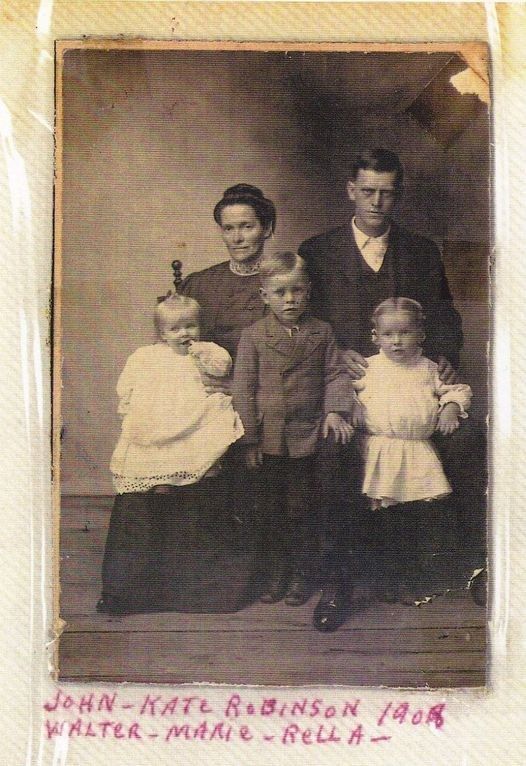
THE GROCERY STORE
At some point, J. W. Robinson and Son expanded. "By now Dad and Mom had built a new building for his business," Opal wrote, "and he added a grocery store — since he had six girls, plenty of help."
The description of what the store held is one of the richest passages Opal ever wrote about Des Arc: "There was always a stalk of bananas hanging in the window and a big bag of candy for a nickel. Pickles and crackers sold out of a barrel. Coffee sold in the grain because everyone had a coffee grinder then. Saturday was always a busy day, everyone came to town to get their blacksmithing done, and pick up the needed things from the store. Many of our groceries, shoes, and sewing materials were exchanged for their eggs, berries, chickens, and other farm commodities." The newspaper in Des Arc confirmed the enterprise. One item noted that J. W.
Robinson and Son were doing a big business with their wagon shop and also selling groceries. A classified advertisement under the firm's name read: "Wanted — A First-Class Blacksmith and Horse Shoer. Pay cash every Saturday night. Good wages and steady work." The business had grown large enough that John Wesley needed to hire. The store operated on the economy of exchange that still governed Iron County commerce in those years. Cash was scarce. Eggs, berries, chickens, and farm goods were not. People brought what they had and took what they needed, and the Robinsons kept track of the difference. It was a system that required trust on all sides and made neighbors into something closer to partners.7
KATIE
Katie ran the household side of this enterprise — the side that didn't show up in the newspaper. The surviving record is lopsided in the way that early-twentieth-century records almost always are: John Wesley left behind a business name, a classified advertisement, a letter in his own hand. Katie left behind an obituary and her daughter's memory. What she actually did — the labor that made all the rest of it possible — went unrecorded because no one thought to record it. "She was a splendid house keeper," Opal wrote. "Always had a good meal on time, which we enjoyed together. She had her garden, canned so many good things for winter. We had no gas and electric, so we had none of the nice conveniences we have today." Seven children, no refrigerator, no gas range, a kitchen that depended on what had been put up the previous fall. She managed it without complaint. Her daughter, writing about it
three decades after her death, still remembered this as the thing most worth saying: she never complained. What Opal described in a sentence was, in practice, a life of unrelenting physical labor. Des Arc had no electricity until the Black River Electric Cooperative began stringing lines through Iron County in 1938 — years after the Robinsons had already left. Every meal Katie cooked came off a wood-burning stove that had to be fed and tended and kept at temperature by feel. Every jar she canned — the green beans, the tomatoes, the berries and pickled vegetables that would carry the family through winter — was processed over that same stove in the dead heat of summer, in a kitchen with no fan and no ventilation beyond an open window.
Water came from a well. Laundry for nine people was scrubbed by hand on a washboard, wrung out, and hung on a line. Ironing required heating flatirons on the stovetop and pressing before they cooled. Monday was wash day, Tuesday was ironing, and by Friday Katie would have worked through the sewing, mending, baking, and shopping that kept the household running — only to start it all again the following week. She also had a garden, which in rural Iron County was not a hobby but a necessity — the main source of vegetables for a family of nine, and the raw material for the canning that would sustain them from October to May.
She kept chickens. She almost certainly helped in the grocery store, where her daughters worked the counter and where the barter economy meant tracking who owed what in eggs and berries and farm goods. She raised seven children through infancy and childhood in a place where diphtheria, typhoid, and scarlet fever could take a child in days, where the nearest hospital was hours away, where a mother's vigilance was often the only medicine available. She buried one of those children — Irma, thirteen years old — in January of 1934. And through all of it, she was, Opal insisted, a wonderful and loving mother. The Des Arc Missionary Baptist Church was the center of Katie's life outside the home.8
Her obituary called her "a faithful member" — the highest praise a community newspaper could offer a woman in 1946 — and Opal described Sunday School as "a very big part of our growing up." In a community without a library, without a theater, without much of anything beyond the traveling road shows that passed through on the wagon roads, the church was where women like Katie found fellowship, purpose, and an identity that belonged to them rather than to their husbands' businesses. The potluck dinners at the Modern Woodman Lodge, the Sunday walks in the woods, the swimming at Big Creek —
these were the rhythms of a life lived in common with neighbors, and Katie was at the center of all of them.
BIG CREEK ON SUNDAYS
They worked hard. They also swam. "Dad was never too tired to take us all swimming in Big Creek," Opal wrote. "On Sundays, he would take us all for walks in the woods." Big Creek runs through Iron County south of Des Arc, cold and clear in the way Ozark streams are — fed by springs, running over gravel, cutting through the hills on its way to the Black River. It was the same country John Wesley had grown up in, the same creek bottoms and ridges his father Ab had been riding for sewing machine commissions since before the children were born. On Sundays, after church and after Sunday School, John Wesley Robinson took his children into the water.
He was also president of the Modern Woodman Lodge — a fraternal organization that provided life insurance and community support for families in exactly the circumstances Iron County families found themselves in. The lodge gave potluck dinners. It was the kind of institution that turned neighbors into a safety net. "We attended all the little road shows that came into town," Opal added. The traveling shows — medicine shows, small theatrical troupes, whatever passed through on the wagon roads — were Des Arc events, things that drew the whole community out. The Robinson children were there for all of them.9
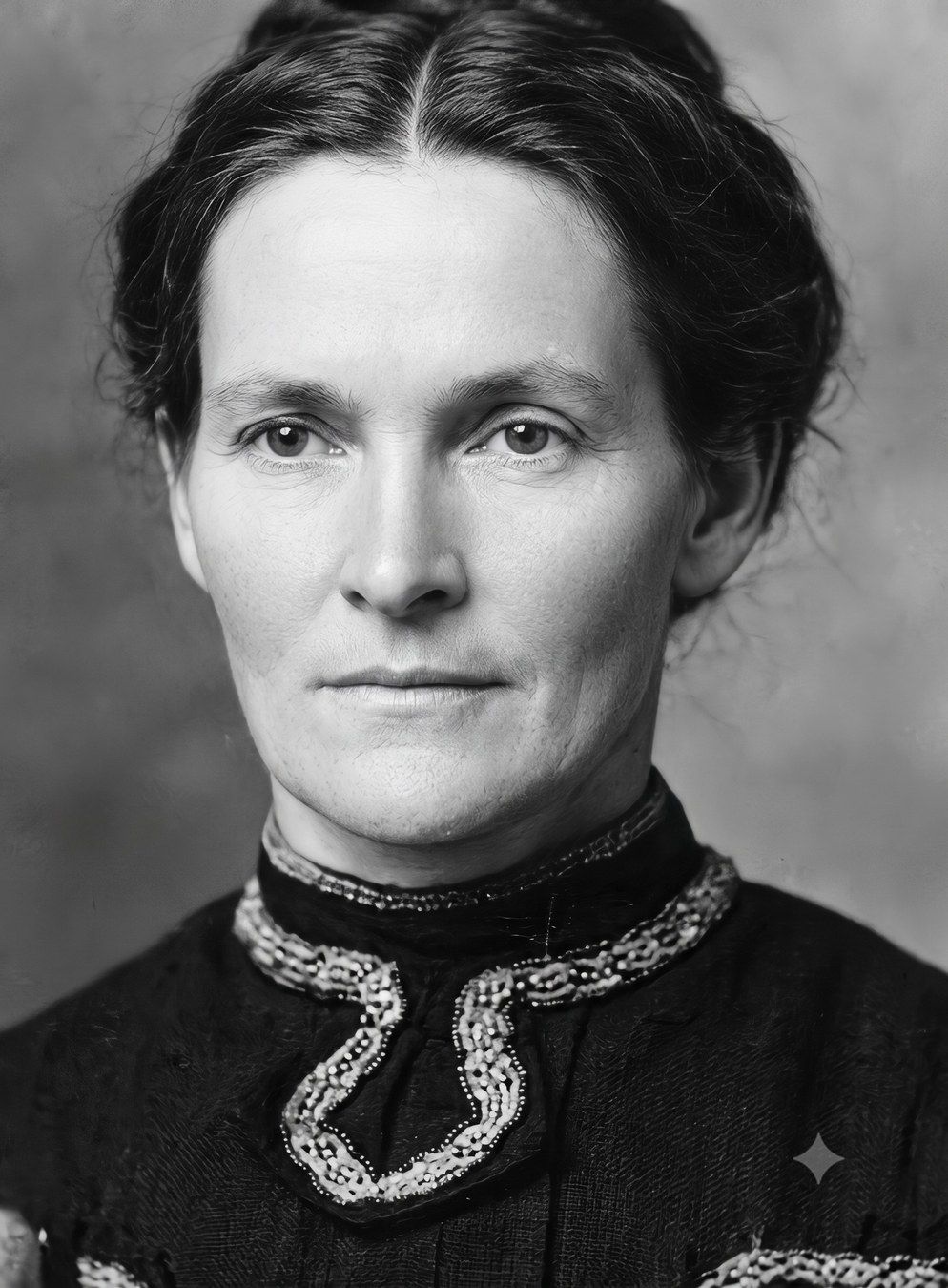
THE STORE OUTLIVED THEM
On February 2, 1928, the "Des Arc Items" column in the Iron County Register reported that J. W. Robinson had sold his blacksmith shop to a man named Charles Jones. The article noted that "Mr. Robinson will continue his mercantile business as usual." He was forty-seven years old, and he was letting go of the anvil. The store — the grocery with the bananas in the window and the pickles in the barrel — was now his sole enterprise. By 1925, a young man named Everett Seal had come to work at the Des Arc grocery, employed by Gene Fitz. Everett would marry Rella Robinson, one of J. W. and Katie's daughters. J. W. was still running his own mercantile in Des Arc as late as 1928 — and in a town as small as Des Arc, the trade and the family were never far apart.10
The family and the business were, as they had always been, the same thing. The Robinsons eventually left Des Arc for Sullivan and then Steelville. But the store did not close. In 1952, Everett Seal and Buford Lewis bought it outright and operated it as Seal and Lewis Grocery until Everett retired in 1972. Des Arc is a very small place. There was almost certainly only one store. The same counter where Katie Robinson had weighed out coffee in the grain and traded eggs for flour was still open for business nearly half a century later — still run by people connected to the family that had started it. Three of the book's four principal family lines — Robinson, Seal, and Lewis — passed through a single small-town storefront across three generations.
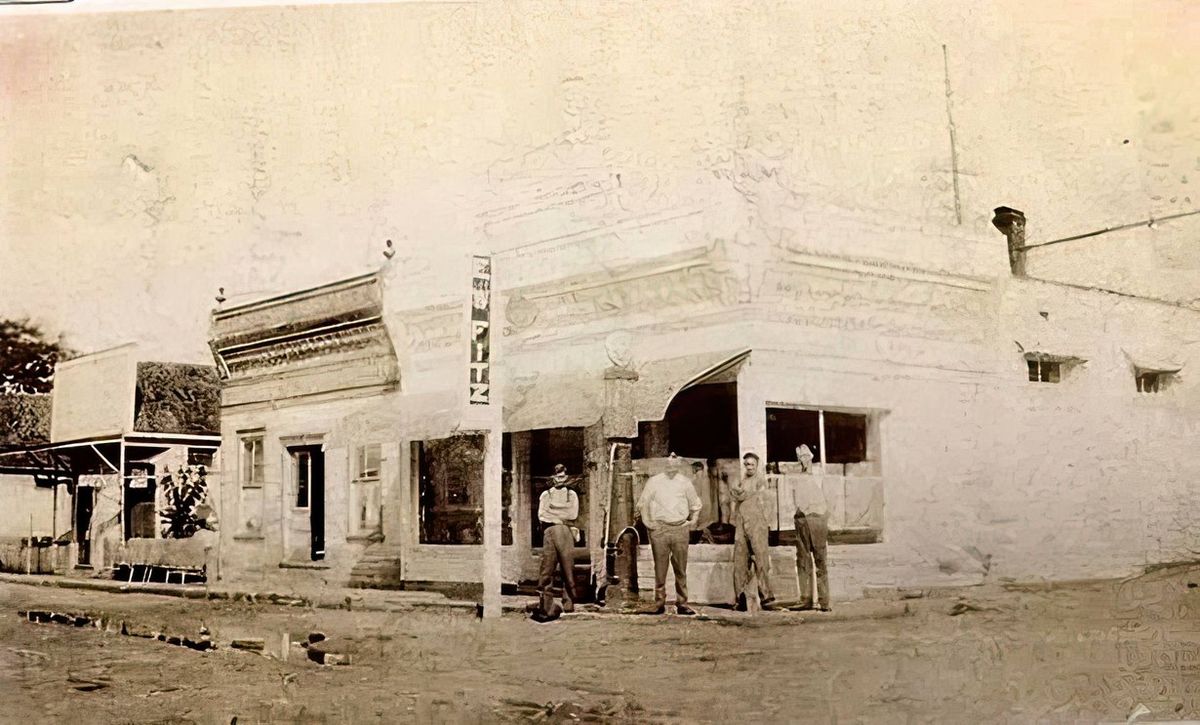
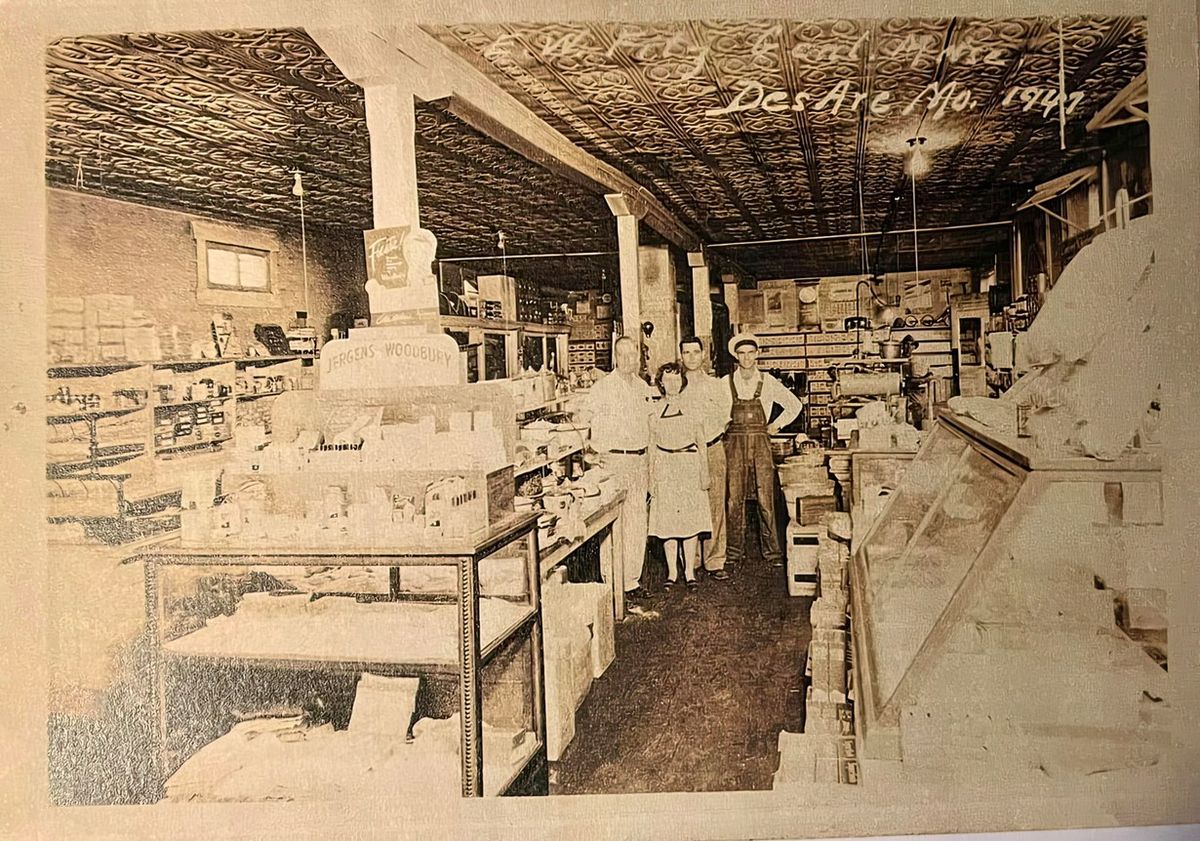
There is one more thread worth pulling, because it shows how tightly these families were already knotted before Everett Seal ever married into them. Orphaned young — his mother gone in 1911, his father in 1922 — Everett came of age under a guardian, and when he married in 1925, still shy of twenty-one, it was that guardian who signed his consent: J. M. Lewis. Almost certainly this was James Monroe Lewis, one of “Uncle Billy” Lewis’s sons — which is to say, a brother of Katie Lewis, whose daughter Rella was the very woman Everett was marrying.11
Thirteen years later, in 1938, Everett bought a piece of land east of town from that same J. M. Lewis. And the grocery he came to own he ran with Buford Lewis — a grandson of “Uncle Billy” Lewis, and the son of Everett’s own half-sister Zilla. A guardian who was also his bride’s uncle; the man who later sold him his land; a business partner who was his half-nephew — every thread a Lewis, all of them wound through one Seal who married one Robinson. In these hills, you did not so much marry into a family as discover how many ways you were already tied to it.
There is even a Mann thread, older than the rest. Everett’s father, John Polk Seal, had by an earlier marriage wed a Mann — Polly, a daughter of Isaac Mann of Logan Township — so that Everett’s older half-siblings, Zilla among them, carried Mann blood. Family genealogies hold that this Isaac was a brother of Arnold Mann — the same Arnold whose daughter, also called Polly, had married John Carter Rayfield Sr. back at the start of this story. No original record has yet surfaced to prove the two men were brothers; but they were born of the same Kentucky Manns within a year or two of each other, settled the same narrow valley, and came to rest in its same cemeteries. If the genealogies are right, the Manns the Rayfields married and the Manns the Seals married were one family — and the families of this book were knotted by one thread more than even they knew. One Seal knot, it turns out, does tie. Everett’s own Seals — his father, John Polk Seal — join the Seals on the Rayfield side: John Polk and Benjamin F. Seal, the father of Myrtle Lee Seal who married Franklin Rayfield, were brothers, both sons of John Seal Sr. That made Everett and Myrtle first cousins.12
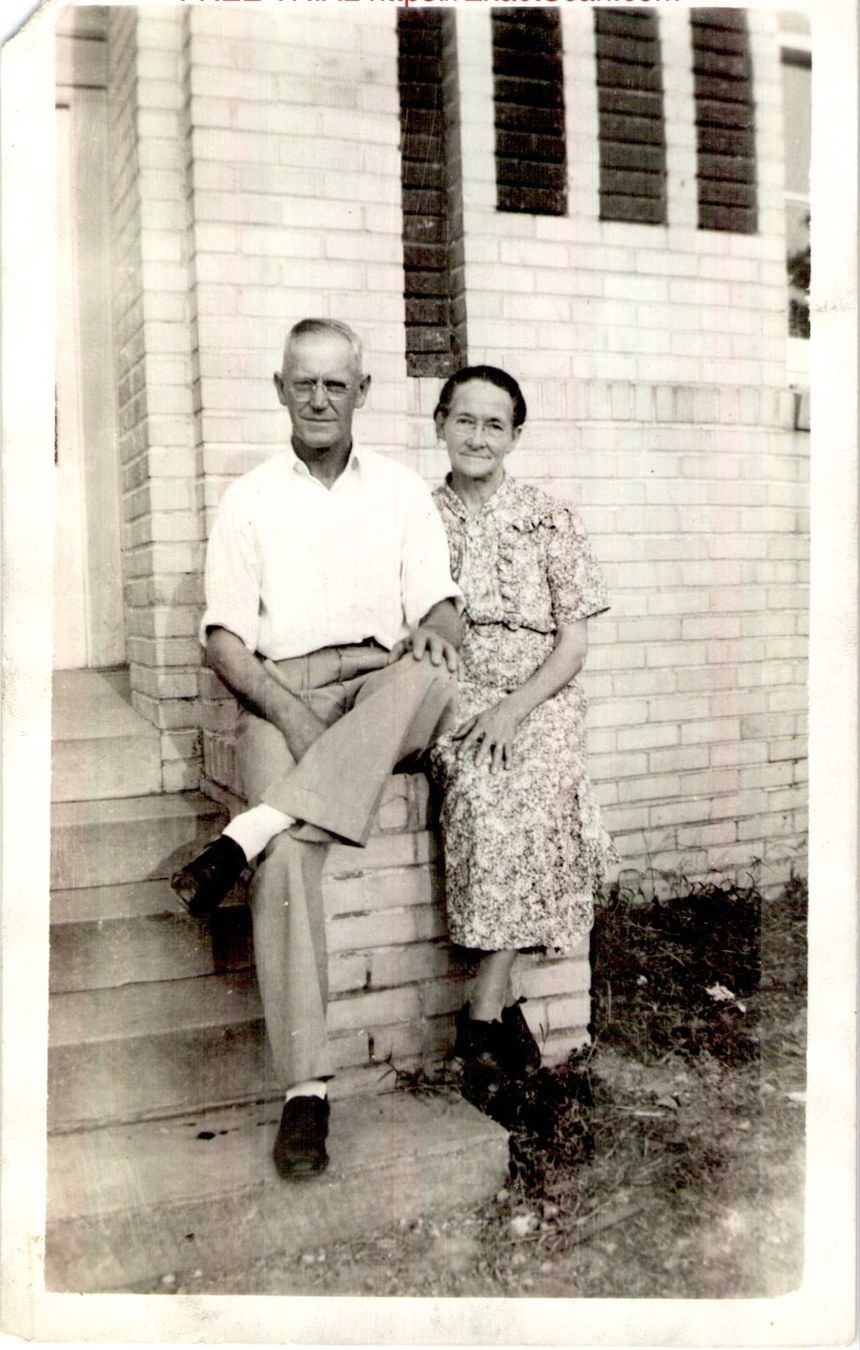
THE MOVE TO STEELVILLE
There were signs, even before they left, that the world John Wesley had built in Des Arc was shifting under him. The 1930 census no longer listed him as a blacksmith. It listed him as a truck driver. The same technology that had turned a teamster into a truck driver — the automobile — had also killed the demand for horseshoes, wagon wheels, and wagon repairs. The blacksmith shop that had sustained the family for two decades may already have been struggling by the time the Depression arrived to finish the job. The family left Des Arc sometime before 1934 — Irma's death certificate that January lists John Wesley's address as Sullivan, in Franklin County, about ninety miles north. They left behind the town where all seven of their children had been born, and where one of them was now buried. What followed was a restless decade. The 1940 census placed John Wesley and Kate in Eminence, Shannon County, where he listed his occupation as sawmill operator — but noted that he had been living in Sullivan, Franklin County, as recently as 1935. A December 1935 item in the Wayne County Journal-Banner found him briefly in Des Arc, calling on his daughter Rella — by then Mrs. Everett Seal — and on his father Ab, who was ill. He had purchased a truck and was hauling lumber from Doniphan to St. Louis. His home, the paper noted, was in Sullivan. By the time he wrote his last letter, in October 1941, the business had settled in Steelville, Crawford County, where the sawmill sat three miles east of town on Highway 8. The J. W. Robinson and Son letterhead from the Steelville years reads: "Manufacturers of Yellow Pine and Hard Wood Lumber, Steelville, Missouri." The blacksmith shop and grocery store were long behind them. Walter, the son who had grown up turning the forge handle, was now the one running the saw.13 John Wesley lived at the mill. He had a drilled well and a power pump and, he wrote to his half-brother, "lots of good water."
THE LAST LETTER
On Monday, October 27, 1941, John Wesley Robinson sat down at his desk in Steelville and wrote a letter to his half-brother, William Abslum Robinson, who was living in Fair Dealing, Missouri. John had just come home from nine days in a hospital in St. Louis. He had to go back in the morning. "The doctors I am about done working," he wrote, "but I am hoping that they are misstakeing." The letter is written in his own hand, in the direct unpunctuated cadence of a man who did not write often but wrote plainly when he did.14
He mentions that Walter had called Delbert and Namon the day before, trying to find a sawyer to cover while John Wesley was laid up, and that they couldn't come. He had heard that William Abslum's house had burned down and everything in it. "I sure hated to hear that," he wrote, "but I would a great deal rether have my house, and every thing burned up, and be well, than to be in hospital, not knowing whether I will ever be well any more or not." The letter is, among other things, a job offer. The mill needed a sawyer. John Wesley wanted his brother to come. He described the mill, the highway, the house at the mill, the water. "So come, or write us by return mail."
He signed it: "Your Brother, J. W. Robinson." Twenty days before John Wesley died, the Japanese attacked Pearl Harbor. On December 7, 1941, while he lay in whatever bed held him at the end — whether at home at the mill or back in the St. Louis hospital — the radio carried the news that would send the country into its second world war. His son Walter was thirty-five, young enough to be called up. His granddaughters and grandson were children of a nation now at war. The letter John Wesley had written in October, with its talk of sawyers and well water and hoping the doctors were mistaken, belonged to a world that no longer existed by the time he was buried. He had been born in 1880, the year James Garfield was elected president, into a world of horse-drawn wagons and hand-forged steel.15
He died twenty days after Pearl Harbor, in a nation mobilizing for a war that would be fought with aircraft carriers and atomic bombs. Everything between those two points — the forge, the grocery store, the satin-lined caskets, Big Creek on Sundays — fit inside a single life. On December 27, 1941, John Wesley Robinson died. The family placed a notice in the paper the following year, on the anniversary: "In loving memory of J. W. Robinson, who departed this life December 27, 1941. As we loved him, so we miss him, in our thoughts he lingers near, loved, remembered, longed for always, bringing many a silent tear. Sadly missed by wife, children and grandchildren."
THE AUCTION
After John Wesley died, Walter carried on the mill in Steelville alone. Katie eventually returned to Des Arc. On a Saturday, June 8 — the year is not printed on the flyer, but the context suggests the mid-1940s — Walter L. Robinson organized a public auction at his mother's home in Des Arc. The items listed tell the story of a household being dispersed: a dining table and six chairs, a buffet, an enamel cook stove, a good ice box, a kitchen cabinet. A Good Bruce Sewing Machine. A Jenny Lind bed. Two pairs of bed springs. Two mattresses. A feather bed. Two wool rugs. An electric iron. An electric toaster. Curtain stretchers. Someone, at the auction or just before it, wrote prices in pencil on the flyer. The handwriting is small and practical. The sewing machine sold. Everything sold. The terms were cash.16
PINE LAWN
Katie Robinson did not stay long in Des Arc after that. She moved to Pine Lawn, Missouri — a community in St. Louis County — to live with her daughter Opal and Opal's husband Vernon Rayfield. It was the same arrangement that women of her generation and circumstances made: when the house was too large and the years too many, you went to your children. She died there on Saturday, May 18, 1946, at the age of sixty-seven years, five months, and twenty days. The obituary that appeared in the local paper described her as "a faithful member of the Des Arc Missionary Baptist Church" — a woman defined, in the accounting of community newspapers, by her faith and her family.17
She left behind six living children: Walter in Steelville, Marie Miller, Rella Seal in Des Arc, Opal Rayfield in Pine Lawn, Mildred Burgess, and Mabel Pierce in Overland. One daughter, Erma Maxine Robinson, had preceded her in death on January 20, 1934. She left four granddaughters and a grandson. She had been born in Iron County and she died in a St. Louis suburb, in her daughter's home, having outlived her husband by four and a half years. The world between those two points — Annapolis, Des Arc, Big Creek in summer, the forge turning, bananas in the window, the smell of satin and sawdust — was the world her daughter Opal would still be writing about thirty years later.
Notes
1. Katherine “Katie” Lewis’s birth (28 November 1878, Annapolis, Iron County), daughter of William John Lewis and Abigail Johnson (see Chapter Five); her obituary refers to “the late Wm. and Abbiegill Lewis.” ↩
2. John Wesley Robinson’s birth (18 March 1880); his listing as a teamster in the 1900 U.S. census (in Absalom Robinson’s household, Iron County); and his description (tall, light hair, light blue eyes) on his September 1918 WWI draft registration card, which records him as a self-employed blacksmith at Des Arc. ↩
3. Marriage of John Wesley Robinson and Katie Lewis, 30 November 1902, Des Arc, Missouri (marriage record). The household is described in Opal Rayfield, “A Tribute to My Parents in This Bicentennial Year Because They Left Their Mark,” 1976 (family papers) — hereafter Opal’s 1976 memoir. ↩
4. The blacksmith shop and the children turning the forge handle are described in Opal’s 1976 memoir. ↩
5. The wagon-manufacturing business, 1909–1920 — the 1909 partnership with P. B. Powers and the six-horsepower International Harvester engine; production of roughly a wagon every two weeks by 1911; Robinson’s buyout of Powers in December 1911; the 1913 illness and recovery; the “wagon factory” employing several men by 1919; and his Ford automobile by 1920 — is documented in the Arcadia Valley Enterprise and Iron County Register, 1909–1920 (ARN0000257–ARN0000269). ↩
6. John Wesley’s casket-making is described in Opal’s 1976 memoir; the death of the Robinsons’ daughter Irma (Erma Maxine), 20 January 1934, at Washington, Missouri (age 13; laryngeal diphtheria; tracheotomy performed the day she died; informant John Wesley Robinson): Missouri death certificate. ↩
7. The grocery store — the bananas in the window, coffee sold in the grain, barter for eggs and berries — is described in Opal’s 1976 memoir; the firm’s classified advertisement (“Wanted — A First-Class Blacksmith and Horse Shoer”) and its “big business” in wagons and groceries appear in the Iron County Register. ↩
8. Katie’s household labor and her membership in the Des Arc Missionary Baptist Church are from Opal’s 1976 memoir; on the arrival of electricity through the Black River Electric Cooperative (1938) and the rural electrification movement, D. Clayton Brown, Electricity for Rural America: The Fight for the REA (Westport, Conn.: Greenwood Press, 1980). ↩
9. Big Creek swimming, the Modern Woodmen lodge potlucks, and the traveling road shows are from Opal’s 1976 memoir. ↩
10. John Wesley Robinson’s sale of the blacksmith shop to Charles Jones, reported in the “Des Arc Items” column, Iron County Register, 2 February 1928. ↩
11. Everett Seal’s 1925 guardianship consent, signed by J. M. Lewis (probably James Monroe Lewis, a son of “Uncle Billy” Lewis and a brother of Katie), his 1938 land purchase from the same J. M. Lewis, and his grocery partnership with Buford Lewis: guardianship and deed records; see also Chapter Five. ↩
12. Everett Seal’s father, John Polk Seal (1850–1922), had earlier married Polly Mann, a daughter of Isaac Mann of Logan Township. John Polk and Myrtle’s father, Benjamin F. Seal (1859–1944), were brothers — both sons of John Seal Sr. — so that Everett and Myrtle were first cousins: John Polk is recorded as Benjamin’s brother, the 1873 Isaac Mann estate suit names “John P. Seal Jr.” (Chapter Four, note 5), and Benjamin’s obituary names their parents as John and Anna (Vance) Seal (Chapter Four, note 14). ↩
13. The family’s later moves — the 1930 U.S. census (John Wesley a truck driver), the 1934 residence at Sullivan (per Irma’s death certificate), the 1940 U.S. census at Eminence, Shannon County (sawmill operator), and the Steelville mill — are documented in the 1930 and 1940 censuses and the “J. W. Robinson and Son” letterhead (“Manufacturers of Yellow Pine and Hard Wood Lumber, Steelville, Missouri”). ↩
14. Letter, John Wesley Robinson to his half-brother William Abslum Robinson, 27 October 1941, Steelville, Missouri (family papers). ↩
15. John Wesley Robinson’s death, 27 December 1941, Steelville, Crawford County (Missouri death record); a memorial notice was published on the anniversary in 1942. ↩
16. Public auction flyer, Walter L. Robinson, auctioneer, at his mother’s home in Des Arc, 8 June [ca. mid-1940s] (family papers). ↩
17. Katherine (Lewis) Robinson’s death, 18 May 1946, at Pine Lawn, St. Louis County; her obituary identifies her as “a faithful member of the Des Arc Missionary Baptist Church”; buried Mountain View Cemetery, Des Arc. ↩
PART III
The House in Piedmont
Chapter Eight
Vernon & Opal Rayfield1909–1977 / 1911–2002
TWO DES ARC FAMILIES
Vernon Jack Rayfield was born on September 9, 1909. His birthplace is recorded variously as Reynolds County, Piedmont, and Union in Iron County — the discrepancy is common in rural Missouri records, where county lines were close and families moved between Iron and Reynolds the way people moved between rooms. What is certain is that he was born into the Ozarks, the third child and second son of Franklin Peter Rayfield and Myrtle Lee Seal, in a household that would eventually hold seven children. By 1920, Vernon was nine years old, living with his parents and siblings in Webb, Reynolds County, on the mortgaged farm where his father still worked the land. He attended Buffington School — a class photograph from 1921–1922 survives, listing the names of students including Vernon Rayfield and his brother Jesse. Opal Myrtle Robinson was born on June 11, 1911, in Des Arc, Iron County, Missouri — the daughter of John Wesley Robinson and Katherine "Katie" Lewis Robinson.1
She was the fourth of seven children, and she would outlive every one of them — the one who would carry the family's stories forward. She grew up in the blacksmith's household — the shop where her father bent horseshoes from straight steel and made caskets lined with satin, the grocery store where bananas hung in the window and coffee sold by the grain, the house where her mother Katie cooked on a wood-burning stove and canned through every summer without complaint. Opal's childhood is the childhood she would describe in 1976, in a tribute she wrote for the nation's bicentennial: Big Creek on Sundays, the forge handle after school, the road shows that came through town, the Sunday School that was "a very big part of our growing up." She was sixteen years old when she married Vernon Rayfield.2
OPAL’S DES ARC
The Iron County Register, the weekly paper that served the small communities of Iron County, kept track of social comings and goings — visitors arriving, trips taken, school events, community programs. Opal Robinson appeared in its Des Arc column regularly in the years before her marriage, not for any single dramatic event but in the accumulation of small notices that, taken together, tell something about a young woman’s life in a small Missouri town in the 1920s.
She had friends from near and far. In July 1925, a Miss Lewis from Flat River was visiting her; two summers later, a young woman named Grace Lewis — also from Flat River — came again. Between those two visits, in the summer of 1927, a friend named La Verta McClain made the trip from Annapolis. The visitors were steady. Opal’s home was evidently the kind of place people came to.
Her closest running companion in this period was Nellie Stamp. In September 1927, the Register noted that the two of them had just returned from a trip to St. Louis together — a journey of some distance for young women from a town without a depot, and the sort of thing the paper thought worth recording. Georgia Davidson was another regular presence. In March 1927, Opal was part of a group that traveled to Ironton for a Fiddlers’ Contest, a party that included Georgia, Maxine Fitz, Everett Seal and his wife, Everett Lewis and his wife, and several others. The following April, Opal was in a party of Des Arc residents who drove to Piedmont to see the senior class play — the same Georgia Davidson, Maxine Fitz again, Earl Seal, and a Mr. and Mrs. P. Rayfield. That Rayfield name almost certainly belonged to Franklin Peter Rayfield — Vernon’s father — then residing in Iron County.
Opal was also engaged in school life. In May 1927, County Superintendent Hanson presided over the eighth-grade graduation at the Baptist Church in Des Arc, and Opal Robinson received her diploma alongside a handful of classmates. She continued her education that fall, and by the winter of 1927–1928 she was participating in high school debates and, at least once, filling in as a substitute teacher for a regular instructor. In September 1927, she had been selected to read the Eighteenth Amendment aloud at a public school program — a civic act before an evening audience, performed by a sixteen-year-old in a dry county in the middle of the Prohibition era.3
The notice that placed her at a high school debate appeared on January 26, 1928. On that same day, Vernon Rayfield’s car overturned south of Sabula; among the passengers were Nellie Stamp and Georgia Davidson, two of Opal’s closest friends. Opal was not in that car. The next morning, she and Vernon went to Annapolis and took out a marriage license.4
THE MARRIAGE
On January 27, 1928, in Annapolis, Iron County, Missouri, Vernon Jack Rayfield and Opal Myrtle Robinson were married by a minister of the gospel. The marriage license, preserved in the Iron County records, tells the story in the language of legal formality: both parties were under the age of twenty-one. Vernon was eighteen. Opal was sixteen. Because they were minors, the law required parental consent. The license records that "the mother (Myrtle Rayfield) of the said Vernon Rayfield and the mother (Katie Robinson) of the said Opal Robinson giving their assent in person to the said marriage." Both mothers came. Both mothers signed.5
The fathers — Franklin Peter Rayfield and John Wesley Robinson — are not mentioned on the consent line, though both were living. Whether they were present, whether they approved, whether the mothers acted alone because the fathers were working or indifferent or simply not required by the clerk's procedure, the document does not say. Eleven months later, on December 9, 1928, their first daughter was born: Charlene Marie Rayfield, in Des Arc. A second daughter, Shirley Joyce, followed on July 30, 1931, in Webb, Reynolds County. The young couple was building a family in the same Iron and Reynolds County country where both of them had grown up. But they would not stay.6
THE CITY
By 1933, Vernon and Opal were living in St. Louis — at 3811a North 23rd Street, according to the city directory, which listed Vernon's occupation as chauffeur. They had left the Ozarks for the city, as thousands of young rural Missourians did during the Depression, looking for work that the hollows and ridge farms could no longer provide. The Depression years were lean. During those hard years, Vernon worked for Nabisco — the National Biscuit Company — and sometimes the only food in the house was what he brought home from work. Opal would take Nabisco vanilla wafers, mash them into a small cup of milk, and that was supper. Decades later, she would make the same mixture for her grandchildren as a sweet snack — mashing the wafers into milk the same way she had done when it wasn't a treat but a necessity. To them it was just something sweet from Grandma — but she always told them where it had come from.
By 1950, the census found Vernon still driving for Nabisco — listed as a driver for a "Wholesale Bakery Co." (the census enumerator's generic description of Nabisco's business), working forty-five hours a week. The household on Pasadena Street in St. Louis had grown. Vernon was forty, Opal thirty-eight. Their youngest, Michael Vernon Rayfield, was one year old — born January 26, 1949. Their oldest daughter Charlene, now twenty-one, had married Douglas Quinton Haig and was living in the household with her husband.
Their second daughter Shirley Joyce, eighteen, had married Alvin M. Schultz, also in the household. A fourth child, Jack Stephen Rayfield, would arrive on March 15, 1957 — nearly thirty years after the first. Opal was forty-five years old, three months shy of her forty-sixth birthday. That is extraordinary by any era’s measure. She had already raised two daughters through the Depression, watched them both marry and move on, and started again with Michael in 1949. Now, at forty-five, she was starting over once more — the sleepless nights, the feedings, the full physical demand of a newborn on a body that knew exactly how hard that work was. Whatever reserves she had, she used them. Four children spanning three decades: Charlene (1928), Shirley (1931), Michael (1949), Jack (1957). The gap between Shirley and Michael — eighteen years — is the gap of the Depression, the war, and the slow rebuilding that followed. Whatever those years cost Vernon and Opal, the record keeps its silence.7
THE WAR YEARS AND THE MILL
In February 1941, Vernon registered for the World War II draft. His registration card, dated February 25, 1941, captures a moment of transition. His address is listed as "Eminence, Mo. c/o J. W. Robinson and Son" — he was working at his father-in-law's sawmill in Shannon County. His employer was Harley Construction Co., with a place of business at 12th and State Street, Chicago, Cook County, Illinois. The person who would always know his address was listed as "Mrs. Opal M. Rayfield, Wife" — at 5679 West Lake Street, Chicago. The card places Vernon in Eminence and Opal in Chicago — an arrangement that likely reflects the chaos of a family managing multiple obligations at once.8
John Wesley Robinson was dying. His October 1941 letter, written from the Steelville mill, makes clear that he knew the end was coming. Vernon appears to have gone to Eminence to help keep the Robinson sawmill running while his father-in-law was hospitalized. Opal may have been in Chicago briefly — her daughter Charlene's husband Douglas Haig had family there, and the 1940 census places the Haig family on West 63rd Throop Street in Chicago. Opal did not live in Chicago. She was visiting, or helping, while the family navigated a difficult year. It became more difficult. Vernon's own father, Franklin Peter Rayfield, died on January 16, 1941 — just weeks before Vernon filled out the draft card. John Wesley Robinson died
on December 27, 1941, twenty days after Pearl Harbor. In the span of eleven months, Vernon and Opal lost both of their fathers. Katie Robinson, now widowed, eventually came to live with Opal and Vernon in Pine Lawn, a community in St. Louis County. She died there on May 18, 1946. Myrtle Lee Seal Rayfield, Vernon's mother, outlived them all — she died on July 1, 1968.9
A SERIOUS ACCIDENT
On Thursday, February 9, 1928, the Wayne County Journal-Banner in Piedmont ran a brief item: "A serious accident happened on the highway recently. Mr. and Mrs. Vernon Rayfield, Misses Nellie Stamp and Inez Lewis started to church at Annapolis in a car and collided with a truck, which caused their car to overturn. Mrs. Rayfield and Miss Stamp were cut about their heads. The others were not hurt, both cars were pretty badly damaged." Vernon and Opal had been married less than two weeks.10
They were driving back to Annapolis — the town where they had stood at the altar on January 27 — to attend church. The car overturned. Opal was cut about the head. They survived. The detail that they were on their way to church — not to work, not on an errand, but to worship — says something about what anchored their week even in the years when everything else was uncertain. The detail that the bride and groom were doing it together, only days into the marriage, says something about how that marriage began.
WELL HOLLOW
The Rayfield family kept one tradition that connected the generations: gatherings at Well Hollow — a valley in Reynolds County, in the upland country a few miles north of Piedmont, where the land slopes down toward the Black River. Michael Rayfield, Opal and Vernon's son, remembered it as an area on land near the Black River, land that had been in the family for some time. Extended families attended — not just Rayfields, but Seals, Buffingtons, and Skaggs.
There were five cabins on the property. The men fished all week — including noodling for catfish, sticking their arms into holes along muddy riverbanks — and gigging sucker fish. There was a large concrete pad with wood beam structures above it. A cousin would break out a fiddle, the dancing would start, and the families would square dance well into the night. The men cleaned and fried the fish caught that week. There was blackberry cobbler. So much food.
She remembered the gatherings from a child's perspective: "Those old folks really knew how to party — and so much love and laughter. As a youngster, our parents would send us to bed, but we wouldn't sleep for hours, listening to all the antics of our big extended family." One family story, repeated often: Uncle Alvy — Shelley's grandfather — was said to be immune to snake bites. He had been bitten so many times by venomous snakes while noodling that the venom no longer affected him. Shelley laughs at the immunity part herself. What she will vouch for is that Alvy loved snakes and had a taste for pranks — he once slipped a live one into someone's car.11
Well Hollow was where the Rayfield and Seal and Buffington lines came together, not in a genealogical chart but in a clearing by the river, with a band playing and fish frying and children listening from their beds. It was the living version of the family connections that the documents only hint at.
PIEDMONT
Eventually, Vernon and Opal came home — not to Des Arc or Iron County, but to Piedmont, in Wayne County, just south of where both of their families had lived for generations. The Social Security Death Index lists Vernon's last residence as Piedmont, Wayne County, Missouri. In December 1972, Opal was granted a letter of dismission from one church to unite with the United Methodist Church in Piedmont. The record is small — a single line in a church ledger — but it marks the moment when Piedmont became permanent. They were home. Vernon Jack Rayfield died on November 9, 1977, in Ironton, Iron County, Missouri. He was sixty-eight years old. He and Opal had been married for forty-nine years — one year short of half a century. He was buried in Mountain View Cemetery in Des Arc, where his father-in-law and the generations before him already lay.12
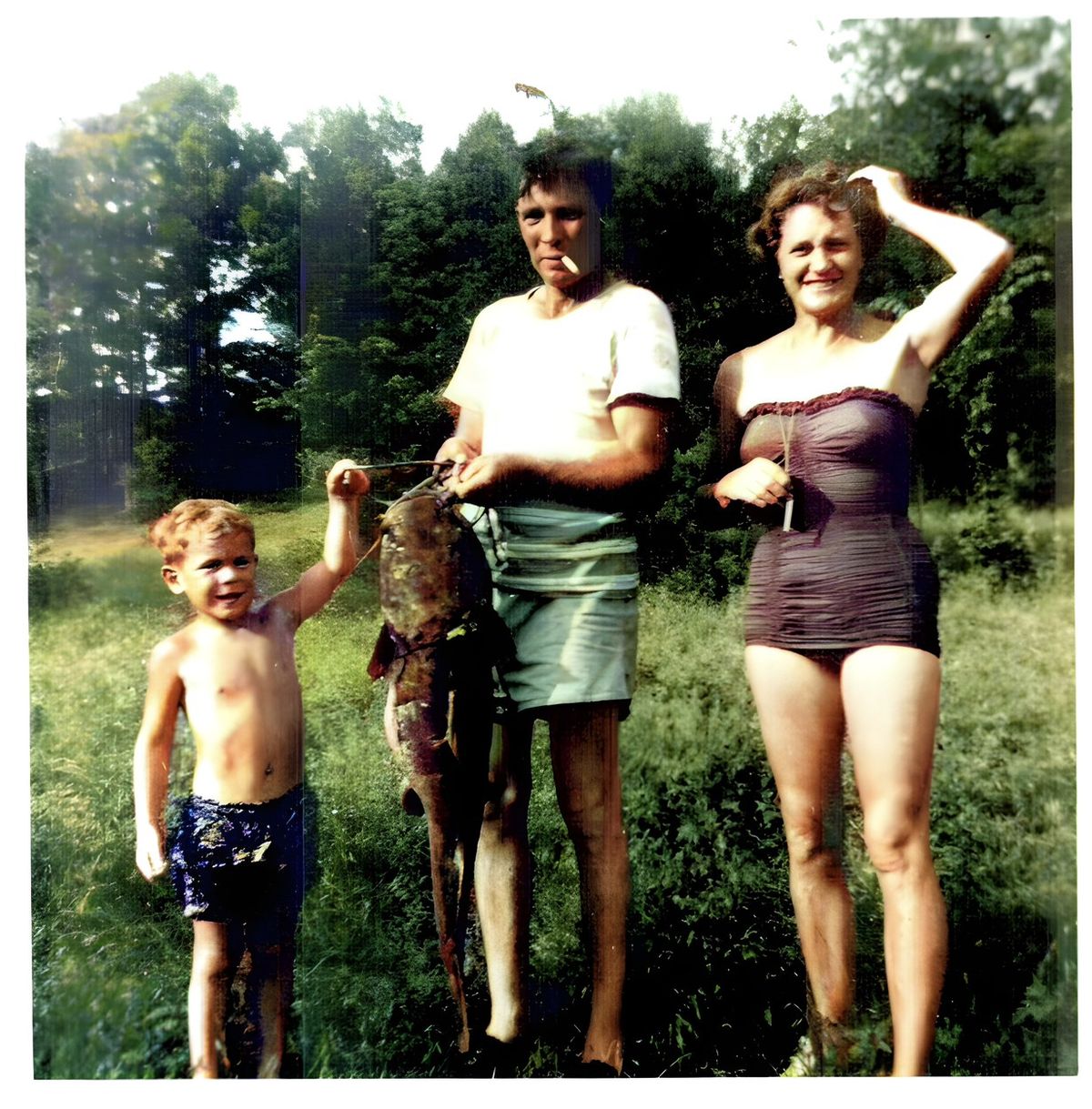
THE KEEPER OF STORIES
After Vernon's death, Opal lived another twenty-five years. She had already begun the work that would matter most. In 1976 — the year before Vernon died — she had written "A Tribute to My Parents in This Bicentennial Year Because They Left Their Mark," the document that preserves the daily life of the Robinson household in Des Arc: the forge handle, the caskets, the bananas in the window, Big Creek

on Sundays. Without that tribute, most of what we know about John Wesley Robinson's blacksmith shop and Katie's kitchen would be lost. Opal wrote it down because she understood that no one else would.13
She lived at Rural Route 3, Piedmont, Missouri. Her neighbors included a woman named Ann Worley and another known only as Dolly. She kept the connections to Des Arc and Iron County alive — the church, the cemetery, the family names that had been woven through that valley for a hundred years. She watched her children and grandchildren grow. She mashed vanilla wafers into milk for them and told them why. The things that had anchored her own childhood, she rebuilt for her grandchildren’s.
When Andrea and her sister Michelle came down from St. Louis each summer, she took them to Bible school at her church in Piedmont, just as Sunday school had been “a very big part” of her own growing up. The congregation came to know the two city girls and watched for them every year, with pool parties and barbecues in the church yard. She took them swimming, as her own father once had, in the cool Ozark water under a big bridge — Big Creek or the Black River; memory has blurred which. She was handing them, almost without their knowing, the very things that had been handed to her.14
She carried the stories — her parents' stories, her husband's family's stories, the stories of Des Arc and the Ozarks and the families that had built something out of hard ground and harder times — into a century that could scarcely imagine the world she had been born into. Opal Myrtle Robinson Rayfield died on July 23, 2002, in Bridgeton, Missouri. She was ninety-one years old. She was buried in Mountain View Cemetery in Des Arc, Iron County — beside Vernon, in the ground where so many of their people already lay. If you walk the rows of Mountain View today, you will find the names from this book carved into stone after stone. Mann. Seal. Lewis. Rayfield. Robinson. Dickson. Buffington. Skaggs. Buffington. Skaggs. The families who had walked into Iron County from Tennessee and Kentucky and North Carolina a century and a half earlier — who had married each other’s daughters, worked each other’s land, bought goods at each other’s stores, and built caskets for each other’s children — came to rest, in the end, on the same hillside. The community that formed along the Black River bottoms is still there, in a sense — quieter now, but together. One heirloom survived the full passage.
Katherine Lewis Robinson's Bible — black leather, stamped with her name, carrying the patina of a century of handling — passed from Katie to Opal, who added a page in her own hand listing the names and birth dates of her grandchildren. After Opal's death, the Bible moved through the family: to Charlene, and eventually to Charlene's granddaughter Brandy. When Andrea Harter, Michael's daughter, began researching the family's history and reached out to ask about heirlooms, Brandy surprised her by mailing the Bible — not a photograph, but the thing itself.15
It sits now in a marble box trimmed with acacia wood, on a shelf in Andrea's office, beside other mementos of the family whose story this book tries to tell. "But this is my family," Opal wrote in 1976, "and we were a very close one. So I remember it best."
Notes
1. Opal Myrtle Robinson’s birth (11 June 1911, Des Arc, Iron County), daughter of John Wesley and Katie (Lewis) Robinson; Vernon Jack Rayfield’s birth (9 September 1909) is recorded on the 1910 U.S. census, his World War II draft card, and Find a Grave. ↩
2. Opal’s Des Arc childhood is drawn from Opal Rayfield’s 1976 memoir (see Chapter Seven, note 3). ↩
3. Twelve social and school notices for Opal Robinson, 1925–1928, in the Des Arc column of the Iron County Register (ARN0000285–ARN0000295, ARN0000279): her visitors, a 1927 Fiddlers’ Contest at Ironton, a senior-class play at Piedmont, her eighth-grade graduation and high-school debates, and her September 1927 reading of the Eighteenth Amendment at a school program. ↩
4. The 26 January 1928 school-debate notice and Vernon Rayfield’s car accident near Sabula the same day: Iron County Register, 26 January 1928. ↩
5. Marriage of Vernon Jack Rayfield and Opal Myrtle Robinson, 27 January 1928, Annapolis, Iron County; both under twenty-one, with consent in person by their mothers, Myrtle Rayfield and Katie Robinson; J. M. Hawkins, Circuit Clerk (Missouri marriage records). ↩
6. First daughters Charlene Marie (b. 9 December 1928, Des Arc) and Shirley Joyce (b. 30 July 1931, Webb, Reynolds County) (birth records). ↩
7. The St. Louis years: 1933 city directory (Vernon Rayfield, 3811a North 23rd Street, chauffeur); the Nabisco employment and the vanilla-wafers-in-milk story from Michael Rayfield’s oral history; and the 1950 U.S. census (Vernon, 40, driver for a wholesale bakery — Nabisco — on Pasadena Street, with son Michael, 1, and married daughters Charlene Haig and Shirley Schultz in the household). Michael Vernon Rayfield was born 26 January 1949; Jack Stephen Rayfield, 15 March 1957, whose birth was announced in the Wayne County Journal-Banner (Piedmont, Mo.), 21 March 1957. ↩
8. Vernon’s World War II draft registration card, 25 February 1941, listing his address as Eminence, Missouri, c/o J. W. Robinson and Son, his employer as Harley Construction Co. (Chicago), and Opal at a Chicago address. ↩
9. The deaths of Vernon’s and Opal’s fathers within eleven months (Franklin Peter Rayfield, 16 January 1941; John Wesley Robinson, 27 December 1941), of Katie Robinson (1946), and of Myrtle Lee Seal Rayfield (1 July 1968): see Chapters Four and Seven and their notes. ↩
10. “A Serious Accident,” Wayne County Journal-Banner (Piedmont, Mo.), 9 February 1928, reporting the collision on the way to church at Annapolis involving Mr. and Mrs. Vernon Rayfield, Nellie Stamp, and Inez Lewis. ↩
11. Well Hollow and the family gatherings: Shelley Buffington Hoffman (granddaughter of Alvy Buffington), personal communication, May 2026, and Michael Rayfield’s oral history; the site is Well Hollow, Reynolds County (USGS Geographic Names Information System, Feature ID 728495). ↩
12. Vernon Jack Rayfield’s death, 9 November 1977, Ironton, Iron County (obituary, Wayne County Journal-Banner [Piedmont, Mo.], 17 November 1977; Social Security Death Index; last residence Piedmont, Wayne County); Opal’s December 1972 letter of dismission to the United Methodist Church of Piedmont; burial at Mountain View Cemetery, Des Arc (Find a Grave). ↩
13. Opal Rayfield’s 1976 memoir preserves the daily life of the Robinson household in Des Arc; without it, most of what is known of John Wesley’s shop and Katie’s kitchen would be lost. ↩
14. Opal’s summers with her granddaughters Andrea and Michelle (Bible school in Piedmont, swimming in the Ozark water) are from family recollection. ↩
15. Opal Myrtle Robinson Rayfield’s death, 23 July 2002, Bridgeton, Missouri (Find a Grave; obituary indexed at Newspapers.com). Katherine Lewis Robinson’s Bible passed from Katie to Opal to Charlene Marie Rayfield to Charlene’s granddaughter Brandy to Andrea Harter (family papers). ↩
Chapter Nine
What the DNA
Tells Us
CONFIRMED BY DNA
There is one more thread to pull, and it's a modern one. For years before October 2020, Andrea Harter — John Carter Rayfield's third-great-granddaughter — had been hunting for a copy of a Rayfield genealogy that older Ancestry forum posts kept mentioning. The book had been compiled, the posts said, by a researcher named Eddy Pratt. It was out of print. It wasn't for sale at any bookseller she could find. It wasn't in any catalog she could search. It wasn't at any used shop she could call. Dead end after dead end. Eventually, after years of looking, she tracked down where a copy lived. She picked up the phone and asked if she could see it. "Sorry," the voice on the other end told her, more or less. "That copy is in the cave." The cave, the voice explained, was the Granite Mountain Records Vault — the LDS Church's archive of rare records, blasted six hundred feet into the side of a mountain in Little Cottonwood Canyon, Utah.
The man on the phone was kind about it. Over the next several days, he reached out to colleagues to see if anyone had a digital copy. Nobody did. He called back, regretful: the book was in the cave, the cave was not going to open, and there was nothing more he could do. Pratt's name kept turning up in old Ancestry forum posts — but with no live link to his profile, no clickable username, no obvious way to reach him. She cold-messaged every Eddy Pratt she could find on Ancestry.com. Four of them. None was the right one. One evening, she gave up on Ancestry and started Googling. She tracked down an Eddy Pratt at a Tennessee law firm. She sent a cold email at 8:42 p.m. her time. Six minutes later, he wrote back. His mother had been a Rayfield. How could he help?
Pratt's draft — careful, source-heavy, the document that pushed the family line back to a 1703 colonial courthouse in Pasquotank Precinct, North Carolina — eventually made its way to her inbox. Before long, the two were corresponding as cousins. Cousins is, in fact, what they turned out to be. To confirm — or disprove — the paternal line, Pratt suggested a Y-chromosome DNA test. Y-DNA passes essentially unchanged from father to son, generation after generation; if two men share a common male-line ancestor, their markers will match. Andrea persuaded her father, Michael Rayfield, to submit a 37-marker yDNA test through Family Tree DNA, with the kit uploaded to the dedicated Raffield-Rayfield haplogroup project. The test went off in November 2020.
The results placed Michael's paternal line in a haplogroup called I-P37 — a confirmation strong enough that the I-P37 Project at FamilyTreeDNA invited his kit to join their study group in January 2021, with a follow-up invitation that May. The match list has kept growing since: as recently as January 2026, new Y-DNA cousins were still surfacing. In plain terms: the paper trail from John Carter Rayfield Sr. back through Isaac, William Jr., and William Sr. the 1703 immigrant — assembled from wills, deeds, censuses, and colonial court minutes — is corroborated by the genetic signature carried in living men. The lineage in this biography isn't just well-documented. It's confirmed in the blood. But here is the part of the story worth lingering on, because it goes much further back than 1703.
TWENTY THOUSAND YEARS
A Y-DNA test works on a simple piece of biology: every man inherits a Y-chromosome from his father, who got it from his father, and so on, back to the first male humans. Each generation, the Y-chromosome copies itself with very small, traceable changes — a letter here, a letter there — that get passed down and never disappear. Those small changes are mile-markers. By comparing the pattern of mile-markers in one man's Y-DNA against a database of thousands of others, geneticists can trace where his paternal line has been — sometimes going back not just hundreds of years, but tens of thousands.
Michael Rayfield's Y-DNA places him in haplogroup I-P37. A haplogroup is a major branch on the family tree of all men on Earth. Every man alive today descends, by Y-chromosome, from a single male who lived in Africa about 230,000 years ago — geneticists call him Y-chromosomal Adam. From him, the line branched. Then branched again. And again. I-P37 is one of those branches. Here is what we know about it. Roughly 21,000 years ago — during the last Ice Age, when much of northern Europe was still buried under glaciers — a man living somewhere in southern or eastern Europe carried the mutations that would come to define the I-P37 paternal line.
He had sons. They had sons. Within a few thousand years, his descendants had spread across the warming continent, hunting in the forests that came in behind the retreating ice. One of those descendants, an infant boy of less than nine months, died about 17,000 years ago and was buried in a cave on the Adriatic coast in what is now Bari, Italy. His skeleton has been recovered and identified by archaeologists as the Grotta delle Mura child. DNA analysis of his remains confirms that he shares Michael Rayfield's paternal haplogroup. The baby had blue eyes.
The same Y-DNA Michael carries today was carried by that child in late-Paleolithic Italy, and by an unbroken chain of fathers stretching across the seventeen millennia between him and now. By around 18,000 BCE, the I-P37 line had a definable most-recent-common-ancestor — one man, the founding father of all 17,000-some I-P37 men alive today. From him the line spread. Today, I-P37 is most heavily concentrated in the Western Balkans — Bosnia, Croatia, Serbia — where in some regions it accounts for as much as a third of all male paternal lines. But descendants migrated everywhere.
Among the men sharing Michael's I-P37 line are some names that may sound familiar: Oliver Winchester, founder of the Winchester Repeating Arms Company and the man whose lever-action rifle was nicknamed "the gun that won the West"; James Monroe, fifth President of the United States; Martin Luther, the German theologian whose 1517 Reformation cracked the Catholic Church in two; Bill Gates, founder of Microsoft; Eddie Izzard, the British comedian; and the Scottish clans Munro and Lindsay, two highland families whose name and DNA have been carried for centuries. The connection to any of these men is genetically real but personally remote: the common ancestor lived roughly twenty thousand years ago, somewhere in late-Ice-Age Europe. "Cousin" stretches when you stretch it that far.
But the Winchester connection carries a quieter resonance. Twenty thousand years ago, in a forest somewhere south of the glaciers, a single man fathered both the line that would eventually produce the Rayfield family and the line that would, in 1860s Connecticut, produce Oliver Winchester and his rifle. By the mid-1800s, Winchester's rifle had become inseparable from the Missouri frontier where John Carter Rayfield was raising his sons — and where, generations later, Michael would return as a child for family gatherings at Well Hollow. He didn't grow up in those hills — his parents had moved to St. Louis before he was born, and only returned to Piedmont decades later — but he knew them. Cousins, catfish, deer in the woods. Two distant cousins of the same deep paternal line: one inventing the rifle that defined the frontier, the other carrying its memory through the same hills his ancestors had walked.
As for the nearer end of Michael's Y-DNA picture: at the resolution his test reached, his closest paternal-line cousin in the FamilyTreeDNA database is another Rayfield man — Jackie Darrell Rayfield — only one mutation step away. The two share a common Rayfield-line ancestor in the colonial era. The Rayfield paternal line is confirmed, in the blood, going back centuries. Beyond that, going back twenty thousand years, the line carries on — Ice Age hunters, Mediterranean coast-dwellers, an unnamed founder, and a baby in an Italian cave with blue eyes. Eddy Pratt, meanwhile, is still working through what the Y-DNA picture has shown him about his own line. The match list keeps surfacing surprises, and the resolution of those surprises is its own story for another telling. The biology, like the paper trail, is rarely finished.
BEYOND THE SURNAME LINE
The Y-DNA story tells us about one specific thread of Michael Rayfield's ancestry — the unbroken father-to-father-to-father line that carries the Rayfield surname back to William Sr. in 1703. But every person has many more ancestors than that one line implies. Y-DNA traces only one of them. Autosomal DNA — the kind tested by Ancestry.com and similar services — looks at all of them: mother, father, both grandmothers, both grandfathers, and every branch backward, blended together by the random recombination of generations. When Andrea compared her autosomal results against her mother's, the contrast was striking. Her mother carries about nine percent Central Scotland and Northern
Ireland ancestry. Andrea is forty-one percent. Andrea inherits roughly half her DNA from each parent, so working backward — Dad's contribution is approximately two times Andrea's percentage minus Mom's percentage — the math says Michael Rayfield is approximately seventy-three percent Central Scotland and Northern Ireland. Running the same arithmetic across the rest of Andrea's regions gives a rough picture of Michael's autosomal makeup: roughly seventy-three percent Celtic and Gaelic (Central Scotland and Northern Ireland); eighteen percent Southern Germanic Europe, including the diluted Mann line; twelve percent Southeastern England and Northwestern Europe; nine percent the Netherlands; and trace amounts of West Midlands, North East England, and a small Nordic contribution. (These regional figures are independent estimates that overlap at the edges, and are not meant to add up to a precise hundred.)
In other words: across all the family branches feeding into Michael — and by John Carter Sr.'s generation, there are dozens — the Rayfield English-origin story is one thread in a much more Scottish-and-Irish-shaped tapestry. Between 1703 and the present, Rayfield men in this line married into many different families: Manns (Germanic), Mansfields, Kings, Boyds, Stanfields, Doss, Farrises, Thorntons, Dicksons, Seals, Pratts, Lewises, Johnsons, Robinsons, Parks. Each marriage diluted whatever Englishness the Rayfield surname carried and brought in new ancestry. The result, three centuries later, is a man whose paternal Y-DNA is English-line Rayfield but whose overall genome is mostly Scottish and Northern Irish. Both stories are true at once. The Y-DNA tells a single line forward through time. The autosomal DNA tells the whole forest. Michael — like every one of us — is the sum of both.
Back Matter
The Record Behind the Stories
Back Matter
A Note on This Book
My grandmother Opal was the one who sparked this. Most of the people in this book were already gone by the time my sister and I came along, but Opal kept them alive — she told their stories like she was still living alongside them. That planted something.
In 2002, my dad got a membership to Ancestry.com and shared it with me. I took it and ran. For more than twenty years I’ve been collecting records, visiting cemeteries, and following threads through census rolls, land patents, and old newspapers. I’d wanted to put it all into something more permanent and shareable for a long time, but turning folders of research into a book is a different kind of project.
In 2026, I finally found a way to turn two decades of research into a book. I worked with an AI assistant as a kind of writing partner — it helped me organize the narrative, draft prose, and surface a few primary sources I’d missed. But I reviewed every original record myself and checked its work against the sources before anything went into these pages. The judgment calls were mine, and the stories belong to the family.
Several of the photographs here have been digitally restored — sharpened, cleaned of scratches and fading — using AI enhancement tools. The restorations recover detail that had degraded; they do not add anything that was not in the original. Where an enhanced image appears, the untouched scan is preserved in the family archive.
A word about what this book is — and isn’t. A family history is never truly finished. It is only ever as complete as the records found so far. I learned that again in the writing: a lineage I thought I had settled turned out to be wrong, undone by a kind message from a distant cousin and a passing comment on a genealogy forum. So I know there are gaps still in these pages — a child whose record I haven’t found yet, a date a better document will sharpen, a story a new letter will deepen. Some of what I have written here will, in time, be refined or corrected. That is not a flaw in the work; it is the nature of it.
What I can promise is that I tried to make it honest. Every fact I could ground in a record, I cited. Where the trail ran out or the evidence disagreed, I said so plainly rather than smoothing the gap over with a tidy guess. My hope is that this book carries our people forward — not as names on a chart, but as the living, working, hoping family they were, set against the hills and rivers they actually walked.
And if you are reading this and you know something these pages do not — a correction, a photograph, a story handed down your branch of the family — please, bring it to me. I would take no offense — only gratitude. It belongs in the next telling.
— Andrea Harter, 2026
Back Matter
The LineThe generations, in summary
This is the genealogical skeleton of the families in this book, summarized in the order their stories appear. The sketches are deliberately spare; the chapters tell the lives.
THE PATERNAL RAYFIELD LINE
The direct paternal ancestry of John Carter Rayfield Sr., established by Eddy Pratt's sourced reconstruction and corroborated by colonial-era records and the Y-DNA test of Michael Rayfield: William Rayfield (Sr.) — born about 1670; died March 1731, Pasquotank Precinct, North Carolina. An English immigrant; arrived in North Carolina by 1703. Wife: Ann. William Rayfield (Jr.) — born about 1698; died March 1757, Tyrrel County, North Carolina. Married (2) Ann Meekins about 1740. Isaac Rayfield — born about 1748, Tyrrel County, North Carolina; died after 1822, Cumberland County, Kentucky. Migrated North Carolina to Surry County to Cumberland County, Kentucky, by 1810.
State of Kentucky relief, 1812. John Carter's father — one of Isaac Rayfield's grown sons, married to a Mansfield woman (first name not yet found) around 1815 in Cumberland County, Kentucky. His identity is not directly documented. William Rayfield (born about 1786) — the “Uncle William” who later traveled west with John Carter — can be ruled out: he was alive into the 1850s and patented land at seventy-one. By elimination, James Rayfield (born about 1793) is the remaining candidate, though no surviving primary record yet found names John Carter’s father directly. John Carter Rayfield Sr. — born December 16, 1816, Cumberland County, Kentucky; died July 27, 1903, Reynolds County, Missouri. Buried Buffington Cemetery. John Carter Rayfield Jr. (1848–1915) married Nancy Ann Farris. Franklin Peter Rayfield (1884–1941) married Myrtle Lee Seal. Vernon Jack Rayfield (1909–1977) married Opal Myrtle Robinson.
Michael Rayfield — Andrea Harter's father; carrier of the Y-DNA whose haplogroup (I-P37) traces this line back through the colonial era to a 1670 English farmer named William Rayfield.
THE MANN LINE
Mary Ann "Polly" Mann, John Carter's first wife, came from a family settled in southeastern Missouri before the Rayfields arrived. Jacob Mann — German immigrant, late 1700s. Settled in Kentucky. Arnold Mann — born 1798, Kentucky; died 1872, Missouri. Named for his mother Mary Arnold. Married into the Biggers family. Moved family to Missouri by 1820. Patriarch of the Sinking Creek Manns. Eleven known children. Mary Ann "Polly" Mann — born about October 20, 1820, Reynolds County, Missouri; died August 1, 1860. Buried Buffington Cemetery beside John Carter. Nancy Ann Mann — John Carter's second wife and Polly's first cousin. Born about 1835; died 1902.
THE SEAL LINE
Myrtle Lee Seal, Franklin Peter Rayfield's wife, came from the lead and iron country around Arcadia. Benjamin F. Seal — born 1859, Arcadia, Iron County, Missouri; died November 21, 1944; buried Mann Cemetery, Reynolds County. Mary Jane Lewis — Benjamin's wife. Whether her Lewis surname connects to the William John Lewis line below is an open research question. Myrtle Lee Seal — born July 29, 1888; died July 1, 1968. Buried Mountain View Cemetery, Des Arc.
THE MATERNAL ROBINSON LINE
Opal Robinson’s paternal line: Absalom Parker Robinson was a son of Isaac Robinson, a North Carolina–born farmer who moved his family from Sevier County, Tennessee, to Iron County, Missouri, in the 1850s — a parentage identified in 2026 from census records and autosomal DNA. Absalom appears as a boy in Isaac’s 1860 household. His mother, who died young, has not yet been identified; he was a half-brother to Isaac’s other children, among them the Alexander long held in family memory as his brother. Earlier research incorrectly identified Absalom’s parents as John A Robinson and Mary Polly Manis of Hawkins County, Tennessee — that family’s Absolom, known as “Dock,” was a different man who remained in Tennessee his entire life.
Absalom Parker Robinson — born approximately 1856–1858, Missouri; died June 17, 1936, Doniphan, Missouri. Father: Isaac Robinson (identified in 2026 from census and DNA evidence), a North Carolina—born farmer who came by way of Sevier County, Tennessee; mother unidentified, died young. Singer Sewing Machine salesman from at least 1910. Married (1) Josephinia Parks (died about 1900); (2) Mary Davis (1904). John Wesley Robinson — born March 18, 1880, St. Francois County, Missouri; died December 27, 1941, Steelville, Missouri. Wagon maker of Des Arc; later sawmill operator. Married Katherine "Katie" Lewis, November 30, 1902, Des Arc. Opal Myrtle Robinson — born June 11, 1911, Des Arc, Iron County, Missouri; died July 23, 2002, Bridgeton, Missouri. Married Vernon Jack Rayfield, January 27, 1928.
THE MATERNAL LEWIS LINE
Katie Robinson's paternal line, traced back through Marion County, Tennessee: George Lewis — migrated from North Carolina to Marion County, Tennessee, early 1800s. Married Elizabeth Gilliland. Died late 1857. William John "Uncle Billy" Lewis — born about 1834, Marion County, Tennessee; died April 9, 1900, Iron County, Missouri. Migrated to Iron County by 1857. Married Abigail Johnson, October 30, 1857. Acquired 160 acres by federal patent, September 10, 1859. Civil War: enlisted October 4, 1862, 15th Missouri Cavalry (Confederate), Company A, Colonel Timothy Reeves. His brothers John, Andrew, and Benjamin enlisted in the same regiment December 22, 1862.
Benjamin was captured at Wilson’s Massacre (December 25, 1863) and died at Gratiot Street Prison, St. Louis, January 30, 1864; buried Jefferson Barracks National Cemetery. William signed a Union oath at Pilot Knob (October 31, 1863). He and Abigail raised two of Benjamin’s orphaned children alongside their own. Father of nine children. Buried Mountain View Cemetery, Des Arc. Abigail Johnson — born February 4, 1840, Floyd County, Kentucky; died December 25, 1919, Des Arc, Iron County, Missouri. Could neither read nor write. Outlived William by nineteen years. Katherine "Katie" Lewis — born November 28, 1878, Annapolis, Iron County, Missouri; died May 18, 1946, Pine Lawn, St. Louis County, Missouri. Married John Wesley Robinson, November 30, 1902.
THE CONVERGENCE
Vernon Jack Rayfield (Rayfield-Mann-Seal lines) married Opal Myrtle Robinson (Robinson-Parks-Lewis-Johnson lines) on January 27, 1928, in Annapolis, Iron County,
Missouri. They had four children: Charlene Marie (1928), Shirley Joyce (1931), Michael Vernon (1949), and Jack Stephen (1957). Michael Vernon Rayfield is the father of Andrea Harter and her sister Michelle.
For the full web — every founding family of the Buffington community and the Iron County hills, and the marriages that tied them together — see the companion site, rayfieldfamilyhistory.com/pioneer-families.
THE SURNAMES THAT MARRIED IN
Across the eight generations covered in this book, the Rayfield line married into many families. Beyond Mann, Seal, Robinson, and Lewis — the lines treated as principal threads — the surnames include Mansfield, King, Farris, Pratt, Thornton, Dickson, Buffington, Skaggs, Parks, Johnson, Gilliland, Biggers, and Arnold. Each name carries its own line and its own country of origin, and any of them could be the principal thread of its own book.
Back Matter
SourcesDocuments, records, and research
The sources below are organized by chapter. Where available, primary documents (land grants, census records, marriage licenses, draft cards, wills, death certificates, original family papers) are cited directly. Where the narrative draws on secondary works, family memoirs, oral history, or community publications, those are identified as well. Citations preserved from the original 2025 research compilation are reproduced verbatim; additional sources for the chapters added in this expanded edition follow the same form.
CHAPTER 1: JOHN CARTER RAYFIELD SR.
Primary documents and family papers Land grant, August 1, 1853 — forty acres in Reynolds County, Missouri, signed by President Franklin Pierce. Family papers. Land grant, January 3, 1856 — two hundred acres along Sinking Creek ("on both sides of Sinking Creek about two miles west of where it runs into Black River"), Reynolds County, Missouri, signed by President Franklin Pierce. Family papers. Will of William Rayfield (Sr.) of Alligator in the Precinct of Pasquotank, dated August 4, 1722, probated March 23, 1731. Pasquotank Precinct, North Carolina.
J. Grimes, Abstract of North Carolina Wills: 1690–1760, p. 307 (1967). Will of William Rayfield (Jr.), planter, Tyrrel County, North Carolina, dated January 24, 1757, probated March 1757. S. Bradley, Tyrrel County Wills, p. 57 (1994). Act of the Kentucky Legislature for the relief of Isaac Rayfield, January 28, 1812. Littell's Laws of Kentucky, Vol. 4, p. 336 (1814). Find-A-Grave memorial 63732396 for Mary Ann "Polly" Mann Rayfield, Buffington Cemetery, Ellington, Reynolds County, Missouri. Federal and state census records
1820 Cumberland County, Kentucky census, p. 158 (William Rayfield household; John Carter believed to be one of two males age 0–10). 1830 Washington County, Missouri census, p. 64 (William Rayfield and John Rayfield households, adjacent; John Carter believed to be the male age 10–15 in the William Rayfield household). 1850 Reynolds County, Missouri census, p. 402 (John Carter Rayfield, wife, several children). 1860 Reynolds County, Missouri census, p. 337 (Mary "Polly" Rayfield, household at Logan, just before her death August 1860). 1870 Reynolds County, Missouri census, household at Logan. 1880 Reynolds County, Missouri census, household at Webb. 1900 Reynolds County, Missouri census (John Carter Rayfield Sr., age 84, residing as "Father" in a child's household, Webb).
Missouri State Census Collection, 1844–1881 (Arnold Mann). United States General Land Office Records, 1776–2015 (Arnold Mann). Genealogical reports and reference works: Eddy Pratt, "The Rayfield Record" (2008). A biographical sketch of William ("Billy") Rayfield — John Carter's cousin, who emigrated with him from Cumberland County — appears in A Reminiscent History of the Ozark Region (Goodspeed Brothers, Chicago, 1894). It documents his merchant firms (Adams & Rayfield, general merchants at Lesterville; and, from 1883, Rayfield & Son at Centreville, with his son James F.) and names his parents, John and Nancy (King) Rayfield. Family-supplied county-history account; the merchant facts were corroborated against the original 1894 edition. ARN0000115 (Andrea's research archive, Google Drive).
Cites North Carolina Colonial Records, Tyrrel and Pasquotank County wills and deeds, federal censuses, and Eddlemon's Missouri Genealogical Records and Abstracts, Vol. 4: 1741–1839, p. 141 (1992). Pratt identifies James Rayfield (born about 1793) as John Carter's father by process of elimination among Isaac Rayfield's sons; the identification is not anchored to a primary marriage, birth, or probate record. Andrea Harter, personal research notes, June 2020 (Google Drive). Notes a transcribed Virginia marriage record dated December 1816 for a William Rayfield and Sarah, and documents internal contradictions among census-based interpretations of John Carter Rayfield's paternity. Source for the alternative William-Rayfield-as-father hypothesis. S. Weeks, ed., Colonial and State Records of North Carolina, Vol. 1, pp. 588–589 (1993). W. Price, North Carolina Higher-Court Records: 1702–1708, pp. 124, 142–43 (1994); and W. Price, North Carolina Higher Court Minutes: 1709–1723, p. 281 (1974).
Geneanet Community Trees Index, entry for Arnold Mann (born 1798 Kentucky, died 1872 Missouri; father Jacob Mann; mother Mary Arnold; spouse Lucinda Biggers); accessed via Ancestry.com. Family-history articles and oral histories Kathryn Vickery, "Rayfield Families in County Trace Genealogy to England," Pioneer Families series, undated newspaper clipping. Filed in family papers as ARN0000015.jpg. Source for the family-tradition stories: the English grandfather, the freed bondsmen, the rescued enslaved couple, the Mansfield disinheritance, the Cumberland ferry, the cooking and living houses, Bald Hill. "History of the Buffington Family," compiled community history.
Source for the Buffington Community setting, the Mann-Farris-Seal-Dickson-Buffington neighbor network, the Gad's Hill robbery anecdote (John Sanders), and the 1954 reunion. J. Lloyd Huett, "Eleven students of fifty years ago meet again at Buffington Reunion," St. Louis Post-Dispatch, October 18, 1954. Source for the 1954 graveyard working, the surviving schoolhouse, and Drew Rayfield's attendance. "Biography of William Rayfield," A Reminiscent History of the Ozark Region (Chicago: Goodspeed Brothers Publishers, 1894). Source for William Rayfield (born 1829 Cumberland County, Kentucky; son of John and Nancy King Rayfield), confirming John Carter's uncle John Rayfield and providing context for cousin Billy.
CHAPTER 2: JOHN CARTER RAYFIELD JR. & NANCY ANN FARRIS
Federal census records: 1850 Reynolds County, Missouri (John Carter Rayfield Jr., about two years old, in the household of John Carter Rayfield Sr., District 76; ARN0000179); 1870 Logan Township, Reynolds County (John Rayfield, 22, farmer, with a wife of matching age and a young child; ARN0000180); 1900 Webb Township, Reynolds County (J. C. R. Rayfield, 52, and wife “Nannie,” 52, with children John, Franklin, and Sarah; ARN0000181); 1910 Webb Township, Reynolds County (ARN0000182).
1880 U.S. Federal Census, Precinct 5, Lamar County, Texas — household of “J. C. Ray Fields” (the surname recorded as two words), age 33, farmer; wife age 34, her father’s birthplace given as Illinois; children Lily (7), William (5), Andrew (3), and Samuel (4 months). The 1880 census records all four children as Missouri-born, but for Samuel this is contradicted by his own later reports: the 1900, 1920, 1930, and 1940 U.S. Federal Censuses — the last with Samuel himself as the enumerated respondent — all give his birthplace as Texas, as does family tradition, establishing Samuel as the one child born during the family’s brief Texas residence. Andrew’s Missouri birth is separately corroborated by his 1968 death certificate.
Nancy Ann (Farris) Rayfield census records: 1850 (as a child in the Lucian Farris household, District 76, Reynolds County; ARN0000205); 1860 Reynolds County (ARN0000206); 1876 Missouri State Census, Reynolds County (ARN0000207); 1920 Reynolds County (widow; ARN0000208); 1930 Reynolds County (widow; ARN0000209).
Obituary of Nancy Ann (Farris) Rayfield, Reynolds County Courier, Centerville, Missouri, February 19, 1931, p. 3 (ARN0000100; full transcript filed as ARN0000100_transcript.md). Source for her community name “Aunt Nan”; her membership in the Sinking Creek Baptist Church; the five sons and their residences (A. C. Rayfield of Sinking Creek, F. P. Rayfield of Ironton, John and William Rayfield of Des Arc, Sam Rayfield of Eminence); the three daughters; the four half-sisters (Mrs. Ella Taylor, Mrs. Molly O’Dell, Mrs. Bell Smith, and Mrs. Ida Boston, all of Piedmont) and two half-brothers; her death at the home of her son A. C. Rayfield; the funeral conducted by the Rev. Joseph O’Dell at the Buffington schoolhouse; burial in the nearby Buffington Cemetery; thirty-nine grandchildren and fifteen great-grandchildren; and the statement that her husband, “Carter Rayfield,” preceded her in death by about sixteen years — placing his death about 1915.
Death record of Andrew Carter (“A. C.”) Rayfield (died 1968), giving his birthplace as Missouri; informant Gladys Brown. Read together with the 1880 census, it places Andrew’s birth in Missouri rather than Texas.
Historical context: on the post–Civil War migration of border-state families into the Paris–Lamar County district of Texas, Handbook of Texas Online (Texas State Historical Association), entry “Lamar County”; on the 1918 influenza pandemic, Alfred W. Crosby, America’s Forgotten Pandemic: The Influenza of 1918 (Cambridge University Press, 2003); and on the early Reynolds County record losses — the courthouse was burned by Confederate forces in December 1863 and burned again in 1871 and 1872 — “Burned to the Ground: Courthouse Disasters in the Region,” KRCU, Southeast Missouri State University, July 10, 2024.
CHAPTER 3: LUCIAN NESTER FARRIS
Federal and state census records: 1850 Census, District 76, Reynolds County, Missouri (Lucian Farris household; ARN0000236); 1860 Reynolds County (the Farris household; ARN0000206). His daughter Nancy Ann appears as a child in both (see Chapter 2).
Biographical account and 1859 letter to his wife, Anna (ARN0000233). Source for Lucian Farris’s service in the Missouri General Assembly; the letter written from Jefferson City on January 12, 1859 — its phonetic spelling, the remark on the 133 assembled legislators, the reference to the Kansas raider “Montgomery,” and the closing to “sweet little Johnny,” their son John Carter Farris; and his two marriages (to Nancy Hyatt, February 15, 1840, and to Anna Carter, September 7, 1856).
Confederate service records: Missouri State Guard service-record card (ARN0000234) and Compiled Confederate Service Record, Missouri Cavalry (ARN0000235). Together with the biographical account (ARN0000233), these document his commission as Lieutenant Colonel, 3rd Regiment of Infantry, 1st Division, Missouri State Guard (from August 1861); his February 1863 capture in Reynolds County and release on oath and bond restricting him to Iron and Reynolds counties; his later service as Captain of Farris’s Company, Clardy’s Battalion, Missouri Cavalry, during Sterling Price’s 1864 Missouri campaign; and his parole at Wittsburg, Arkansas, May 25, 1865. A separate Union provost record — U.S., Union Provost Marshals’ File of Papers Relating to Individual Citizens (National Archives microfilm M345, roll 0089), file for Lucian N. Farris, Missouri, six images (Fold3.com) — documents the forfeiture of his one-thousand-dollar bond by Special Order No. 313 (St. Louis, December 8, 1864) for violating its conditions, together with sworn statements that in the autumn of 1864 Farris was conscripting men in Reynolds County for Confederate service.
Land grant, 1856, Reynolds County, Missouri (ARN0000080a–b).
Death notice, St. Louis Republic, August 16, 1876 (ARN0000232). Lucian Nester Farris died August 8, 1876, in Reynolds County, and was buried at Buffington Cemetery.
Portrait photographs of Lucian Nester Farris, c. 1860s–1870s (ARN0000248a; ARN0000248b, digitally enhanced).
Historical context: on the Missouri Constitution of 1865 (the “Drake Constitution”) and its ironclad test oath barring former Confederates from voting and office — in force from 1865 until Missouri voters repealed it in 1870 — William E. Parrish, Missouri Under Radical Rule, 1865–1870 (University of Missouri Press, 1965), and the “Constitution of 1865 (Drake Constitution)” resource sheet at The Civil War in Missouri (civilwarmo.org); on Sterling Price’s 1864 Missouri Expedition, Kyle S. Sinisi, The Last Hurrah: Sterling Price’s Missouri Expedition of 1864 (Rowman & Littlefield, 2015); and on the Kansas border raids of James Montgomery, Nicole Etcheson, Bleeding Kansas: Contested Liberty in the Civil War Era (University Press of Kansas, 2004). The identification of the “Montgomery” named in the 1859 letter is offered in the narrative as probable, not confirmed.
CHAPTER 4: FRANKLIN PETER RAYFIELD AND MYRTLE LEE SEAL
Federal census records: 1900 Reynolds County, Missouri (Frank Rayfield, age 16, farm laborer, in household of J.C.R. Rayfield); 1910 (Franklin Rayfield, farmer on own account, with Myrtle and children Jesse and Bessie); 1920 (Webb, Reynolds County, mortgaged farm, household of seven); 1930 (head of household, occupation Furniture Store Retail, working on own account, rented home); 1940 (Arcadia, Iron County, North Side Wayne Street, rented). World War I draft registration card, Franklin Peter Rayfield, June 1917 (Reynolds County, Missouri). Physical description: medium height, slender to medium stout, dark brown hair, blue eyes. Nearest relative: Myrtle Lee Rayfield.
Wayne County Journal-Banner, Piedmont, Missouri, January 13, 1938, and May 4, 1939. Reports on F. P. Rayfield's hospitalization for tuberculosis at Woodman Hospital, St. Louis. Missouri death certificate for Franklin Peter Rayfield, January 16, 1941, Ironton, Iron County. Cause: prostate trouble and left bronchial pneumonia. Informant: Myrtle Rayfield. Find-A-Grave records for Franklin Peter Rayfield and Myrtle Lee Seal Rayfield, Mountain View Cemetery, Des Arc, Iron County, Missouri. Elmo Rayfield obituary (1964) identifying Myrtle Seal Rayfield. Marriage record, Franklin Peter Rayfield and Myrtle Lee Seal, June 17, 1905, Butler County, Missouri. Ozark logging and the pine cutover — the operations of the Missouri Lumber and Mining Company and the Cordz-Fisher Lumber Company, and the exhaustion of the region's shortleaf pine by about 1910 — from Milton D. Rafferty, The Ozarks: Land and Life, 2nd ed. (University of Arkansas Press, 2001), and “Pining for the Dwindling Shortleaf,” Missouri Conservationist (December 2001). The fraternal tuberculosis-care networks referenced by the newspaper's “Woodman Hospital” notice from David T. Beito, From Mutual Aid to the Welfare State: Fraternal Societies and Social Services, 1890–1967 (University of North Carolina Press, 2000). The 1918 influenza epidemic and the Panic of 1893 are given as general period background.
CHAPTER 5: WILLIAM JOHN "UNCLE BILLY" LEWIS
Federal census records: 1850 Marion County, Tennessee (George Lewis household, real estate valued at six hundred dollars); 1870, 1880 Iron County, Missouri (William Lewis household). United States General Land Office patents, William Lewis, Certificate Numbers 26,147 and 27,410, September 10, 1859, Jackson Land Office, Missouri; 160 acres total, Township 31 North, Range 3 East, Sections 10 and 15, signed by President James Buchanan. Marriage record, William Lewis and Abigail Johnson, October 30, 1857, Iron County, Missouri. Confederate Company Muster Rolls, 15th Missouri Cavalry (Confederate), Company A, Colonel Timothy Reeves: William Lewis, enlisted October 4, 1862, Pocahontas, Arkansas; muster roll for May–August 1863 lists him absent, sick at Little Rock since August 9, 1863; muster roll for January–February 1864 lists him absent, temporarily attached to Kitchen’s Regiment, recruiting activity noted.
Brothers John, Andrew, and Benjamin Lewis enlisted December 22, 1862, same regiment and company (info courtesy Rob’s Genealogy, https://www.robsgenealogy.com). Bond and Oath of Allegiance, William Lewis, October 31, 1863, Pilot Knob, Missouri. Missouri State Archives, Provost Marshal General records (Provost Marshal, Jefferson City, Missouri). Physical description: age 29, height five feet six inches, eyes black, hair black. Signed with his mark. Benjamin Lewis: captured at Wilson’s Massacre, December 25, 1863, Pulliam’s Farm, Ripley County, Missouri; sent to Gratiot Street Prison, St.
Louis, December 31, 1863; died January 30, 1864, inflammation of the lungs (“Report of Sick and Wounded”). Buried Jefferson Barracks National Cemetery, St. Louis; headstone reads BENJAMIN LEWIS / CO A / 7 REGT / MO CAV / CSA / JAN 30 1864 (regiment number likely transcription error by 1908 Commission for Marking Graves of Confederate Dead; 7th Missouri Cavalry, Company A recruited from Dunklin County, not Iron County). 1860 U.S. Federal Census: Benjamin Lewis, age 30, farmer, Liberty Township, Iron County, Missouri; wife Naoma, age 25. Benjamin Lewis estate administration, Iron County probate court, 1867–1868; heirs named: Nancy, Daniel, William, Kizie, Mary, Oma Lewis. 2008 letter from Norma Kniss Schaub (Naoma’s great-granddaughter) to Wilma Cofer, Iron County Historical Society, preserving family tradition regarding Naoma’s death at Gratiot Street Prison. 1870 and 1880 U.S.
Federal Census records documenting the placement of Benjamin and Naoma’s children with William Lewis, Andrew Lewis, and Elizabeth Lewis Jackson households. Confederate parole record, May 25, 1865, Witesburg, Arkansas. NOTE: This record has been widely attributed to our William Lewis but is a different person — the parolee was approximately 23 years old (born ~1842 in Missouri, auburn hair, 5’5") whereas our William was 29 in 1863 (born ~1834 in Tennessee, black hair, 5’6"). The misattribution likely originated from a single tree and was copied across others. Battle of Pilot Knob (Fort Davidson), September 27, 1864: Bryce A. Suderow and R. Scott House, The Battle of Pilot Knob: Thunder in Arcadia Valley (Southeast Missouri State University Press, 2014); Cyrus A. Peterson and Joseph Mills Hanson, Pilot Knob: The Thermopylae of the West (Neale Publishing, 1914); and National Park Service documentation for Fort Davidson.
Iron County Register newspaper accounts: June 1888 (lead ore discovery on William Lewis farm); July 1897 (Fourth of July celebration at Uncle Billy's home, free silver and Bryan vote); September 1898 (Lewis graveyard meeting near Sabula); April 1900 (obituary). Find-A-Grave records for William Lewis (died April 9, 1900) and Abigail Lewis (died December 25, 1919), Mountain View Cemetery, Des Arc, Iron County, Missouri. The collapse of Iron County mining in the Panic of 1893 — the closing of the mines and the cooling of the iron furnaces — from R. S. Douglass, History of Southeast Missouri: A Narrative Account of Its Historical Progress, Its People and Its Principal Interests (Lewis Publishing Co., Chicago, 1912). Rural electrification reaching Iron County through the Black River Electric Cooperative, incorporated February 25, 1938, from the cooperative's own published history and the broader Rural Electrification Administration record. Missouri's Civil War guerrilla (“bushwhacker”) warfare is given as general background.
CHAPTER 6: ABSALOM PARKER ROBINSON
Federal census records: 1860 Arcadia, Iron County, Missouri (Isaac Robinson household, including “Apsa,” age 5, male, birthplace Missouri — possible match for Absalom as a child in his guardian’s household); 1880 Perry Township, St. Francois County, Missouri (Ab Robinson, age ~23, farm laborer; Josephinia Robinson; John Wesley Robinson, two months); 1900 Iron County, Missouri (Ab Robinson, age 42, day laborer; Josephinia, married 22 years, 9 of 13 children surviving); 1910 Union Township, Iron County (A. B. Robinson, salesman sewing machine); 1920 Union Township; 1930 Des Arc, Iron County (sewing machine agent). Marriage records: Absalom Robinson and Josephinia Parks, March 22, 1878, Perry Township, St. Francois County, Missouri, performed by George Crump, Justice of the Peace, at the home of Donaldson; Absalom Robinson and Mary Davis, May 15, 1904, Iron County, Missouri, performed by Elder H.
G. Wray. Death certificate, Absalom Parker Robinson, June 17, 1936, Doniphan, Ripley County, Missouri. Cause: lobar pneumonia. Physician: Dr. Clifton Go Fort. Informant: D. L. Robinson. Buried Mountain View Cemetery, Des Arc, June 19, 1936. Reynolds County Courier, "Peola News" column, April 1929, noting "A. B. Robinson, the Singer Sewing Machine Salesman, was on our creek last Friday." Family oral history via Roxanna Robison (descendant of Alexander Robinson, Absalom’s brother), May 2026: story of separated siblings, Isaac Robinson as guardian, and the “injured foot” reunion. WikiTree profile Robinson-10159, including comment by Anonymous Cope (April 2016) identifying the conflation of two Absolom Robinsons. The Singer Sewing Machine Company's territorial-agent and installment-collection system, the framework behind Absalom Robinson's work as a sewing-machine salesman, from Ruth Brandon, Singer and the Sewing Machine: A Capitalist Romance (J. B. Lippincott, 1977; Kodansha reprint, 1996). Ozark granny women and rural midwifery are given as general community background.
CHAPTER 7: JOHN WESLEY AND KATIE ROBINSON
Federal census records: 1900 Iron County, Missouri (John Wesley Robinson, age 20, teamster, in Absalom Robinson household); 1910 Des Arc, Iron County (J. W. Robinson, blacksmith, with Katie and children); 1920 Des Arc (blacksmith); 1930 (truck driver); 1940 Eminence, Shannon County (sawmill operator, prior residence Sullivan, Franklin County). Marriage record, John Wesley Robinson and Katie Lewis, November 30, 1902, Des Arc, Missouri. World War I draft registration card, John Wesley Robinson, September 1918.
Physical description: tall, medium build, light hair, light blue eyes. Self-employed blacksmith, Des Arc. Death certificate, Irma Maxine Robinson, January 20, 1934, Washington, Missouri. Age 13. Cause: laryngeal diphtheria. Tracheotomy performed January 20, 1934. Informant: John Wesley Robinson. Buried Mountain View Cemetery, Des Arc. Death record, John Wesley Robinson, December 27, 1941, Steelville, Crawford County, Missouri. Iron County Register newspaper items: classified advertisement, "Wanted — A First-Class Blacksmith and Horse Shoer," J.
W. Robinson and Son; report on the J. W. Robinson and Son wagon shop and grocery store doing big business. J. W. Robinson and Son letterhead, Steelville, Missouri: "Manufacturers of Yellow Pine and Hard Wood Lumber, Steelville, Missouri." Letter, John Wesley Robinson to William Abslum Robinson, October 27, 1941, Steelville, Missouri. Family papers. Public auction flyer, Walter L. Robinson auctioneer, Des Arc, June 8 (year not printed; circumstantial dating mid-1940s). Family papers. Obituary, Katie Lewis Robinson, May 18, 1946, Pine Lawn, Missouri. Identifies her as a faithful member of the Des Arc Missionary Baptist Church. Buried Mountain View Cemetery, Des Arc. In memoriam notice, J. W. Robinson, anniversary of death, 1942 (newspaper clipping in family papers). Opal Rayfield, "A Tribute to My Parents in This Bicentennial Year Because They Left Their Mark," 1976. Family papers. Primary source for the forge handle, the casket-making,
the grocery store ("a stalk of bananas hanging in the window," coffee sold in the grain), Sunday School, Big Creek swimming, Modern Woodman Lodge potlucks, and the daily rhythms of the Robinson household. John Wesley Robinson's presidency of the Modern Woodmen of America lodge from Opal Rayfield, “A Tribute to My Parents in This Bicentennial Year Because They Left Their Mark” (1976, family papers); the organization's role providing fraternal life insurance and mutual aid from David T. Beito, From Mutual Aid to the Welfare State: Fraternal Societies and Social Services, 1890–1967 (University of North Carolina Press, 2000). Rural electrification of Iron County via the Black River Electric Cooperative (incorporated 1938) from the cooperative's published history. Diphtheria as a childhood killer, Steelville's sawmill economy, and the Pearl Harbor attack are given as general background.
CHAPTER 8: VERNON AND OPAL RAYFIELD
Wayne County Journal-Banner, Piedmont, Missouri, February 9, 1928 — "A Serious Accident" article documenting the car accident involving Vernon and Opal Rayfield, Nellie Stamp, and Inez Lewis, less than two weeks after Vernon and Opal's January 27, 1928 wedding. Shelley Buffington Hoffman, personal communication, May 2026 — granddaughter of Alvy Buffington; provided the name "Well Hollow" for the family gathering site and firsthand memories of the gatherings. USGS Geographic Names Information System (GNIS), Feature ID 728495 — Well Hollow, Reynolds County, Missouri, coordinates 37°15'39"N, 90°45'52"W.
Birth records: Opal M. Robinson, June 11, 1911, Des Arc, Iron County, Missouri (Ancestry.com, eight sources); Vernon Jack Rayfield, September 9, 1909 (1910 census; World War II draft registration card; Find-A-Grave). Marriage record, Vernon Rayfield and Opal Robinson, January 27, 1928, Annapolis, Iron County, Missouri. Both parties under twenty-one; consent in person by mothers Myrtle Rayfield and Katie Robinson. Officiant: minister of the gospel. J. M. Hawkins, Circuit Clerk and ex-officio Recorder of Deeds, Iron County. Missouri Marriage Records, 1805–2002. Children: Charlene Marie Rayfield (December 9, 1928, Des Arc; died 2009); Shirley Joyce Rayfield (July 30, 1931, Webb, Reynolds County; died 2010); Michael Vernon Rayfield (January 26, 1949, St. Louis); Jack Stephen Rayfield (March 15, 1957, St. Louis; died April 5, 2023).
United States city directories, 1822–1995: Vernon Rayfield, 3811a North 23rd Street, St. Louis, 1933, occupation chauffeur, spouse Opal Rayfield. World War II draft registration card, Vernon Jack Rayfield, February 25, 1941. Serial Number 2414, Order Number 877. Address: Eminence, Missouri, c/o J. W. Robinson and Son. Person who will always know address: Mrs. Opal M. Rayfield, Wife, 5679 West Lake Street, Chicago, Cook County, Illinois. Employer: Harley Construction Co., 12th Street and State Street, Chicago. 1950 United States Federal Census: Vernon J. Rayfield (40), Head; Opal M. Rayfield (38); Michael V. Rayfield (1); Douglas Q. Haig (21); Charlene Haig (21); Alvin M. Schultz (22); Shirley J. Schultz (18); Louise C. Schultz (7). Pasadena Street, Apartment 6508a, St. Louis. Vernon's occupation: Driver, Wholesale Bakery Co. (Nabisco), 45 hours/week, private worker.
1920 United States Federal Census: Vernon Rayfield (9), Son, in household of Frank P. Rayfield and Myrtle L. Rayfield, Webb, Reynolds County. 1910 United States Federal Census: Vernon Rayfield (0), Son, in household of Frank P. Rayfield and Myrtle Rayfield, Union, Iron County. Find-A-Grave records: Vernon Jack Rayfield, Mountain View Cemetery, Des Arc, Iron County, born September 9, 1909, died November 9, 1977; Opal Myrtle Robinson Rayfield, same cemetery, born June 11, 1911, died July 23, 2002. Social Security Death Index, Vernon Rayfield. SSN 494-10-0689. Last residence 63957, Piedmont, Wayne County, Missouri. Death November 1977. Religious record: Opal M. Robinson Rayfield, December 27, 1972, Piedmont, Wayne County, Missouri. Letter of dismission granted to unite with the United Methodist Church.
Opal Rayfield, "A Tribute to My Parents in This Bicentennial Year Because They Left Their Mark," ca. 1976. Family papers. Katherine Lewis Robinson's Bible — black leather, stamped with Katherine's name. Contains a page in Opal's hand listing grandchildren's names and birth dates. Provenance: Katie to Opal to Charlene Marie Rayfield to Charlene's granddaughter Brandy to Andrea Harter. Currently held by Andrea Harter. Newspaper clipping, undated, on car accident en route to church at Annapolis involving Mr. and Mrs. Vernon Rayfield, Misses Nellie Stamp and Inez Lewis. Michael V. Rayfield, oral history — stories told to Andrea Harter on the Holler family gatherings, Uncle Alvy and snake bites, the vanilla wafers and milk during the Depression.
Iron County Register (Des Arc column), Iron County, Missouri. Twelve notices documenting Opal Robinson’s social and school life, 1925–1928, filed in Andrea Harter’s research archive: ARN0000285 (30 July 1925 — Miss Lewis from Flat River visiting); ARN0000286 (1 April 1926 — Glee Club program at Des Arc school); ARN0000279 (31 March 1927 — Fiddlers’ Contest, Ironton; transcript verified by Andrea Harter, June 30, 2026); ARN0000287 (10 March 1927 — high school elimination debate, Des Arc); ARN0000288 (28 April 1927 — senior play at Piedmont; Opal in party that included probable Mr. and Mrs. P. Rayfield); ARN0000289 (5 May 1927 — eighth-grade graduation, Baptist Church, Des Arc); ARN0000290 (4 August 1927 — Grace Lewis of Flat River visiting); ARN0000291 (18 August 1927 — La Verta McClain of Annapolis visiting); ARN0000292 (1 September 1927 — Opal and Nellie Stamp returned from St. Louis); ARN0000293 (22 September 1927 — Opal to read Eighteenth Amendment at school program); ARN0000294 (19 January 1928 — Opal substituted as teacher for Mr. Rhodes); ARN0000295 (26 January 1928 — Opal debate participant). All Iron County Register, Des Arc column; filed locally as of June 30, 2026, not yet entered in research archive Google Sheet.
WHAT THE DNA TELLS US
Family Tree DNA, 37-marker Y-DNA test of a male-line Rayfield descendant, ordered November 2020. Y-DNA paternal haplogroup: Raffield-Rayfield haplogroup project.
I2a (I-P37). Uploaded to the
Correspondence with Eddy Pratt, October 2020 to November 2020, regarding the Tidewater North Carolina Rayfields genealogy and Y-DNA confirmation. Pratt is descended from a Rayfield mother.
Bernie Cullen, volunteer, Haplogroup I2a (I-P37) Project at Family Tree DNA, invitations to the family's kit dated January 5, 2021, and May 28, 2021. Grotta delle Mura child reference: archaeological and genetic analysis of late-Paleolithic Italian remains, peer-reviewed scientific literature on I-P37 ancient DNA findings. Ancestry.com ethnicity estimates for the author and her mother, used to derive an arithmetic estimate of the tested kit's autosomal makeup.
GENERAL
Andrea Harter's Ancestry.com family tree, "Rayfield Robinson Seal," person ID 2110952058 (John Carter Rayfield Sr.) and 2110952059 (Mary Ann Mann). Andrea Harter, "Rayfield Ancestry Land Map," Google My Maps, last edited June 28, 2020. Pins for Clearwater Dam, Buffington Cemetery, Mountain View Cemetery, Rayfield Cemetery, the Sinking Creek-Black River confluence, the two-mile-west reference point of John Carter Rayfield's 1856 land grant, Cumberland County Kentucky, and Logan Missouri. Correspondence with T. Grissom, February 2021, on Kathryn Vickery's sketch of John Carter Rayfield and Andrew Jackson Rayfield's daughter Eula Coleen Jones.
Find-A-Grave (Buffington Cemetery, Reynolds County, Missouri; Mountain View Cemetery, Des Arc, Iron County, Missouri) and missouri.hometownlocator.com (cemetery coordinates and feature records). Missouri's Civil War guerrilla conflict — William Quantrill's band, William “Bloody Bill” Anderson's split from it, and the teenaged Jesse James's service under Anderson — from T. J. Stiles, Jesse James: Last Rebel of the Civil War (Alfred A. Knopf, 2002), and Albert Castel and Thomas Goodrich, Bloody Bill Anderson: The Short, Savage Life of a Civil War Guerrilla (Stackpole Books, 1998). The Gad's Hill train robbery of January 31, 1874 — the first train robbery in Missouri, in which the James–Younger gang took an estimated twelve thousand dollars — from Stiles, Jesse James. The New Madrid earthquakes of 1811–1812 from the U.S. Geological Survey, “1811–1812 New Madrid, Missouri Earthquakes,” and Jay Feldman, When the Mississippi Ran Backwards (Free Press, 2005). The St. Francois lead and iron mining district (Mine La Motte, 1715; the Pilot Knob Iron Company, 1846; the Iron Mountain Railroad of the 1850s) from Douglass, History of Southeast Missouri (1912), and the Missouri Geological Survey. The Trail of Tears Northern Route through southeast Missouri — the Mississippi crossing near Cape Girardeau and the road through Farmington and Caledonia — from the National Park Service, Trail of Tears National Historic Trail. The American ginseng (“sang”) export trade to Canton from David A. Taylor, Ginseng, the Divine Root (Algonquin Books, 2006), and the Smithsonian Center for Folklife and Cultural Heritage, “American Ginseng.”
Cemeteries
Burial grounds referenced in this book, with current location information
The families in this book are buried across a small number of cemeteries in the Missouri Ozarks and one national military cemetery in St. Louis. The table below provides current location information and Find A Grave links for each. Coordinates are from Find A Grave or GNIS where available.
| Cemetery | Location | Notes | Coordinates |
|---|---|---|---|
| Buffington Cemetery | Ellington, Reynolds County, Missouri | Historic community cemetery on high ground above the Buffington valley, now submerged as part of Clearwater Lake. The cemetery itself was on ground the water could not reach and remains intact. Burials include John Carter Rayfield Sr., Mary Ann "Polly" Mann Rayfield, and members of the Mann, Farris, Seal, and Buffington families. 127 memorials on Find A Grave. | 37.23030, -90.78940 |
| Mountain View Cemetery | Des Arc, Iron County, Missouri | Active cemetery serving the Des Arc community. Burials include William John Lewis, Abigail Johnson Lewis, and members of the Robinson family, including Katie Lewis Robinson. The families referenced in Chapters 3 and 5 are concentrated here. 2,131+ memorials on Find A Grave. | 37.28626, -90.62656 |
| Old Lewis Cemetery (near Sabula) | Near Sabula, Iron County, Missouri | Referenced in the Iron County Register, September 1898, as the site of a "Lewis graveyard meeting" — the Ozark tradition of an annual gathering to clean and tend the cemetery. 27 memorials on Find A Grave. | 37.40996, -90.69999 |
| Jefferson Barracks National Cemetery | St. Louis County, Missouri | Federal military cemetery established 1827. Benjamin Franklin Lewis, brother of William John Lewis, is interred here following his death as a Union prisoner at Gratiot Street Prison on January 30, 1864. 260,000+ memorials on Find A Grave. Open to the public; administered by the National Cemetery Administration. | 38.48960, -90.29000 |
| Rayfield Cemetery | Lesterville, Reynolds County, Missouri | Rural roadside cemetery near Lesterville, well-maintained and active. Named for the Rayfield family and contains burials from multiple generations of the extended family. Not referenced in the main narrative of this book, but relevant to the family and included here for researchers. 612 memorials on Find A Grave, 87% photographed. | 37.48560, -90.89920 |
Citations
This is the cited digital edition of "The Rayfields — A Family History." Each superscript number links to a source document in the research archive. Records are identified by ARN and linked to Google Drive where available.
Citations are being added progressively. Check back for updates.
- ARN0000027 Colonial Records of North Carolina, Vol. 1, William Rayfield 1703. View record ↩
- ARN0000011 Will Abstract, William Rayfield, Pasquotank 1722. View record ↩
- ARN0000014 1830 Census, John Rayfield, Black River, Wayne County, Missouri. View record ↩
- ARN0000076 Land Grant, John Carter Rayfield Sr., 1853, 40 acres. View record ↩
- ARN0000077 Land Grant, John Carter Rayfield Sr., 1856, 200 acres along Sinking Creek. View record ↩
- ARN0000019 Find A Grave, John Carter Rayfield Sr.. View record ↩
- ARN0000025 Reynolds County Genealogy Sketch, Kathryn Vickery. View record ↩
- ARN0000005 War of 1812 Service Record, Isaac Rayfield. View record ↩
- ARN0000007 1850 Census, John Rayfield, Reynolds County, Missouri. View record ↩
- ARN0000020 1860 Census, John Carter Rayfield Sr., Reynolds County, Missouri. View record ↩
- ARN0000017 1870 Census, John Carter Rayfield Sr., Reynolds County, Missouri. View record ↩
- ARN0000057 Land Grant #26147, William Lewis, 1859 (marriage record referenced). View record ↩
- ARN0000055 Muster Roll, William Lewis, Enlistment 1862. View record ↩
- ARN0000064 Muster Roll, Benjamin Lewis, Enlistment 1862. View record ↩
- ARN0000056 Muster Roll, William Lewis, 1864. View record ↩
- ARN0000051 Bond and Oath of Allegiance, William Lewis, October 1863. View record ↩
- ARN0000061 POW Record, Benjamin Lewis, Captured December 1863. View record ↩
- ARN0000062 Gratiot Prison Death Report, Benjamin Lewis, 1864. View record ↩
- ARN0000066 Jefferson Barracks Confederate Burials. View record ↩
- ARN0000059 Obituary, William Lewis, April 1900. View record ↩
- ARN0000057 Land Grant #26147, William Lewis, 1859. View record | ARN0000058 Land Grant #27410, William Lewis, 1859. View record ↩
- ARN0000033 Marriage Record, Absolom Robinson & Josephine Parks, 1878. View record ↩
- ARN0000028 1880 Census, AP Robison, St. Francois County, Missouri. View record ↩
- ARN0000029 1900 Census, Abe Robinson, Iron County, Missouri. View record ↩
- ARN0000030 1910 Census, Abraham Robinson, Iron County, Missouri. View record ↩
- ARN0000031 1920 Census, Abson B Robinson. View record ↩
- ARN0000032 1930 Census, Absom B Robinson. View record ↩
- ARN0000035 1929 Newspaper, AB Robinson, Singer Salesman. View record ↩
- ARN0000034 Death Certificate, Absolam P Robinson, 1936. View record ↩
- ARN0000037 Obituary, Katie Lewis Robinson, 1946. View record ↩
- ARN0000037 Obituary, Katie Lewis Robinson, 1946. View record ↩
- ARN0000046 Opal Rayfield Tribute Article, 1976. View record ↩
- ARN0000046 Opal Rayfield Tribute Article, 1976. View record ↩
- ARN0000041 Newspaper, JW Robinson & Son Business. View record ↩
- ARN0000042 Advertisement, JW Robinson, Blacksmith Wanted. View record ↩
- ARN0000040 Iron County Register, JW Robinson, 1928. View record ↩
- ARN0000044 Death Certificate, Irma Maxine Robinson, 1934. View record ↩
- ARN0000045 WWI Draft Card, John Wesley Robinson, 1918. View record ↩
- ARN0000038 In Memoriam, JW Robinson, 1941. View record ↩
- ARN0000043 Auction Notice, Mrs. JW Robinson Property. View record ↩
- ARN0000046 Opal Rayfield Tribute Article, 1976. View record ↩
- ARN0000087 Kate Robinson Bible Pages. View record ↩
- ARN0000025 Reynolds County Genealogy Sketch, Kathryn Vickery — children of John Carter and Polly. View record ↩
- ARN0000025 Reynolds County Genealogy Sketch, Kathryn Vickery — full list of children and spouses. View record ↩
- ARN0000024 FindAGrave, Mary Ann "Polly" Mann Rayfield. View record ↩
- ARN0000015 Newspaper Sketch, John Carter Rayfield Sr. — Nancy Ann Mann dates. View record ↩
- ARN0000025 Reynolds County Genealogy Sketch, Kathryn Vickery — marriage to Nancy Ann Mann. View record ↩
- ARN0000022 1880 Census, John Carter Rayfield Sr. and Nancy, Webb Township, Reynolds County, Missouri. View record ↩
- ARN0000023 1900 Census, Franklin Rayfield household with John Carter Rayfield Sr. View record ↩
- ARN0000019 FindAGrave, John Carter Rayfield Sr.; see also ARN0000084 (tombstone photo). Tombstone View record ↩
- ARN0000079 Land Grant, William Rayfield, 1857. View record ↩
- ARN0000014 1830 Census, John Rayfield, Black River, Wayne County, Missouri. View record ↩
- ARN0000007 1850 Census, John Rayfield, Reynolds County, Missouri. View record ↩
- ARN0000023 1900 Census, Franklin Rayfield age 16, born April 1884, in household of JCR Sr. View record ↩
- ARN0000023 1900 Census, Franklin Rayfield, Webb Township, Reynolds County, Missouri. View record ↩
- ARN0000059 Obituary, William Lewis, 1900 — "aged about sixty-five years." View record ↩
- ARN0000059 Obituary, William Lewis, 1900 — referred to as "Uncle Billy." View record ↩
- ARN0000059 Obituary, William Lewis, 1900 — disability from horse fall. View record ↩
- ARN0000057 Land Grant, William Lewis, Certificate No. 26,147; and ARN0000058, Certificate No. 27,410 — 160 acres total. Second patent View record ↩
- ARN0000059 Obituary, William Lewis, Iron County Register, 1900. View record ↩
- ARN0000034 Death Certificate, Absolam P Robinson, 1936 — occupation: salesman, solicitor. View record ↩
- ARN0000034 Death Certificate, Absolam P Robinson, 1936 — birthplace Missouri. View record ↩
- ARN0000034 Death Certificate, Absolam P Robinson, 1936 — informant D. L. Robinson. View record ↩
- ARN0000029 1900 Census, Abe Robinson, Iron County — Josie: 13 born, 9 surviving. View record ↩
- ARN0000029 1900 Census, Abe Robinson, Iron County — occupation day laborer. View record ↩
- ARN0000031 1920 Census, Abson B Robinson — son Lloyd age 14. View record ↩
- ARN0000032 1930 Census, Absom B Robinson — age 73, sewing machine agent. View record ↩
- ARN0000034 Death Certificate, Absolam P Robinson, 1936 — cause of death: lobar pneumonia. View record ↩
- ARN0000033 Marriage Record, Absolom Robinson and Josephinia Parks, 1878. View record ↩
- ARN0000037 Obituary, Katie Lewis Robinson, 1946 — "daughter of the late Wm. and Abbiegill Lewis." View record ↩
- ARN0000037 Obituary, Katie Lewis Robinson, 1946 — siblings listed. View record ↩
- ARN0000037 Obituary, Katie Lewis Robinson, 1946; and ARN0000046, Opal Rayfield Tribute, 1976 — seven children. Tribute View record ↩
- ARN0000046 Opal Rayfield Tribute Article, 1976 — forge handle memory. View record ↩
- ARN0000046 Opal Rayfield Tribute Article, 1976 — grocery store. View record ↩
- ARN0000046 Opal Rayfield Tribute Article, 1976 — Big Creek swimming. View record ↩
- ARN0000046 Opal Rayfield Tribute Article, 1976 — Modern Woodmen Lodge. View record ↩
- ARN0000044 Death Certificate, Irma Robinson, 1934 — diphtheria, tracheotomy details. View record ↩
- ARN0000045 WWI Draft Card, John Wesley Robinson, 1918 — physical description. View record ↩
- ARN0000041 Newspaper, JW Robinson & Son Business — letterhead reference. View record ↩
- ARN0000037 Obituary, Katie Lewis Robinson, 1946 — date of death May 18, 1946. View record ↩
- ARN0000037 Obituary, Katie Lewis Robinson, 1946 — Des Arc Missionary Baptist Church membership. View record ↩
- ARN0000038 In Memoriam, JW Robinson, 1941 — Steelville years. View record ↩
- ARN0000038 In Memoriam, JW Robinson, 1941 — anniversary notice. View record ↩
- ARN0000165 Warranty Deed, Isaac Roberson (Robinson) and wife Nancy to John Button, Iron County, Missouri, 23 July 1859 — places Isaac in Iron County by name; signed by mark. View record ↩
- ARN0000166 Newspaper, Iron County Register, 22 Nov 1923 — “Des Arc Items”: Alex Robinson’s death notice names his brother “Abb Robinson.” View record ↩
- USACE Clearwater Lake Dam, Black River, Missouri: construction began 1940, paused during World War II, dam opened 1948. U.S. Army Corps of Engineers, Little Rock District, "Clearwater Lake — Dam and Lake Information"; and Wikipedia, "Clearwater Lake (Missouri)." USACE Wikipedia ↩
- ARN0000170 1954 "Class / Cemetery reunion" photograph, Buffington Cemetery, Reynolds County, Missouri (annotated/numbered copy). Attendees identified by Shelley Buffington Hoffman in a comment (edited 18 April 2025) on the Reynolds County Missouri Genealogy Chat Facebook group, where the photo was shared; identification partial. Numbered key: 1. Frank Rayfield; 2. Roger Rayfield; 3. Karen Rayfield; 5. John Harlow; 6. Robert Copeland; 7. Kenneth Carter Jr.; 10. Lillie Kohn Piles; 11. Loretta Rayfield; 12. Eva Seal Farris; 13. Wilma Skaggs Buffington; 15. Freda Mann Rayfield; 16. Gladys Rayfield Brown; 19. Alta Guilliams Thornton; 20. Mable Simpson Dinkins; 22. Ella Seal Skaggs; 23. Lucy Piles; 26. Ann Buffington Copeland; 27. Mozelle Lee Buffington; 28. Bettie Buffington Carter; 29. Bettie Jean Carter; 30. Opha Charlton Howard; 31. Esther Buffington Gwin; 34. Lora Seal Buffington; 36. Jim Cavendar; 37. Rube Miller; 38. Dave Miller; 41. Elmo Rayfield; 42. George Rayfield; 46. Carl Mann; 47. Jesse Evans; 49. Byron “Boyd” Dinkins; 50. Andrew Rayfield; 51. Ed Buffington; 52. Zed Buffington; 53. John Buffington; 54. Jacob Buffington; 56. Angelo Adams. View record Facebook thread ↩
- ARN0000115 Biography of William Rayfield, in A Reminiscent History of the Ozark Region (Chicago: Goodspeed Brothers Publishers, 1894). Subscription county-history sketch (family-supplied); the Adams & Rayfield and Rayfield & Son merchant facts corroborated against the original 1894 edition (Internet Archive). View record ↩
- ARN0000025 Reynolds County Genealogy Sketch, Kathryn Vickery, 1978 — family tradition recorded from descendants’ oral history; source for the grandfather-and-manumission story, which has no contemporary documentary support. View record ↩
- Community trees Mann lineage — Jacob Mann (German immigrant, late 1700s), his son Arnold Mann (b. 1798 KY, d. 1872 MO), mother Mary Arnold, and the Biggers marriage: drawn from the Geneanet Community Trees Index and FamilySearch community trees (user-submitted; a lead, not proof). No primary documentation yet for Jacob Mann or the marriage (Jacob’s probate outstanding); Arnold Mann’s presence in Missouri is independently supported by census and federal land-patent records. ↩
- Marriage record Marriage of Vernon Rayfield and Opal Robinson, January 27, 1928, Annapolis, Iron County, Missouri (Missouri Marriage Records, 1805–2002). Both parties under 21; consent given in person by the mothers, Myrtle Rayfield and Katie Robinson; officiant a minister of the gospel. ↩
- ARN0000111 Family memory: Andrea Harter's firsthand recollection of her grandmother Opal making the vanilla-wafers-and-milk snack, and Opal's telling of its Depression origin. ↩
- Census & vital records Vernon Jack Rayfield — birth (Sept 9, 1909), parentage, and childhood household: 1910 U.S. Census (age 0, in Frank P. & Myrtle Rayfield household, Union Twp., Iron County) and 1920 U.S. Census (Webb, Reynolds County; siblings Jesse, Bessie, Elmo, Imogean); WWII draft card; Find-A-Grave (Mountain View Cemetery, Des Arc); Buffington School class photograph, 1921–1922. ↩
- Vital records Opal Myrtle Robinson — birth (June 11, 1911, Des Arc, Iron County) and parentage (John Wesley & Katie Lewis Robinson): Ancestry.com (multiple records); Find-A-Grave (Mountain View Cemetery, Des Arc). ↩
- ARN0000046 Her own memoir: Opal Rayfield, "A Tribute to My Parents in This Bicentennial Year Because They Left Their Mark," ca. 1976 — Opal's first-person account of her Des Arc childhood. Family papers. ↩
- Vital records Children of Vernon & Opal Rayfield — births: Charlene Marie (Dec 9, 1928, Des Arc); Shirley Joyce (Jul 30, 1931, Webb, Reynolds County); Michael Vernon (Jan 26, 1949, St. Louis); Jack Stephen (Mar 15, 1957, St. Louis). Ancestry.com / family records. ↩
- City directory U.S. City Directories, 1822–1995: Vernon Rayfield, 3811a North 23rd Street, St. Louis, 1933, occupation chauffeur, spouse Opal Rayfield. ↩
- 1950 census 1950 U.S. Federal Census, St. Louis (Pasadena Street): Vernon J. Rayfield (40, driver, Wholesale Bakery Co. [Nabisco], 45 hrs/wk), Opal M. (38), Michael V. (1); with Douglas Q. & Charlene Haig and Alvin M. & Shirley J. Schultz. ↩
- Draft card World War II draft registration card, Vernon Jack Rayfield, February 25, 1941 (Serial 2414, Order 877): residence Eminence, MO, c/o J. W. Robinson and Son; employer Harley Construction Co., Chicago; contact Mrs. Opal M. Rayfield, 5679 West Lake Street, Chicago. ↩
- Vital records Deaths: Katherine Lewis Robinson (May 18, 1946, Pine Lawn, St. Louis County); Myrtle Lee Seal Rayfield (July 1, 1968). Find-A-Grave / death records. ↩
- Newspaper "A Serious Accident," Wayne County Journal-Banner, Piedmont, Missouri, February 9, 1928 — the car accident involving Vernon and Opal Rayfield, Nellie Stamp, and Inez Lewis, days after their wedding. ↩
- Family memory Family memory & field sources: Michael V. Rayfield, oral history (ARN0000111, not linked) — the Well Hollow family gatherings and the Uncle Alvy stories; Shelley Buffington Hoffman, personal communication, May 2026; USGS Geographic Names Information System (GNIS), Well Hollow, Reynolds County, Missouri. ↩
- Vital records Vernon Jack Rayfield — death (Nov 9, 1977, Ironton, Iron County) and burial (Mountain View Cemetery, Des Arc): Find-A-Grave and Social Security Death Index (last residence Piedmont, Wayne County). Opal's December 1972 letter of dismission to the United Methodist Church, Piedmont (church record). ↩
- Family heirloom Katherine Lewis Robinson's Bible (black leather, stamped with her name; a page in Opal's hand lists grandchildren's names and birth dates). Provenance: Katie → Opal → Charlene → Charlene's granddaughter Brandy → Andrea Harter, who holds it. ↩
- ARN0000046 Her own memoir: Opal Rayfield, 1976 bicentennial tribute — closing words. Family papers. ↩
- Vital records Myrtle Lee Seal — birth (July 29, 1888) and parents (Benjamin F. Seal, b. Arcadia, Iron County, 1859; Mary Jane Lewis); marriage to Franklin Rayfield, June 17, 1905, Butler County, Missouri (Missouri Marriage Records). Census and vital records. ↩
- 1910 census 1910 U.S. Census, Webb, Reynolds County: Franklin Rayfield (26, farmer on own account), Myrtle (22), children Jesse (3) and Bessie (2); Franklin literate, eighth-grade education. ↩
- Vital records Children of Franklin & Myrtle Rayfield -- five children -- births: Jesse Clyde (1906, Ironton), Bessie L. (1907, known to family as Betty), Vernon Jack (Sept 1909, Reynolds County), Elmo (1912), Imogene Inez (~1919). Harmon (b. 1911, Union, Iron County) and Glenn E. (b. Mar 7, 1924) appear in some census/family records but are not children of Franklin and Myrtle. Census and vital records. ↩
- 1920 census 1920 U.S. Census, Webb, Reynolds County: Franklin (36) & Myrtle (32) Rayfield, home owned but mortgaged; children Jesse (12), Bessie (11), Vernon (9), Elmo (7), Imogene Inez (1). Harmon (age 9) also appears in this census household but is not their child. ↩
- Draft card World War I draft registration card, Franklin Peter Rayfield, June 1917, Reynolds County: b. April 13, 1884; R.F.D. No. 2; medium height, dark brown hair, blue eyes; nearest relative Myrtle Lee Rayfield. ↩
- 1930 census 1930 U.S. Census: Franklin Rayfield, head of household, occupation furniture store (retail), working on own account, rented home — the move off the land into town. ↩
- Newspaper F. P. Rayfield's tuberculosis and hospitalization at Woodman Hospital, St. Louis: Wayne County Journal-Banner, Piedmont, Missouri, January 13, 1938 and May 4, 1939; Woodmen of the World fraternal-benefit context. ↩
- Death certificate Missouri death certificate, Franklin Peter Rayfield, January 16, 1941, Ironton, Iron County (cause: prostate trouble and left bronchial pneumonia; informant Myrtle Rayfield); Find-A-Grave, Mountain View Cemetery, Des Arc. ↩
- Vital records Myrtle Lee Seal Rayfield — widowhood and death (July 1, 1968; buried Mountain View Cemetery, Des Arc): Find-A-Grave; Elmo Rayfield obituary (1964) identifying Myrtle Seal Rayfield. ↩
- Census William Lewis — origin: 1850 U.S. Census, Marion County, Tennessee (George Lewis household); later Iron County, Missouri, censuses (1870, 1880). ↩
- Census & probate Benjamin Lewis's household: 1860 U.S. Census, Liberty Township, Iron County (Benjamin, 30, farmer; wife Naoma, 25); Benjamin Lewis estate administration, Iron County probate, 1867–1868 (heirs Nancy, Daniel, William, Kizie, Mary, Oma Lewis). ↩
- Census 1870 and 1880 U.S. Censuses, Iron County (William Lewis household; Abigail keeping house; placement of Benjamin and Naoma's orphaned children among the Lewis households). ↩
- Newspaper Iron County Register — contemporary newspaper item on the proposed mining company near the Lewis farm. ↩
- Newspaper Iron County Register, July 1897 — account of the community Independence Day gathering (the Declaration of Independence read aloud). ↩
- Death certificate Death certificate, Irma Maxine Robinson, January 20, 1934, Washington, Missouri (age 13; laryngeal diphtheria; tracheotomy; informant John Wesley Robinson). Buried Mountain View Cemetery, Des Arc. ↩
- 1940 census 1940 U.S. Census, Eminence, Shannon County (J. W. Robinson, sawmill operator; prior residence Sullivan, Franklin County). ↩
- Family papers Letter, John Wesley Robinson to William Abslum Robinson, October 27, 1941, Steelville, Missouri. Family papers. ↩
- Death record Death record, John Wesley Robinson, December 27, 1941, Steelville, Crawford County, Missouri; in-memoriam notice, 1942 (family papers). ↩
- Obituary Obituary, Katie Lewis Robinson, May 18, 1946, Pine Lawn, Missouri (named a faithful member of the Des Arc Missionary Baptist Church; lists her surviving children); buried Mountain View Cemetery, Des Arc. ↩
- ARN0000179 1850 U.S. census, Reynolds County, Missouri, John Carter Rayfield household (John Carter Jr. enumerated as a child of about two). ↩
- ARN0000100 Obituary of Nancy Ann (Farris) Rayfield, Reynolds County Courier, February 19, 1931 (distinguishes “Carter Rayfield” from his father; names her half-siblings, church, and survivors). ↩
- ARN0000180 1870 U.S. census, Logan Township, Reynolds County, Missouri (John Carter Rayfield Jr. and Nancy Ann, own household). ↩
- Census 1880 U.S. census, Precinct 5, Lamar County, Texas, household of “J. C. Ray Fields” (surname recorded as two words), age 33, farmer; wife age 34, her father’s birthplace given as Illinois; children Lily, William, Andrew, and Samuel; digital image, Ancestry.com. ↩
- Census Birthplace of the children: the 1880 census records all four children as Missouri-born, but Samuel gave Texas as his birthplace on the 1900, 1920, 1930, and 1940 U.S. censuses (the 1940 enumeration taken with Samuel himself as respondent), establishing him as the one child born during the family’s Texas residence. Andrew’s Missouri birth is corroborated by his 1968 death certificate. ↩
- ARN0000181 1900 U.S. census, Webb Township, Reynolds County, Missouri (J. C. R. Rayfield, 52; wife “Nannie,” 52; with John, Franklin, and Sarah). ↩
- ARN0000182 1910 U.S. census, Webb Township, Reynolds County, Missouri. ↩
- ARN0000233 Biographical account of Lucian Nester Farris (arrival from Franklin County, Illinois, 1840; service in the Missouri General Assembly; the January 12, 1859 letter from Jefferson City; second term 1872–1874). ↩
- ARN0000236 1850 U.S. census, District 76, Reynolds County, Missouri (Lucian N. Farris farming in the same district as John Carter Rayfield Sr.). ↩
- ARN0000234 Confederate service records of Lucian N. Farris (Lieutenant Colonel, 3rd Regiment of Infantry, 1st Division, Missouri State Guard; 1863 capture and release on oath and bond) — Missouri State Guard service-record card and Compiled Confederate Service Record (ARN0000235). ↩
- Fold3 U.S., Union Provost Marshals’ File of Papers Relating to Individual Citizens (National Archives microfilm M345, roll 0089), file for Lucian N. Farris, Missouri (Fold3.com): Special Order No. 313 (St. Louis, December 8, 1864) declared his one-thousand-dollar bond forfeited for violating its conditions, with sworn statements that he was conscripting men in Reynolds County for Confederate service in the fall of 1864. ↩
- ARN0000232 Death notice, St. Louis Republic, August 16, 1876; burial at Buffington Cemetery, Reynolds County, Missouri. ↩
- ARN0000297 Will of William Rayfield Jr., planter, Tyrrell County, N.C., dated January 24, 1757, proved March 1757; original manuscript image, North Carolina Wills, 1663-1789, imgs. 1397/1466, FamilySearch (ARN0000297b probate page, img. 1398). Previously cited to S. Bradley, Tyrrel County Wills, p. 57 (1994), which stands alongside this. ↩
- ARN0000298 Will of Isaac Meekins, Tyrrell County, N.C., dated 5 January 1760, naming grandson "Isaac Rapheld" among his heirs -- establishing that Isaac Rayfield's mother was Ann Meekins; Tyrrell Wills, 1744-1836, img. 437/700, FamilySearch. ↩
- Attribution Eddy Pratt, The Rayfield Record (Norris, Tenn., 2008), FamilySearch Digital Library -- the William Sr. to William Jr. to Isaac chain was first traced in this work; the original wills above (cite-2, cite-137, cite-138) were located and verified against the manuscript images for this book. ↩
- ARN0000299 Deed, Isaac Rayfield to William Rayfield, Cumberland County, Kentucky, 15 March 1826, proved 31 October 1826; Cumberland County, Kentucky Deeds, 1822-1832, img. 377/765, FamilySearch. The dower release names and "privily examines" Jerusha Rayfield, wife of Isaac, who signed by mark; a companion 1827 deed renders the name "Jemitha," a clerk's variant spelling. Transcription confirmed against the manuscript image by Andrea Harter, July 4, 2026. ↩
- ARN0000257 Arcadia Valley Enterprise, August 1909: Robinson & Powers install a six-horsepower International Harvester gas engine and machinery at their Des Arc blacksmith shop; "both energetic and practical men," "bound to succeed." ↩
- ARN0000258 Iron County Register, April 1911: Robinson & Powers manufacturing wagons at a rate of one every two weeks; "enterprising." ↩
- ARN0000259 Iron County Register, December 1911: Robinson buys out Powers, becomes sole owner, "a deserving young man"; purchases home on College Hill. ↩
- ARN0000260 Iron County Register, February 1913: shop advertised for sale (tools, equipment, three-room house) citing bad health. ↩
- ARN0000261 Iron County Register, April 1913: new log wagon completed and shipped to the Lewis Brothers, six weeks after the sale advertisement. ↩
- ARN0000262 Iron County Register, February 1917: Des Arc has three blacksmith shops; Robinson turning out "some nice wagons," "a credit to him for he started out with nothing." ↩
- ARN0000263 Iron County Register, December 1918: "the blacksmith and wagon maker from Des Arc" purchases a cow and calf from James G. Chilton, Ironton. ↩
- ARN0000264 Iron County Register, May 1919: Robinson in Ironton on business, again described as "the blacksmith and wagon maker from Des Arc." ↩
- ARN0000265 Iron County Register, August 1919: Mr. Fisher relocates his family to Des Arc to assist Robinson in the shop. ↩
- ARN0000266 Iron County Register, October 1919: Robinson on the "local sick list"; his "wagon factory" employing a number of men, with log wagon orders from Arkansas customers waiting to be filled. ↩
- ARN0000267 Iron County Register, November 1920: "the well-known blacksmith and wagon maker from Des Arc" has repairs made on his Ford automobile. ↩